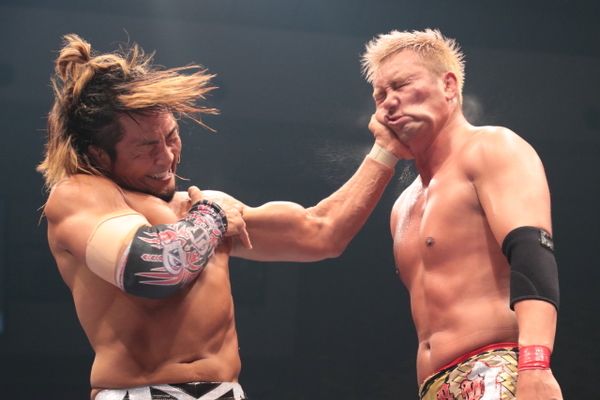
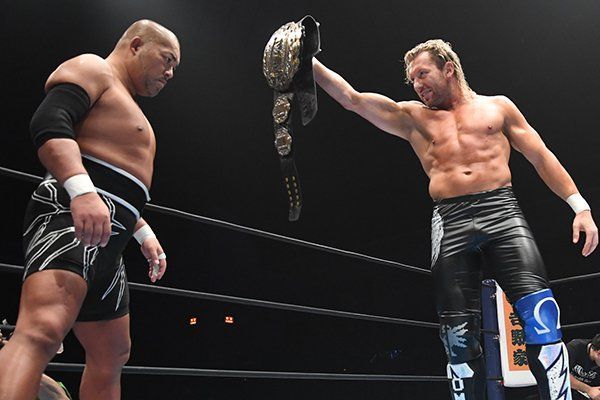
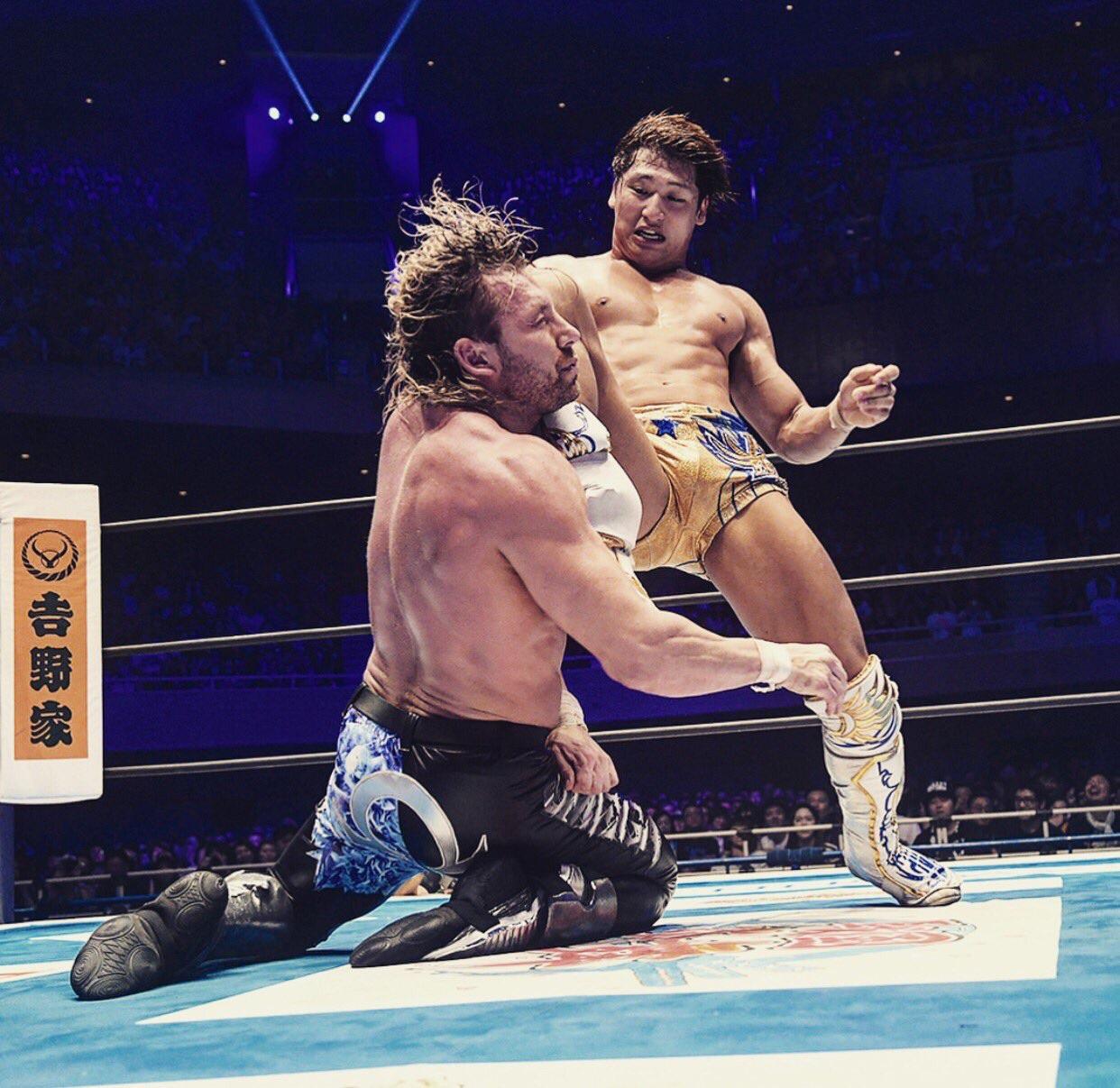
Throughout the week leading into December 31st, we are taking you back to some of Dave Meltzer’s top-rated matches of the past year, starting with the five star matches and ending up with a seven star classic.
15 matches got the five star treatment while six matches garnered ratings above that level. You can check them out under Columns & Opinions on the front page.
What follows is an edited version of Dave’s writeup from the match from the Wrestling Observer Newsletter, available in full for subscribers. Also, we want to give a big shoutout to Cagematch.net who makes research for this list ridiculously easy.
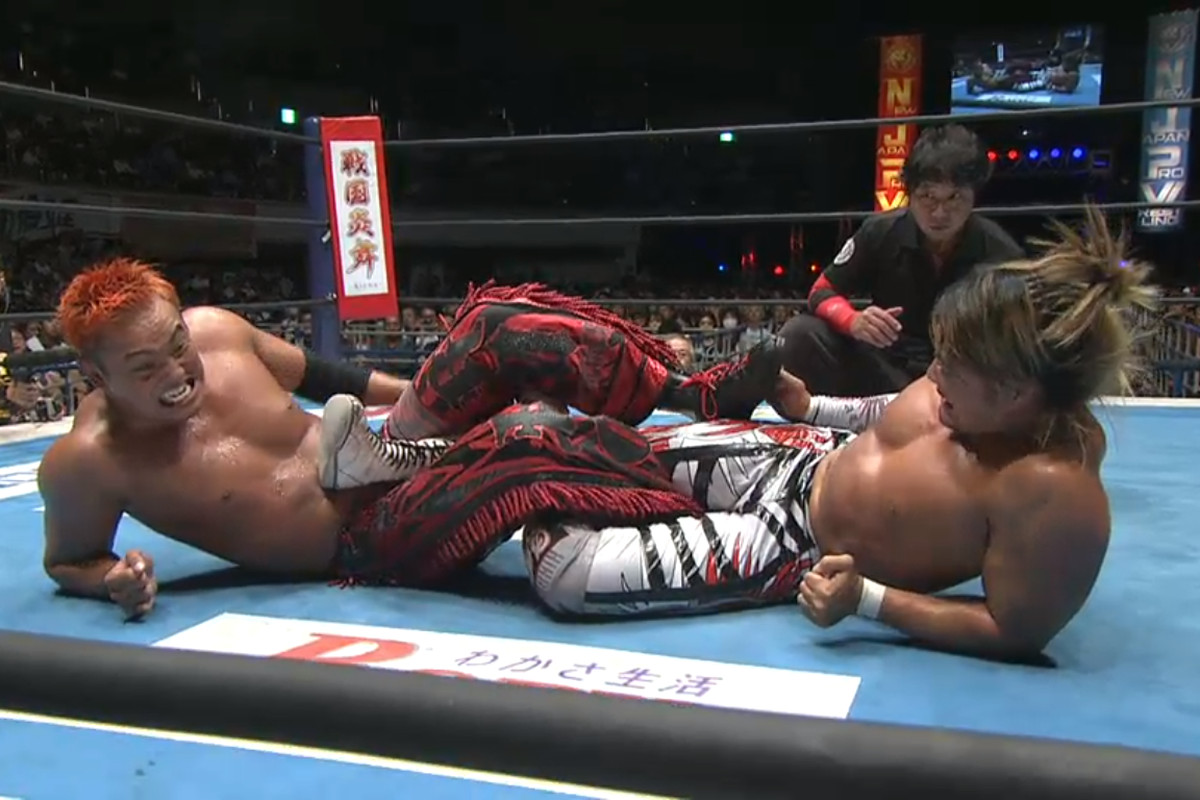
IWGP Champion Kazuchika Okada vs. Hiroshi Tanahashi
NJPW Wrestling Dontaku Day 2 | May 4, 2018
*****1/2
“Kazuchika Okada broke the all-time record for consecutive IWGP title defenses, beating Hiroshi Tanahashi, who he was tied with, in one of the best storytelling and psychological matches you’ll ever see to headline the second Wrestling Dontaku show on 5/4 in Fukuoka.
Okada had tied Tanahashi’s record set in 2011 and 2012, which ended at 11 when Okada beat him on February 12, 2012, in Osaka. All of the booking of the title, notably the question regarding Okada not losing to Tetsuya Naito at the Tokyo Dome, were done to set up this storyline. The negative was it was in Fukuoka, which is traditionally the company’s most difficult major city when it comes to crowd reaction. And the first night of Dontaku didn’t give a positive indication that this was the place for an epic match, because the crowd was very tough. For whatever reason, on the second night, they were hot, and they were on fire for the match.
The match was less reliant on big moves than any of their previous matches, but it was all about the story of Tanahashi trying to win back the title, his selling his injuries, and was really a classic in pacing and making every move mean something. The only match I could compare it was with one of the Mitsuharu Misawa vs. Toshiaki Kawada matches (I think it 1997 and not the 1994 match that a lot of modern fans feel was the greatest match of all-time) when it was slow, deliberate, and every single movement built to the story.
The crowd was super hot for the start and were behind Tanahashi ending the streak. They used their normal spots and did creative counters. For example, Okada always does the dropkick while his foe is sitting on the top rope. Tanahashi, instead of taking a bump to the floor, held on and was in the skin the cat position. Tanahashi tried to flip him over the top from there, but Okada blocked and instead used a draping DDT. He did another draping DDT on the floor. Okada hit another DDT and a neckbreaker over the knee. He hit the Randy Savage elbow, and went for the Rainmaker, but Tanahashi got in his face, and then ducked for a dragon screw. This was slow and deliberate with perfect pacing. They weren’t rushing, and made sure everything meant something. This was really almost a clinic of doing a long world title match that was both off the charts and safe, based on selling. Tanahashi did the high fly flow to the floor, which was probably the most dangerous thing in the match.
You have to also give the announcers a ton of credit as they didn’t miss any key things and Don Callis, who is usually a heel, was leading the audience into being into Tanahashi’s quest and made that aspect feel even more real and significant. They basically made you feel you were watching one of the most important matches in history between two of the best ever. Obviously, it was not the former even if it was the latter. Tanahashi ran at him but Okada caught him with a tombstone piledriver on the floor, and then collapsed. Okada barely beat the 20 count and Tanahashi dove in at 19 ½.
They traded elbows, and Tanahashi dropped Okada three times in the exchange. Okada missed a dropkick. Tanahashi blocked a flapjack and turned it into a twist and shout and a sling blade. He went for the high fly flow, but Okada moved. Okada then hit a dropkick to the back and another dropkick to the front. Okada tried the rainmaker, but Tanahashi hit the sling blade. Tanahashi did a high fly flow to the back, and went for his winning high fly flow, but Okada got his knees up. Okada hit a German suplex and Tanahashi kicked out at one. Tanahashi ducked a rainmaker and hit a dragon suplex. Okada hit the dropkick and Tanahashi hit the sling blade. Tanahashi went to the top for another high fly flow, but this time Okada dropkicked him as he flew off. Okada went for the rainmaker, but Tanahashi ducked and hit the rainmaker on Okada, who kicked out at one.
Tanahashi was slapping him around and started slapping him hard. Okada’s left cheekbone area was swollen. Okada kept going for the Rainmaker and Tanahashi ducked and slapped him, and when you were sure he wasn’t hitting it, he did, and got the pin at 34:36 of a match that felt much shorter because of how well it was paced.
Unlike most classics, this wasn’t about kicking out of finishers. It was the story that got over and not the spectacular spots. It was a safe match by modern big bout standards. Tanahashi three times went for the winning regular high fly flow. The first time, he missed. The second time Okada got his knees up. The third time, Okada got to his feet and hit a dropkick as he came off.
Another notable point is that even though the Fukuoka International Center Arena was sold out with 6,307 paid, and I believe set the company’s gate record in the building they’ve been running forever, to see Okada go for the record, probably 90 percent of the audience was behind Tanahashi with the story of wanting to instead see Tanahashi preserve his record. Okada played the role perfectly with subtle heel facials to make the story all about Tanahashi’s quest rather than his own quest.
It was really something to see because it was the example of protecting a championship (only the elite get to hold the title under Gedo’s booking) and building of wins, losses and records. There have been some ups and downs in recent weeks with New Japan, but this was a Gedo booking plan that turned out to perfection.
This put the 11 match series between Tanahashi and Okada in Okada’s favor with five career wins to four for Tanahashi and two draws.”
The company formerly known as TNA sure has had a topsy-turvy last 5 years, haven’t they? Their in-ring action has always been decent at worst and pretty good at best, but that has never really been their big problem. Rather, one poor business decision after another led to the company going from a solid no. 2 company and an alternative to WWE to a company hanging on by a thread.
While 2018 brought some business and creative stability to Impact, the one thing everyone knew had to improve was their U.S. TV distribution.
We all know the story by now. Impact was on Spike TV (now Paramount Network) until 2014 and then signed a deal with Destination America which lasted all of five months before the plug was pulled. Since then, they have been on POP TV. This continued TV shuffle wasn’t just a case of going to lesser networks, but continually getting less money in exchange for their programming.
They went from a reported $9 million on Spike to $3 million on DA to a barter deal on POP where they split advertising revenue. According to a 2016 report on PWTorch, Impact was receiving about $18,000 an episode, which doesn’t come close to covering the production costs, even with a stripped down budget. In comparison, USA Network charges around $13,000 for a single commercial on Raw or SmackDown.
So with that in mind, everyone knew Impact had to find a better home on cable. Rumors flew. WGN seems to always be looking for wrestling, Syfy, which had WWE for 10 years, was talked with and even TruTV was in the mix. There was even hope of a Impact Homecoming of sorts on Paramount. Needless to say what happened was surprising for more than one reason.
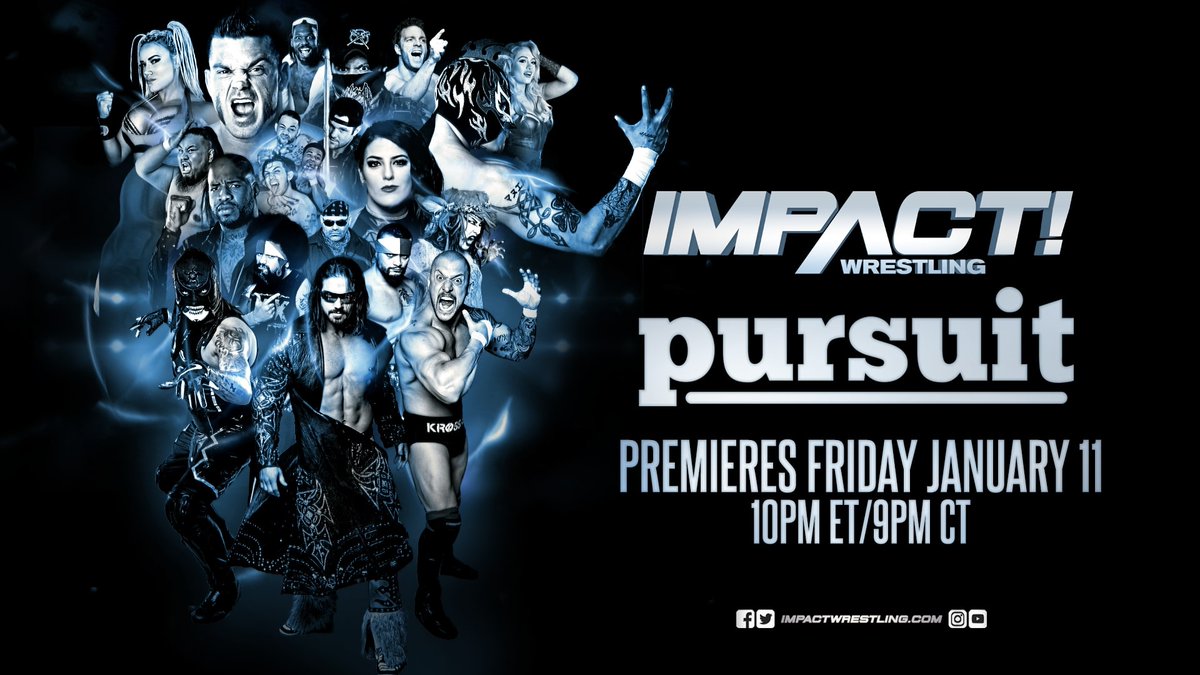
On December 21st, Impact posted a graphic on their Facebook page that just read “Impact Wrestling. Pursuit. Friday January 11. 10pm”. For 30 seconds, I thought that Pursuit was a brand new show they were producing, that the name was cool, and good for them as they may make a little more money even with a lousy time slot. Then I read the comments and realized that it wasn’t a name of a show, but the name of an obscure network that Impact was headed to.
After quickly checking my Comcast guide and finding out that Pursuit Channel is nowhere in my 1000 channels, I went on my own pursuit to find out more. Pursuit is a hunting and fishing channel that, as of 2015, was available in around 42 million homes, mostly through DirecTV and Dish Network. Based on quotes from Anthem’s Ed Nordholm, you can generously round up and say they are at around 50 million homes currently.
In comparison POP TV was in 75 million homes as of 2016, so Impact is losing around a third of its potential viewership, which was shrinking to begin with, and are going to a bad time slot on the worst night to draw tv viewers. In March 2018, seven million people total watched Pursuit, an average of 225,806 people per day.
This weekend, I contacted Comcast, the largest cable subscriber in the US with over 22 million subscribers, and asked them if there were any plans to add Pursuit to which my customer service agent informed me that there were no plans as of this time. All 22 million subscribers do have access to POP, so all Comcast viewers will no longer be able to watch Impact which makes it even more difficult to sell pay per views without the weekly tv to build it up.
The kicker is Anthem, the parent company of Impact, owns a “significant minority interest” in Pursuit. So we may never know if any of those aforementioned tv networks were really negotiating with Impact, but what we do know is Anthem basically got it put on their own network. That means that not only are they taking a cut in potential viewership and not only are they going to a worse night to draw viewers, they are in a weird conundrum where, if they are being paid, the network is paying their parent company to air the show, so they are taking whatever monies out of one pocket and putting it in the other. If that was a legit way to run a profitable business, TNT should have just paid WCW $60 million a year for Nitro in 2000.
The funniest comment I saw online from all this was someone mentioning the crossover potential during next year’s 3rd Annual Eli Drake Gravy Train Turkey Trot which would definitely make the match more dangerous with the loser dressed like a turkey while on a hunting network.
Ten years ago, TNA had the reputation of having a truly loyal audience with 1.4 million people watching no matter if it was Christmas, Thanksgiving, New Year’s or against football. Next year will put the loyalty of what’s left of their audience to a major test.
Throughout the week leading into December 31st, we’ll take you back to some of Dave Meltzer’s top-rated matches of the past year, starting with the five star matches and ending up with a seven star classic.
15 matches got the five star treatment while six matches garnered ratings above that level.
What follows is an edited version of Dave’s writeup from the match from the Wrestling Observer Newsletter, available in full for subscribers. Also, we want to give a big shoutout to Cagematch.net who makes research for this list ridiculously easy.
Kenny Omega vs. Tomohiro Ishii
NJPW G1 Climax | August 4, 2018
*****1/2
“The experiment in running the Edion Arena in Osaka on two straight nights was a financial success, as both shows sold out. The first night featured Omega vs. Ishii which seems to be considered the best match of the tournament.
While there are a number of candidates for this honor (Omega vs. Naito, Ibushi vs. Ishii and Ishii vs. Goto the ones mentioned the most often), this seems to have the most support. It would easily have won match of the year most years, but this year is just ridiculous, but even so, a number of matches here would probably be ranked anywhere from two to ten in match of the year so far, and really, because there are so many that could be, some will likely be lost in the shuffle. But that also happens every year.
The crowd was hot for this right away. The story here was that if Omega, with 12 points, lost to Ishii, with four, it would tie the biggest point differential upset in G-1 history. The other eight point differential was last year in the same building, when Omega, with ten points, lost to Robinson, with two. That record ended up being broken the next day when Yano beat Omega, which was a ten point differential.
The story early is Omega was a better athlete, too fast, and he’d slap him around, but he couldn’t hurt Ishii badly and finish him. Ishii then started slapping Omega around. Omega did a huracanrana out of nowhere and followed with the Terminator dive, which was the move he hurt his heel with in the Cody match in San Francisco and he’s still doing it on most shows. They did sick chops. Ishii did a delayed superplex. Omega’s mouth was bleeding from what looked to be a hard clothesline, and got worse as the match went on. Ishii’s mouth was also bleeding. Omega kept hitting V triggers and Ishii got stronger. Ishii was back with elbows. Omega did the reverse huracanrana. Omega also did a springboard double foot stomp onto Ishii who was draped on the apron.
Omega landed on his feet after a German suplex and hit another V trigger followed by a J driller but Ishii kicked out again. Ishii was killing him with hard lariat and Omega was back with V triggers. Ishii did two more head-butts and Omega did an inside out bump after a lariat. Omega hit the brainbuster, Ishii’s finisher, on him but Ishii kicked out at one. Ishii did another sick lariat, a headbutt, an enzuigiri and finished him with a brainbuster.”
Throughout the week leading into December 31st, we’ll take you back to some of Dave Meltzer’s top-rated matches of the past year, starting with the five star matches and ending up with a seven star classic.
15 matches got the five star treatment while six matches garnered ratings above that level.
What follows is an edited version of Dave’s writeup from the match from the Wrestling Observer Newsletter, available in full for subscribers. Also, we want to give a big shoutout to Cagematch.net who makes research for this list ridiculously easy.
Kenny Omega vs. Kota Ibushi
NJPW G1 Climax Semifinals | August 11, 2018
*****1/2
“Omega vs. Ibushi was huge and drew the biggest next-to-last night crowd in G-1 history. Part of that was it was the larger Budokan Hall, but it has been years since the next to last night sold out the big configuration at Sumo Hall, and it was easily the most anticipated block final match since the mainstream 90s heyday.
It drew 12,023 paid, a sellout with standing room. There was a stage and such so they didn’t have the number of seats opened in the All Japan sellout days, or even the 90s set-up when New Japan used the building. Usually the second night of G-1’s last three does around 7,500, so this really speaks to the drawing power of Omega vs. Ibushi as much as anything, especially since it sold out in advance and demand got stronger after no tickets were left.
The fans were way behind Ibushi at the start. Omega did sick chops and Ibushi did hard kicks. Each did middle rope moonsaults and the other countered with knees up. The story here is that these two were training partners and knew the spots before they came. They traded Frankensteiners. Ibushi got out of a One Winged Angel off the apron and Omega got out of the power German superplex. Omega came back with a tombstone on the apron and a missile dropkick to the back, a chop to the back of the head and a V trigger to the back of the head. Omega brought back Croyt’s Wrath, which starts as a One Winged Angel and ends up as a German suplex. Omega hit a running V trigger, a tornado DDT, and hit the Terminator dive. Ibushi used a Pele kick with Omega on the middle rope. Omega teased a piledriver off the top rope and Ibushi blocked and turned it into a Super Frankensteiner. Ibushi hit a top rope moonsault to the floor. Ibushi did a devastating looking standing moonsault into double knees to the chest.
Then came the trademark spot of the match.
Omega went for the dragon superplex that he did in the first Okada match, and did it, but Ibushi flipped in mid air and landed on his feet. The next several minutes were just insane with big moves, killer lariats, and sick V triggers. Omega hit the Rites of Passage for a near fall,. He tried a One Winged Angel off the middle rope but Ibushi hit elbows and then did a double foot stomp from that position. Ibushi then won after a Tiger driver and the Kamagoye.
The creativity here was incredible and the explosions in the strikes and all the offense was unreal. The scary part is that I was told live this was Omega-Okada level because you couldn’t appreciate just how hard they were hitting while watching.”
Throughout the week leading into December 31st, we’ll take you back to some of Dave Meltzer’s top-rated matches of the past year, starting with the five star matches and ending up with a seven star classic.
We kick off with our floor: five star ratings. In 2018, 15 matches got that honor, a mix of New Japan Pro Wrestling, NXT, and even an indie group out of Spain.
What follows are edited versions of Dave’s writeups from the Wrestling Observer Newsletter, available in full for subscribers. Also, a big shoutout to Cagematch.net who makes research for this ridiculously easy.
And now, enjoy looking back at part two of three of Dave’s five star matches from 2018 in the order in which they happened. Based on this list alone, it was a hell of a year. Here’s part 1 and part 2 if you missed it.
Hiroshi Tanahashi vs. Kazuchika Okada
NJPW G1 Climax finals | August 10, 2018
“Tanahashi went to a 30:00 draw with Okada in the A block final. Because Tanahashi came in with a 7-1 record and Okada at 6-2, Tanahashi only needed a draw to win. Tanahashi vs. Okada at this point has to be considered among the greatest long-term programs in wrestling history. Nearly every match has been a match of the year candidate, ironically, perhaps except this one because of what a freaky year this has been. Still, this was a tremendous match with the story that Tanahashi hit the high fly flow to the back, but Okada kicked out, just as time expired.
Tanahashi needed the visual of being strong to go to the final and, in theory, if he goes all the way to the Tokyo Dome main event. You could argue for the win to make it more clear, but it appears the plan now, based on Tanahashi at the press conference, is to do Tanahashi vs. Okada for the briefcase sometime this fall with the idea of a longer time limit match and thus the draw and not doing the pin makes long-term sense.
So the draw accomplished two things. The first is it leaves an opening for Okada to still be in the title match at the Tokyo Dome, as he’s been every year since 2013. Okada is coming off his record-setting title run, and since losing the title, he has not gotten a rematch. The draw was a surprise if only because Tanahashi and Okada had draws in their last two G-1 matches, in 2013 and 2016 and you just wouldn’t think they’d do it again. But the key is that in the Tanahashi vs. Okada program, Tanahashi hasn’t beaten Okada since January 4, 2015, and given that pretty much every match that has had a finish has been past the 30:00 mark there is a story there as well.
There was the belief earlier this year that maybe, with Okada becoming the clear major star, that he never would never lose to Tanahashi again. But very clearly, this will be the biggest briefcase match in history.
I would not say this was the best match of G-1, although some would. In some ways it was my favorite, because as far as a match where every single move meant something, this was pretty much textbook. It was paced perfectly and while hard hitting and very physical, it was never scary at any time. But as big as this seemed, the next two nights rocked the crowd more.”
Hiroshi Tanahashi vs. Kazuchika Okada
IWGP Title Shot Contract On The Line
NJPW Destruction In Kobe | September 23, 2018
“The story behind the match is that this was their 13th career singles match, and Okada came in with a 5-4 edge in wins with three of the matches being 30 minute draws in G-1 competition. But Tanahashi hadn’t beaten Okada since January 4, 2015, nearly four years ago. Also, every match the two have had in at least six years has gone either to a 30 minute draw or longer.
With three high-profile big show classics in one year, this feud is very much like Okada vs. Omega in 2017 and Flair vs. Steamboat in 1989. It’s all a matter of opinion, but I’d rate the May match the best because of the story elements which I think is the best of the 13 matches the two have had. This was a different match, but similar in quality to the G-1 match. It would be among the best of the series, but not top three.
The crowd was pro-Tanahashi in a big way. Tanahashi dropkicked Okada off the apron and hit a pescado, but in doing so, started selling the left knee. His ability to sell the left knee with his facial expressions is as good as anyone. Okada started doing some Negro Navarro style knee submissions. Okada dropkicked the knee as Tanahashi hung upside down in the corner, and used a kneebreaker and a figure four. Tanahashi reversed the figure four and the two rolled into the ropes. They were fighting on the floor, when, out of nowhere, Tanahashi gave Okada a tombstone piledriver on the floor. The story is Tanahashi could have won via count out, but instead did a high fly flow to the floor, and of course, his knee went out, leading to him selling the knee like crazy. As far as the ability to produce a long dramatic match where every move means something, Tanahashi is one of the greatest of all-time.
Both were fighting over a tombstone piledriver but couldn’t get it until Okada dropkicked Tanahashi in the left knee. They each kept reversing out of big moves. Okada chop blocked the knee, but Tanahashi hit a sling blade as Okada went for the rainmaker. Tanahashi went for a high fly flow but Okada got up and dropkicked him and hit the tombstone. But Okada’s left knee went out. Tanahashi ducked two rainmakers but Okada finally hit a spinning rainmaker. He went for another rainmaker but Tanahashi hit the dragon suplex for a near fall. Tanahashi went to the top rope but Okada dropkicked him. Okada teased a tombstone piledriver off the middle rope, and then a gut wrench superplex but Tanahashi blocked. Okada fell off the ropes and as he was falling, Tanahashi jumped off and crushed him with a high fly flow. Tanahashi went to the top, but Okada got to his knees, not standing, and was hit with another high fly flow. Tanahashi did a third one on the prone Okada for the pin.”
Kazuchika Okada & Tomohiro Ishii vs. Kenny Omega and Kota Ibushi
NJPW Fighting Spirit Unleashed | September 30, 2018
“The tag team main event where Omega & Ibushi beat Okada & Ishii had four of maybe the six best wrestlers in the world right now, and it was perhaps the best tag team match of the year. Really, the Omega & Ibushi vs. Young Bucks match in the same building would be its challenger. They were very different. This past week’s match was crisper and reached more of a fever pitch in the New Japan realistic style and had the great explosive moves at the right time. The prior match had a unique emotional element, was built with a most in-depth story going in and was longer and told more of a story. It’s really a matter of taste.
This was a great match. The story was to keep Omega and Okada apart for most of the match as this was the first time the two were in the same match in the U.S. So a lot of early action was Ibushi vs. Ishii. The one thing about this match is that every combination, Omega vs Okada, Omega vs. Ishii, Ishii vs. Ibushi and Ibushi vs. Okada, give you constant match of the year level action and intensity. Omega did an ugly DDT on Ishii and got up limping but that didn’t play a part in the match. Omega & Ibushi did the golden triangle, which was Omega giving Okada a moonsault off the middle rope to the floor and Ibushi doing the same to Ishii. At 13:00, Omega and Okada finally squared off and started throwing the elbows. They did a series of reversals until Omega hit the snap dragon suplex. Okada hit a dropkick on Omega and went for the rainmaker, but Ibushi saved.
Omega used a V trigger and Ibushi a moonsault on Okada. Ibushi did a plancha on Ishii. After a series of reversals, Okada hit the tombstone on Omega and Ishii followed with a sliding lariat on Omega, but Ibushi saved. Okada went for the rainmaker but Omega ducked and hit a uranage. Ishii and Ibushi started trading elbows. Ibushi did a standing double knees moonsault on Ishii. Omega picked up Ishii and power bombed him into a moonsault by Ibushi for a near fall. Okada went for a dropkick and Omega stepped back, caught him and power bombed him, and Ibushi followed with a Pele kick. Ibushi and Ishii did another crazy exchange and blows that was ridiculous. Ibushi was bleeding from the mouth.
Ibushi went for the Kamagoye but Ishii ducked and went for a German suplex, but Ibushi landed on his feet and clotheslined him back. It ended when Omega hit a high kick on Ishii and Omega & Ibushi did the double golden trigger for the pin. Omega then did an interview with The Young Bucks in the ring and talked about wrestling Ibushi when Cody came out to set up the three-way and then Omega ended the show.”
Hiroshi Tanahashi and Will Ospreay vs. Kenny Omega and Kota Ibushi
NJPW Road To The Tokyo Dome | December 15, 2018
“The 12/15 show featured the annual dream tag team match, and this year’s version may have been the best tag team match of the year. The best tag match of the year to me was Young Bucks vs. Omega & Ibushi, largely due to the storytelling. But as far as crisp action and excitement, Omega & Ibushi’s win over Tanahashi & Ospreay was better. Ospreay, who was pinned by Omega’s One Winged Angel in 28:46, was the star of the match with his fire, facial expressions, and intensity. The big spot was Ibushi doing a ropewalk super Frankensteiner off the top and Ospreay flew over and landed on his feet. The camera work captured this amazingly as Ibushi made his face that seemed to say, “I hear the crowd but as long as I don’t turn around I can pretend he didn’t do that.” So, Omega opened 2018 with a ***** match and ended it with a ***** match. The show ended with Omega & Ibushi doing a promo which included Omega singing and snow coming down from the ceiling.”
Starting Saturday and twice a day, we begin our dive into Dave’s top six rated matches of the year, all above the ***** mark.
Throughout the week leading into December 31st, we’ll take you back to some of Dave Meltzer’s top-rated matches of the past year, starting with the five star matches and ending up with a seven star classic.
We kick off with our floor: five star ratings. In 2018, 15 matches got that honor, a mix of New Japan Pro Wrestling, NXT, and even an indie group out of Spain.
What follows are edited versions of Dave’s writeups of match from the Wrestling Observer Newsletter, available in full for subscribers. Also, a big shoutout to Cagematch.net who makes research for this ridiculously easy. Please support them in any way you can.
And now, enjoy looking back at part two of three of Dave’s five star matches from 2018 in the order in which they happened. Based on this list alone, it was a hell of a year. Here’s part 1 if you missed it.
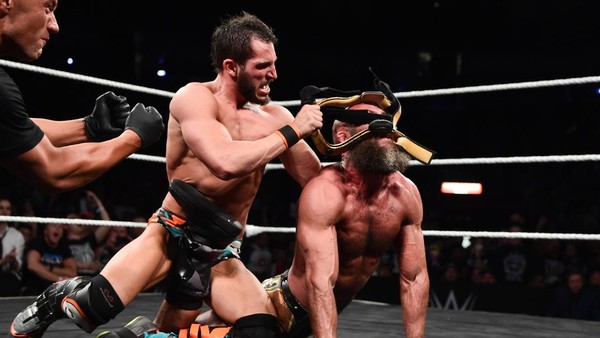
Johnny Gargano vs. Tommaso Ciampa
Unsanctioned Match
NXT TakeOver | April 7, 2018
“With two of the best matches in WWE history bookending the card, the 4/7 NXT Takeover show from New Orleans ended up as the best show over WrestleMania weekend, and one could argue the best from an in-ring standpoint in company history. It ended with a dramatic war where Johnny Gargano got his job back in beating Tommaso Ciampa in an unsanctioned match, a brutal and dramatic battle.
This was just a crazy match. Gargano did his spear into the ring, whipped Ciampa over the barricade, and followed with a running dive over the barricade. Ciampa suplexed Gargano off the table to the floor. Ciampa then back suplexed Gargano onto another table. Gargano powerbombed Ciampa off the apron onto the floor after the mats were removed. Fans chanted “you deserve it” at Ciampa who then brought in a crutch from a planted fan at ringside. They had a tug-of-war over the crutch that Gargano won, and he hit Ciampa’s stomach, back and head with it. Gargano tried another spear into the ring but got caught with a knee. Ciampa did a power bomb for a near fall. Gargano got the Gargano Escape on for the first time. Because this was a non-sanctioned match, apparently that meant no rope breaks. Ciampa escaped by raking the eyes.
Gargano came back with punch after punch until Ciampa hit a low blow, a crutch shot to the back, and a power bomb into double knees. Gargano came back with a lawn dart spot, throwing Ciampa’s head into an exposed turnbuckle. Gargano hit two superkicks but Ciampa kicked out. After several more near falls, Ciampa pulled off his brace and his sleeve to expose his knee. Gargano got the crutch and was about to hit him with it. Ciampa begged off and Gargano wouldn’t hit him. Ciampa’s right eye was all swollen by this point. Ciampa then tired to hit Gargano with the crutch, but Gargano put on the Gargano Escape and used Ciampa’s knee brace around his throat to give it more pressure and get the submission, the picture of which you can see above.”
The Undisputed Era (Kyle O’Reilly and Roderick Strong) vs. Trent Seven and Tyler Bate
NXT Tag Team Titles
NXT TV Tapings | June 21, 2018 (airdate July 11, 2018)
“The show featured the best match in a long time, perhaps ever, on the NXT television show with Roderick Strong & Kyle O’Reilly regaining the tag titles over Trent Seven & Tyler Bate. I gave this match ***** as it was that great, the second best tag team match I’ve seen this year behind only Omega & Ibushi vs. Young Bucks. The full on seriousness of this match made every twist and turn mean something and nothing felt like it was done out of context. The basic format worked because of the story and while there were some cool moves, it was more about drama than moves or spots.
The crowd was electric by the end, the storytelling was excellent, and the finish of throwing in the towel because Bate was concerned for his partner who wouldn’t give up would often be used as a heel move but the announcers got it over as a face move, because the build to the finish made that the natural context ending and not a fake way out. The crowd kept chanting “Mustache Mountain/Undisputed” for minutes on end which was unique but also wasn’t reacting to what was going on. But once they stopped, they reacted to everything. This was classic storytelling.
O’Reilly & Strong kept working on Seven’s legit bad left knee, selling like he was Tanahashi, and went for a hot tag but O’Reilly pulled Bate off the apron. They kept working on Seven’s knee. The second time he went for a tag to Bate, O’Reilly kicked Bate off the apron and put him in a heel hook. Finally Bate got the hot tag and went crazy. He did a giant swing and airplane spin at the same time on both guys. It was great hot tag and he got some near falls. Seven was selling his knee but wanted to tag in. Bate wouldn’t tag him in, seeing his partner was hurt. Strong kept working over Bate, who wouldn’t tag out. Seven finally tagged himself in and got a lot of offense in on both guys. Seven was limping around, including giving Strong a lariat.
Seven tried a torture rack but his knee gave out. Strong then chop blocked him and put him in the Stronghold. Bate made the save. O’Reilly knee dropped onto Seven’s bad knee and put him in a heel hook. Seven wouldn’t quit and both ended up slapping each other back and forth on the ground. O’Reilly went for a double kneebar. Seven wasn’t going to quit. Bate picked up a towel. He kept hovering between throwing in the towel while O’Reilly kept the submission on Seven who wouldn’t submit. Finally Bate threw in the towel.
Very often a finish like that, particularly in a U.S. match, wouldn’t work since you need a legit feel to the match to do it. But, it worked here.”
Kenny Omega vs. Tetsuya Naito
NJPW G1 Climax | July 15, 2018
“The thing notable here was the conditioning of these guys going so fast for so long while it didn’t turn into a numbing sprint. The crowd was so into this because of both the personalities and the work. Omega gave Naito a back suplex on the apron. Omega gave him a Frankensteiner out of nowhere. Naito blocked a Terminator dive and used a tornado DDT. Omega used a sliding kick that sent Naito over the barricade and then did a springboard plancha several rows deep into the stands. It was really amazing. He went for a missile dropkick but Naito got up and crotched him on the top rope. Naito went for a Frankensteiner off the top but Omega reversed and hit a snap dragon and a doctor bomb.
Naito went for a German suplex, Omega landed on his feet and hit a V Trigger to the back. Omega went for the One Winged Angel and Naito escaped with a reverse huracanrana. Naito hit a Frankensteiner off the top an Gloria for a near fall. Omega was back with a spinning heel kick and a V trigger to the back fo the head. He teased a dragon superplex but Naito blocked. Naito used a power bomb off the top rope and a destino, but Omega kicked out. Omega finally won with a Jay driller, a V trigger and the One Winged Angel.”
Kenny Omega vs. Hirooki Goto
NJPW G1 Climax | July 19, 2018
“Omega hit a huracanrana out of nowhere. Goto blocked the Terminator dive. Omega set up a crazy springboard plancha with Goto a few rows deep. Goto grabbed a chair and threw it at Omega and hit him squarely, knocking him off the ropes. The timing to pull that off was incredible. Omega could only balance for a split second and Goto had to throw the chair at his head (Omega actually blocked it with his hands while still balancing) from a few rows deep to hit him in the head at that second. The crowd booed heavily as they wanted to see the move. Goto hit a GTR on the floor. They were fighting in the bleachers and Omega slammed Goto on the wooden permanent benches at Korakuen Hall. Omega then did a moonsault off the stair banister while Goto was in the wooden bleachers. Omega did sick chops and Goto was back with a Saito suplex and an ushigoroshi.
Goto went for a German suplex, Omega landed on his feet and hit the V trigger. Goto came back and went to the top rope, but Omega hit a running V trigger and Goto sold it like he was knocked out. This was tremendous. Omega went for a muscle buster top rope superplex but Goto reversed into a code red off the top rope. They traded hard elbows and Omega hit the snap dragon suplex but Goto back came with a lariat. Omega kicked out of shoten kai. There was molten heat at this point. Omega then won after a jumping V trigger, an ushigoroshi, another V trigger and the One Winged Angel. Just incredible.”
Tomohiro Ishii vs. Hirooki Goto
NJPW G1 Climax | July 21, 2018
“This was just all action and hard hitting from start-to-finish. Everything was hard and it was non-stop. They’d hit each other and stay up. They kept hitting super hard clotheslines and neither would go down. They did all their big spots like Ishii’s delayed superplex and Goto’s ushigoroshi. Goto clotheslined him out of his boots. Ishii got out of the GTR and put Goto in the dragon sleeper. Ishii hit a Saito suplex but as he went for the brainbuster, Goto hit the shoten kai and Ishii kicked out. They ran at each other with head-butts to the others’ shoulder until Ishii hit the sliding D and brainbuster for the pin.”
Keep watching for our Best of 2018 lookbacks all week.
Throughout the week leading into December 31st, we’ll take you back to some of Dave Meltzer’s top-rated matches of the past year, starting with the five star matches and ending up with a seven star classic.
We kick off with our floor: five star ratings. In 2018, 15 matches got that honor, a mix of New Japan Pro Wrestling, NXT, and even an indie group out of Spain.
What follows are edited versions of Dave’s writeups of match from the Wrestling Observer Newsletter, available in full for subscribers. Also, a big shoutout to Cagematch.net who makes research for this ridiculously easy. Please support them in any way you can.
And now, enjoy looking back at the first part of three of Dave’s five star matches from 2018 in the order in which they happened. Based on this list alone, it was a hell of a year.
Chris Jericho vs. Kenny Omega
NJPW U.S. Championship | No DQ
NJPW Wrestle Kingdom 12 | January 4, 2018
“Wrestle Kingdom 12, headlined by Kazuchika Okada’s retaining the IWGP title over Tetsuya Naito and Kenny Omega beating Chris Jericho in a U.S. title match was the biggest non-WWE pro wrestling event on a worldwide basis since the collapse of WCW.
The appearance of Jericho brought a new fan base that watched new Japan for the first time, either on New Japan World, AXS TV, or through other means. It wasn’t just the idea that a WWE star was facing a New Japan star in the “Alpha vs. Omega” match, but the brilliance in which the angle played out. You could have a bigger WWE star like Roman Reigns, John Cena, or Brock Lesnar face a New Japan star, and it’s extremely doubtful they’d have drawn the same money just because the angles and storylines wouldn’t have been as good. It wasn’t WWE vs. New Japan that was the main draw, although it was an underlying theme. It was more a newly-reinvented Jericho and the series of angles that built to the match, combined with Omega becoming such a strong underground draw in the U.S. It was also the work of serious hard promotion.
In many ways, it was a career climax for Jericho. He’s been in tons of big shows before, headlining many PPVs in WWE. He was a key part of several WrestleManias and in the main event position in one, in 2002, with HHH, although the real main event on that show was Hulk Hogan vs. The Rock. Nevertheless, with the show billed as a double main event, Jericho did join only Ric Flair and Brock Lesnar as men who have headlined both a New Japan Tokyo Dome show (Hulk Hogan headlined an SWS show in that building and was on a few New Japan shows, but never in the main event) and a WrestleMania.”
Johnny Gargano vs. Andrade Cien Almas
NXT Championship
NXT TakeOver | January 27, 2018
“Several months ago, I saw Andrade Cien Almas and Johnny Gargano work the opening match at an NXT house show in San Jose and they had one of the best WWE house matches I’d seen in years. Reports of their matches from other cities was similar.
The idea that the two would get to work in a main event position on a TakeOver show was as close to a guarantee of a great match and the probable WWE match of the weekend if not the pro wrestling match of the weekend. But it delivered all of that and more in a classic that ended when Almas drove the back of Gargano’s head into the ring post with double knees on the apron, and followed with his second hammerlock DDT for the pin.
Gargano’s selling and ability to engage the crowd was really the story of the match. While Almas was outstanding, and has completely turned around his WWE fortunes since being put with Zelina Vega, it was Gargano’s crowd connection that made it special.
It becomes an interesting question of what is next for Gargano because Sami Zayn and Bayley were the last NXT stars to have that kind of a crowd reaction and both sputtered as babyfaces on the main roster. It was also notable that Gargano wasn’t put in the Royal Rumble, where he’d have torn the house down if he had come out.
This was really an incredible, almost flawless match.”
Golden Lovers (Omega/Ibushi) vs. Young Bucks (Nick and Matt Jackson)
NJPW Strong Style Evolved | March 25, 2018
“It was the main event that stole the show. It was a unique match, because from a storytelling standpoint, with the pained facial expressions and mixed feelings by Kenny Omega in particular, and Matt Jackson to a degree, it in that realm was the closest thing to that type of a match since the Shawn Michaels vs. Ric Flair match at the 2008 WrestleMania. But this match was athletically and technically in a different world from that one. The match story was that Matt Jackson refused to lose even taking incredible punishment on his injured back. Omega had mixed feelings about hurting his longtime friend. Reality also struck in the match as Ibushi may have suffered a concussion. He completely missed his spot on the double golden triangle moonsault off the middle rope. Omega hit his on Nick.
Then he tried to improvise doing it off the apron and Matt wasn’t there. He eventually just threw Matt down. Then came the “You can’t escape” spot, but Ibushi hit the moonsault off the middle rope after the double fireman’s carry. Omega then went for a moonsault but Ibushi didn’t get out of the way in time and they bonked heads. Omega ended up with swelling under his right eye and at first thought he broke his orbital bone. Ibushi may have gotten hurt on that spot as well, but ended with a busted lip. With Matt selling a very legit back injury (he also had a neck injury stemming from his last match in New York) it was up to Nick to carry the load when it comes to all the high flying spots the team is known for and while Omega and Matt were the emotional stars, Nick was the athletic star of the match.
After 39:21, Omega & Ibushi both pinned Matt after the Golden trigger, a double knee strike. Cody then came out and yelled at the Young Bucks for losing. He threw down Nick. Omega & Ibushi ran in and chased Cody away. Omega shook hands with Nick, but Matt refused to shake Omega’s hand. Omega then closed the show, saying that this wasn’t a happy world, but the Golden Lovers are back to stay. He said that he would make sure both he and Ibushi were in a big match when they return (the Cow Palace show), and said people like Cody are only good at talking and that he would beat the ever loving poop out of him.”
Marty Scurll vs. Will Ospreay
NJPW Junior Heavyweight Championship
NJPW Sakura Genesis | April 1, 2018
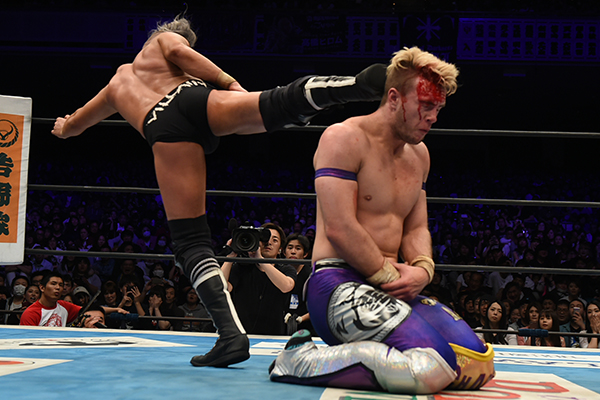
“Will Ospreay and Marty Scurll have had one of the best in-ring rivalries in wrestling over the past several years. It was their series in the U.K., where Scurll won every time in some of the best bouts seen in that country, that, along with Ospreay’s loss to Kazuchika Okada, really put him on the map as one of the best young talents.
On 4/1, the two had what would be their biggest singles match to date, a battle for Ospreay’s IWGP jr. title at Sumo Hall, in one of the key matches of the Sakura Genesis show.
The match in many ways was not just a match of the year candidate, but the first match this year to in some ways rival with Okada-Kenny Omega level of 2017.
On the flip side, in going more than 30:00 of a match where the story was Scurll working over Ospreay’s neck, Ospreay took some dangerous looking falls that were concerning. It seemed to continue the narrative that Ospreay is headed to be this generation’s Dynamite Kid, an incredible talent whose style of giving so much of himself in the ring led to his body turning on him at a young age, and a short career.
Late in the match, Ospreay went for a Spanish fly off the apron. In doing so, instead of landing on the floor, his head hit the apron at a bad angle. It was more than just concerning. In the locker room, the talent, those who had seen Yoshitatsu’s career nearly end with a broken neck a few years back when he took an A.J. Styles Styles clash wrong, got flashbacks of that. At press time, it appears Ospreay’s injuries weren’t serious, since he sent word that he’s going to do his complete WrestleMania week schedule.
Ospreay continued the match and didn’t feel badly in the ring, continuing to sell the neck as part of the match story, and working with his head all bloody. If anything, the concern over the injury and visual of the blood created more drama to many, and scared many others. I’m not sure being scared for someone’s safety and long-term is the kind of emotion one is looking for, but it’s the one he’s getting and it’s the same feeling I had when Ospreay faced Hiromu Takahashi in a title defense. You have the conflict because the matches are incredible, but if you say they’re incredible it feels like it’s encouraging those type of risks.
The reality is if you took the really dangerous spots out of Ospreay’s matches with Takahashi and Scurll, they would still be two of this year’s best matches. Yet, on the flip side, what will make people remember Ospreay vs. Scurll more than the plethora of incredible matches pro wrestling now produces on a weekly basis is that Spanish fly spot, and Ospreay continuing while being bloodied up.”
Adam Cole vs. EC3 vs. Killian Dain vs. Lars Sullivan vs. Ricochet vs. Velveteen Dream
NXT North American Championship Ladder Match
NXT TakeOver | April 7, 2018
“The storyline on EC 3 is that he comes from a family that owns a number of restaurants and other commercial properties, so he’s doing the same rich kid character as in TNA. They tried to initially put him over strong to the audience as a heel, particularly since they knew this crowd would never boo him. The place went nuts when Ricochet was introduced last. The crowd was jacked before the match ever started, and they stayed hot throughout.
I won’t go so far to say it was the best ladder match period. There were risky spots for sure, and it was very physical, but previous ladder matches that had more dangerous stunts. But this topped it with the athletic big men in Sullivan and Dain, the ridiculous athleticism of Ricochet, and Cole came across as a real superstar personality wise with this crowd.”
A-Kid vs. Zack Sabre Jr.
White Wolf Wrestling | April 14, 2018
Outside putting over the match on Wrestling Observer Radio and briefly in the Wrestling Observer Newsletter, Dave didn’t do a full review as he saw the match months after it happened. You can watch the match free on YouTube.
Watch for more Best of 2018 on the website all week long.
Editor’s Note: In this monthly series written exclusively for our website, combat sports television commentator and regulator Sean Wheelock takes an in-depth and analytical look at infamous matches from MMA, boxing, pro wrestling, kickboxing, and the long and confused history of mixed match fighting to determine whether the controversial and contentious bouts were shoots (real competition) or works (predetermined result).
If there a bout that you’d like Sean to give the “Shoot or Work?” treatment to, send him a tweet.
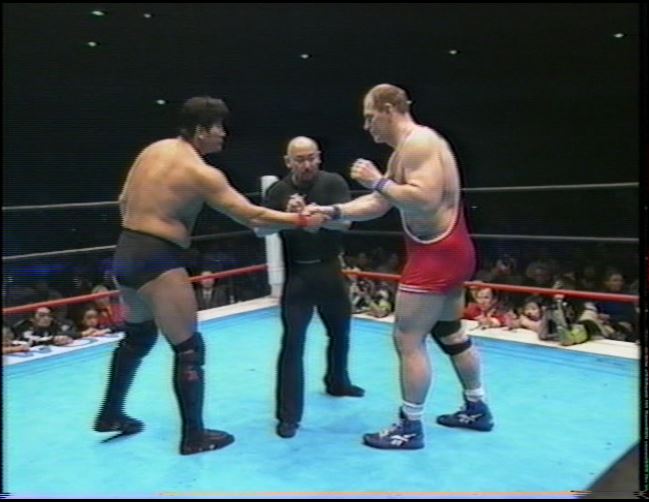
Aleksandr Karelin vs. Akira Maeda | Yokohama Arena, Yokohama, Japan | February 21, 1999 | RINGS
Overview
Aleksandr Karelin vs. Akira Maeda was the main event of the 27th MMA card held by the Japanese promotion Fighting Network Rings, which had pivoted from pro wrestling to mixed martial arts four years prior. Dubbed “RINGS: Final Capture”, the nationally televised show in Japan was comprised of seven total bouts, and included future PRIDE fighters Ricardo Morais, Yoshihisa Yamamoto, and Valentijn Overeem (Alistair’s older brother); Sean Alvarez, who went on to fight at UFC 42; and Nikolai Zouev, who became Sergei Kharitonov’s main grappling coach.
A sellout crowd of 17,048 produced a live gate of almost $2.5 million USD, widely reported as the largest monetary sum to that point for a fight card of any kind held at an indoor arena in Japan.
The bout, scheduled for two five-minute rounds, featured the MMA debut of Karelin, known as “The Experiment”, and (then and now) widely considered the greatest ever Greco-Roman wrestler, vs. Japanese puroresu superstar and promotion co-founder Maeda.
Competing in the 130 kg (286 lb) weight class, Karelin ultimately amassed a record of 887-2 in his truly remarkable wrestling career in which he won three straight Olympic gold medals as well as gold at nine World Championships and at 12 European Championships.
At the time of the Maeda match, Karelin was the reigning Olympic Gold Medalist from the 1996 Atlanta Games where he didn’t concede a single point in the entire competition, and where he was given the honor of carrying the flag for his native Russia at the Opening Ceremonies.
At 31, Karelin didn’t just seem unbeatable–he actually was unbeatable, having not lost a Greco-Roman wrestling match in 12 years, nor dropped a point in five years.
His opponent for this “Fight of the Decade” was truly a legend in Japanese pro wrestling. Although unable to achieve the popularity of Antonio Inoki at home and abroad, Maeda was still an outright star in his native Japan, and one who transcended sports into popular culture.
Having just turned 40 the month prior, and having retired from both pro wrestling and MMA the year before, Maeda was still viewed as the man who possessed both the fighting ability and the requisite fame to serve as a worthy opponent for the mighty Karelin. And with seven career MMA victories, coupled with a well earned reputation as a pro wrestler who could and would shoot on uncooperative and/or disliked opponents in worked matches, he was even seen by some in the Japanese public as the fighter who just might be able to actually defeat Karelin in this still new and rapidly evolving combat sport.
Maeda had begun his career 21 years earlier in New Japan Pro Wrestling, did a brief stint in the WWF in 1984, helped launch Newborn UWF in 1988, and then co-founded Fighting Network Rings in 1991. The Wrestling Observer Newsletter named Maeda Wrestler of the Year in 1988, and Promoter of the Year just a year later. In MMA, Maeda had fought 11 times entering the Karelin bout – all in RINGS – with his most notable win coming over future UFC heavyweight champion Maurice Smith on New Year’s Day 1997.
Like the other six fights on the card that night, Karelin vs. Maeda used the RINGS rule set which made closed fist punches and elbow strikes to the head illegal from all positions; closed fist punches to the body and knees to the head illegal on the ground; and which allowed for rope escapes to break submission holds. Ryogaku Wada, RINGS’ top referee, was assigned to the bout. Like virtually all Japanese mixed martial arts refs at that time (including Yuji Shimada), Wada had come from pro wrestling, in this case UWF International. He’d reffed alongside Shimada at the inaugural PRIDE event two years prior, and had helped write the RINGS MMA rule book.
Although the line was continually blurred between MMA and pro wrestling during this era across all Japanese promotions (PRIDE and Pancrase most definitely included), and although the bout was taking place in Fighting Network Rings, which had begun life as a unabashed puroresu promotion, Karelin vs. Maeda was sold as a completely legitimate MMA bout to be honestly contested by two hugely accomplished stars from very different disciplines.
The Match
Immediately after the opening bell, Maeda, attired in pro wrestling trunks and boots, comes forward and throws two solid low kicks with his right leg. Karelin, wearing a wrestling singlet and wrestling shoes, takes the strikes flush on the outside of his lead left leg, which causes him to circle out towards the ring ropes. Maeda then closes the distance, throws another right low kick which lands, re-sets and just misses with a right head kick, then turns over another right outside kick into Karelin’s left leg.
Maeda then shoots a double leg, on which Karelin sprawls, gains double underhooks, and takes Maeda to the ring mat. Karelin then quickly sits through from side control to take Maeda’s back. But instead of looking for a choke, Karelin goes for a wrist ride. Maeda then turns onto his own back, and drapes his right leg over the bottom rope, forcing the stand up. The absence of submission attempts and utter submission awareness by Karelin would quickly become the recurring theme of this bout.
From the center ring restart, Maeda throws another right low kick, followed by a fingers out slap to Karelin’s face with his lead left hand, and then two more right low kicks, which flows to a completely whiffed upon arm drag takedown. This miss allows Karelin to take Maeda’s back again, from where he goes to work with a chest hold, a head chancery, and a modified half nelson. Maeda is able to get open guard, which Karelin quickly turns into what seems like a perfect Boston crab set up.
But the lack of sub attempts continue as Maeda moves to the edge of the ring on all fours in a stalling position. Karelin locks an S-grip under Maeda’s chest, and starts to set up a reverse body lift (renamed the Karelin Lift as this was his signature and fearsome move in Greco-Roman). But Maeda’s position on the ring apron causes referee Ryogaku Wada to order the bout’s second stand up.
After the re-start, Maeda lands yet another hard right low kick. Karelin attempts to counter with a an illegal closed fist lead left jab, which misses Maeda’s head. Perhaps remembering the RINGS rules, Karelin then puts an open left palm in Maeda’s face, but with almost no force. After the trading of open hand slaps to the head, Karelin is able to then gain inside position. From there, he snatches what could have been a standing guillotine, but Karelin instead uses as a head chancery to hit a clean front head lock throw. This lands Karelin in side control, but Maeda is able to scramble out and then take down Karelin with a single leg.
Karelin quickly turns onto his stomach and starts to crawl towards the ropes as Maeda holds his opponent’s right leg, contemplating perhaps a reverse knee bar from a really odd angle, or a modified rolling ankle lock. But before Maeda can attempt any true leg lock submission, Karelin gains the automatic escape by clutching the bottom rope with his right hand.
Back in the stand up, Karelin actually checks his first kick of the match (and perhaps of his life), and takes Maeda down with a throw from a single underhook to again do nothing more than hold top position and awkwardly squeeze Maeda from various angles.
Maeda is able to get back to his feet only to be taken down once more, this time by a solid head and arm throw. Karelin elects to pop back up, rather than stay tight to his opponent on the ground, and methodically moves into the Karelin lift as Maeda is on all fours. Karelin then brings Maeda off the mat, and holds him almost completely vertical and upside down. Maeda takes the brunt of the impact on his left shoulder as he’s slammed to the mat. Karelin lands in side control, but Maeda is able to work back to his feet, where he connects with a series of punches and knees to Karelin’s body. Karelin answers with another takedown, where he applies a somewhat arm-in side headlock while using an S-grip. Maeda postures on to his left hip to alleviate the pressure, just before the bell sounds to end Round 1.
Lax officiating by Ryogaku Wada causes the one-minute break between rounds to run 75 seconds as he’s slow to hustle Karelin’s four cornermen out of the ring.
Upon the start of Round 2, Maeda comes out quickly with a barrage of low kicks, head slaps, and a knee to the body as he closes the distance. Karelin attempts an arm drag takedown, and just as Maeda did in the opening round, fails to execute. This error lands Maeda in top position, which he quickly uses to take Karelin’s back, and look for a rear naked choke. But with no hooks in, Maeda gets very high in the ride and goes over the top as he loses the submission attempt. Karelin seizes the opportunity to sit through and grabs a side headlock. Rather than attempting to defend, Maeda instead shoots his right foot over the bottom rope, forcing the automatic break.
With both fighters back on their feet center ring following the re-start, Maeda lands two more low kicks with his right leg to Karelin’s left leg, making Karelin look extremely awkward in the process. Karelin is able to work to the inside and tie up Maeda, who elects to take himself to the mat, roll to his back, and into open guard. Karelin bases up, gains full mount, and then mystifyingly proceeds to bend Maeda’s left arm in the anatomically correct direction. As an aside, arm and leg locks work on the basis of moving the limbs in the direction in which they are not anatomically designed to move. Karelin, however, bends Maeda’s left arm downward towards Maeda’s own chest, creating absolutely no pressure on the elbow joint; the reverse actually.
Hand fighting followers with Karelin still in top position until Maeda shrimps under the bottom rope whereupon Wada elects to stand up the two fighters. Back on their feet, Karelin absorbs more leg kicks until he clinches and hits another head and arm throw. From side control, Karelin turns a side head lock into an almost accidental neck crank. Maeda immediately drapes his right foot over the bottom rope for yet another rope escape.
This time from the center ring re-start, a suddenly weary looking Maeda fails to throw any of his outside kicks that have been so effective to this point, and allows Karelin to come back inside unabated. From the clinch, Maeda throws a left knee, which Karelin catches, and then transitions into a slick scoop body slam. Maeda turtles, Karelin locks on a chest hold, and then Maeda rolls to his back. Karelin goes back to the side head lock, which Maeda is able to escape, and then regains his feet.
From the ensuing tie-up, Maeda takes himself back down to the canvas, is lifted up by Karelin, and then drops down again while feebly and unsuccessfully trying to cradle Karelin’s left leg. From top position, Karelin again goes for the Karelin Lift, but this time is only able to elevate Maeda about 10 inches off of the ground, and horizontally rather than vertically. Karelin does however hit the throw, perhaps the least impressive Lift of his life, and then grabs a half nelson. Maeda turtles once more, then rolls to his back. Karelin breaks contact completely, and Wada orders both men to get up. Karelin now looks utterly exhausted, but not quite as exhausted as Maeda.
Back on their feet, Maeda shoots a fingers-fully-extended open hand jab towards Karelin’s face, but misses. Karelin comes inside, and maneuvers into prime belly to back suplex position. But Maeda grabs Karelin’s wrists as an effective counter, causing Karelin to instead force his opponent forward and down onto the mat. In the closing seconds of the bout, Karelin bypasses a guillotine to instead grab another head chancery as his left arm overhooks Maeda’s head. Before it can be fully applied, the bell rings, thus ending the second and final round.
Karelin immediately stands up while Maeda stays on the canvass, flat on his back. Exactly 13 seconds after the final bell, Karelin is announced as the winner, getting the decision victory.
The Case for a Shoot
In the book that I co-wrote with UFC founder and Hall of Famer Art Davie about his launching the UFC, we recounted Art’s unsuccessful attempt to recruit Karelin for UFC 1 due to the byzantine politics of post-Soviet Russia at that time. Art could never even get a contact of a contact of a representative of an associate of Karelin, let alone reach the great man himself. But even after the first UFC, Art persisted in his quest, which caused his business partner and fellow UFC co-owner of the time Rorion Gracie, genuine concern.
What is not in our book, but what Art has told me, is that Rorion confided in him that if Karelin did sign with the UFC, Rorion would replace Royce with the real family champion, Rickson. The respect was that great for Karelin within the Gracie Family.
Yet, for all of the talk before and after this match that Karelin was the real-life Ivan Drago of Rocky IV fame, it’s painfully clear that Karelin has absolutely no idea how to strike and doesn’t know a single submission. Being the greatest Greco-Roman wrestler of all time doesn’t automatically make him a great, or even a good, mixed martial artist. In the Maeda match, Karelin appears not like the most ferocious and unbeatable fighter on the planet, but instead looks like a lot of international level wrestlers who crossed over to MMA in the 1990s and early 2000s: quality takedowns, solid top control, positional dominance, and absolutely nothing else.
For their bout, both men were listed at 6’3″ (although numerous sources note Karelin was actually 6’4″), but Karelin had 38 pounds on Maeda, being announced at 295 to his opponent’s 257 on that night. Other than the takedowns and throws, Karelin did virtually nothing with his sizeable weight advantage.
Maeda, meanwhile, had an extensive and high level karate background from his youth, understood catch wrestling and elementary submissions from his long run in puroresu, and entered the Karelin match as a four-year veteran of MMA. He also had a well earned tough guy reputation from two decades of incidents in and out of the pro wrestling ring.
This all brings us to the main (and earliest) argument for Karelin vs. Maeda being a work. If it were a legit MMA match, Karelin would have absolutely trucked by Maeda. Yet, this is really based on the evidence of Karelin’s unparalleled Greco-Roman wrestling career, coupled with his massive athletic frame. Pawel Nastula won 312 straight matches, 2 World Championships, and an Olympic Gold Medal in judo, yet was TKO’d in the first round by Antonio Rodrigo Nogueira (Big Nog) when Nastula made his MMA debut in PRIDE in 2005.
Karam Gaber and Istvan Majoros both won Gold in Greco-Roman wrestling at the 2004 Summer Olympics and both were finished inside of one round in their lone MMA bouts. All three men were superstars in their respective sports but were unable to make an impact in MMA. Perhaps Karelin could have replicated his Greco-Roman dominance in mixed martial arts, but based on the Maeda fight, he had a very, very long way to go.
In the match itself, Maeda landed numerous hard outside kicks to Karelin’s lead leg, which visibly caused Karelin to move off of his striking line, and in some cases, even retreat. For his part, Karelin hit both throws and takedowns, including the Karelin Lift. To view this match properly, it’s important to be reminded of the RINGS MMA rule set, which greatly limited striking from what we see in the sport today. Karelin simply wasn’t allowed to legally throw punches and elbows to Maeda’s head from the top position that he continually gained throughout the 10 minute match. And Maeda wasn’t permitted to punch Karelin’s head in the stand up. Had the rules been more liberal, things could possibly have looked, and gone, much different.
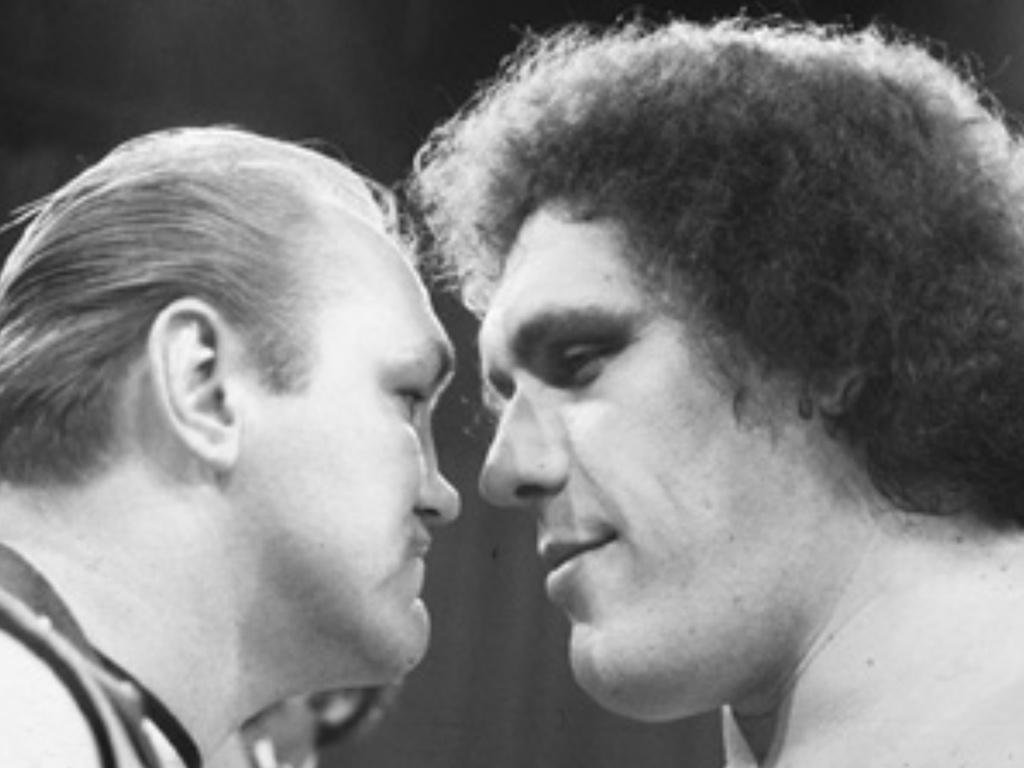
And then there is, to a lesser extent, the reaction of the media towards this match. As I wrote in my column last month on Andre the Giant vs. Chuck Wepner, how the press views a bout (at the time and with historical perspective) doesn’t really mean anything, but it’s still worth noting.
In 1999 Japan, this match was covered as a straight up fight and the biggest in the country since Muhammad Ali vs, Antonio Inoki 23 years earlier. The Russian media treated it as legit, as did the mainstream US press, including The New York Times and Sports illustrated. A 2008 profile of Karelin, written by Jeff Wackerly for Bleacher Report stated, “Karelin threw him (Maeda) around for the duration of the match…imagine the potential.” Even now, Sherdog lists Karelin vs. Maeda in their MMA records database (although incorrectly as a three-round bout).
The Case for a Work
For starters, you have Karelin facing one of Japan’s most famous pro wrestlers in his own organization which started by promoting pro wrestling before it turned to mixed martial arts, and which is now widely accepted to have featured numerous worked MMA matches. Maeda wasn’t just a legendary figure in puroresu, he was one of the founding fathers of shoot style. And make no mistake, this match contains numerous markings of a shoot style pro wrestling bout.
Strikes are definitely landed, including those numerous Maeda right outside kicks to Karelin’s left leg, which Maeda really turns over. But the knees that Maeda lands to Karelin’s body clearly lack forceful impact. And while Karelin hits numerous throws and takedowns, including a really solid front headlock throw in the opening round, none of them are beyond what you would see daily between teammates in a quality wrestling room. In fact, they seem a bit more gentle.
Those who cling to the legitimacy of this fight often cite the fact that 18 months later at the 2000 Summer Olympics in Sydney, Australia, Karelin lost the Gold medal match to Rulon Gardner and then promptly retired. The implication is that Karelin was pretty much shot by the time that he faced Maeda, thus the reason for his lackluster (albeit victorious) performance in Yokohama vs. Maeda. What is omitted from this narrative is that Karelin won his other four matches of the 2000 Olympic competition by a combined score of 13-0 and fell to Gardner in the final 1-0 with the lone point being scored through Karelin’s loss of a grip.
Karelin may have been in his fourth Olympiad but was only 33, having had his birthday the week before the Gardner match. He was hardly old, and far from past his prime.
There are actually two smoking guns in this bout which expose this as an outright work: one big and one massive. The big one is the single leg takedown that Maeda hits on Karelin in round 1. Really? A single leg takedown on Karelin? Of course, in Greco-Roman wrestling, it is illegal to grab an opponent’s legs. But still, the guy who entered this fight without having conceded a single point in wrestling in five years, is taken down by a 40 year old who had never had a match in Greco-Roman, freestyle, or folkstyle wrestling in his life. And, this takedown occurs right after Maeda had been on the receiving end of a front head lock throw that dumped him on his back.
But the massive smoking gun comes in the form of a move that Karelin actually did hit: the Karelin Lift in round 1. Now, the round 2 Karelin lift was awful, but the poor form could be explained away by his presumed exhaustion. But in the opening round, Karelin looked completely fresh as he held Maeda, with his legs straight up, head straight down, above the mat. Karelin had done this with numerous world class Greco-Roman opponents before, many of whom weighed considerably more than Maeda’s 257.
To be clear, Karelin didn’t invent the reverse body lift. Rather, he became the only big weight category Greco-Roman wrestler to be able to accomplish it at the international level. And, of course, Karelin accomplished it so frequently and with such ferocity and perfection, that it now bares his name. During his wrestling career, Karelin would regularly and legally spike his opponent’s head into the mat from the Karelin Lift, viciously compressing their neck, spine, and shoulders.
The move was so feared that in the final round match of Pool A at the 1992 Summer Olympics, Ioan Grigoras elected to roll on to his back and concede the pin to Karelin in just 14 seconds, rather than risk severe injury via the Lift. Grigoras rationalized that he had a zero percent chance of defeating Karelin, but by losing quickly and relatively violence free, he could come back and capture the Bronze medal (which he did).
But against Maeda, Karelin dumped his opponent onto his left shoulder from the first round Karelin Lift rather than onto his head. The impact is so slight, and the sell is so minimal, that Maeda is actually back on his feet 15 seconds later. This moves from the realm of unthinkable to actually laughable. All that was missing was a Hulk Hogan style finger wag by Maeda after surviving the Lift to move into full blown kayfabe territory.
The result of the match is extremely telling as well. Karelin got his win, but Maeda went the distance against the unbeatable champion. Maeda was allowed to have his moments along the way: landing strikes, taking Karelin’s back, attempting subs, and even hitting that single leg takedown.
That Karelin had never had either a pro wrestling or MMA match when he faced Karelin speaks fairly well of his performance. Still, he’s far from fluid, and, at times, looks as though he’s moving at half speed compared to his Greco-Roman matches of the era.
For his part, Maeda did just enough to lose and put Karelin over while making the bout appear competitive. He did, however, seem unrealistically exhausted and/or injured at the conclusion of the match, and then carried the act out of the ring as the live broadcast cameras followed him backstage. Even had this been a shoot, it was only a ten minute match, and one in which Maeda never got hit. Oh well.
And what’s with the decision being announced just 13 seconds after the end of the match? How could it possibly have been legitimately determined so quickly that Karelin was the winner when Maeda was never in any serious jeopardy during the two rounds?
The Verdict
This is a work without question. It’s just not overly obvious due to the lack of theatrics and histrionics that no doubt would have been present had Karelin instead faced someone from Vince McMahon’s stable in a purported real fight under the WWF banner. Watch any high level shoot style wrestling match from Japan during this era and Karelin vs. Maeda suddenly doesn’t look that unique. This is just one of numerous matches from 1990s Japanese MMA that settles firmly into that gray area between real and imagined.
In the United States, MMA was partially inspired by the backroom Gracie Challenges that UFC creator Art Davie witnessed during his time as a student at the Gracie Academy in Torrance, California; real fights emanating from a Brazilian Jiu-jitsu base. Japanese MMA, meanwhile, evolved directly from pro wrestling, namely strong style and shoot style pro wrestling with puroresu icons such as Nobuhiko Takada, Masakatsu Funaki, Satoru Sayama, and of course Maeda, leading the way.
Aleksandr Karelin vs Akira Maeda serves as the prototypical example of a match from the time when professional wrestling and mixed martial arts in Japan were rapidly heading towards a clean split, yet were still intrinsically linked together. That it features two absolute legends meeting in the same ring, regardless of the circumstances, makes it something truly special.
Next month: Ken Shamrock vs. Kimbo Slice.
*********
Sean Wheelock is an MMA, boxing, and combat sports television commentator, having broadcast over 3,00 bouts across 21 countries. He’s also the Chairman of the ABC’s MMA Rules and Regulations Committee, a Commission Member of the Kansas Athletic Commission, and a former licensed professional boxing referee. And despite his best efforts and years of diligent training, Wheelock remains a very mediocre grappler, and a less than mediocre striker.
Buy the book that Sean wrote with UFC creator and Hall of Famer Art Davie about the birth of the Ultimate Fighting Championship, enttiled Is This Legal? It’s also available in hard copy or Kindle ready at Amazon.
After a five-year run, the UFC’s run on “big” Fox ends tonight with an interesting card that isn’t exactly star-laden but, well, that’s the UFC today. (In retrospect, I should have added tonight’s Bellator show from Hawaii which features some interesting fights as well.)
Helping me look at the show are our friends Ryan Frederick and Paul Fontaine. Note that the card has likely kicked off by the time you’re reading this as the main card starts at 8 PM Eastern.
The card
Kevin Lee vs. Al Iaquinta II
Edson Barboza vs. Dan Hooker
Rob Font vs. Sergio Pettis
Jim Miller vs. Charles Oliveira
Zak Ottow vs. Dwight Grant
Bobby Green vs. Drakkar Klose
Jared Gordon vs. Joaquim Silva
Gerald Meerschaert vs. Jack Hermansson
Dan Ige vs. Jordan Griffin
Adam Millstead vs. Mike Rodriguez
Trevor Smith vs. Zak Cummings
Chris de la Rocha vs. Juan Adams
What are you most looking forward to?
Paul: There’s a lot of good stuff on this card. I’m very interested in the opening Fight Pass fight because heavyweight prospects are few and far between and Juan Adams is a good one with four first round finishes in just four pro fights and Chris De La Rocha has been knocked out in both of his losses. S, it’s a recipe for an impressive KO for the UFC newcomer Adams.
Ryan: I really like the feel of the main card. It’s not the most stacked one for a Fox show, but it is really good. Lee and Iaquinta should be a good rematch and they are both worlds better than when they first fought. Barboza and Hooker is a fireworks fight that will show whether Hooker is a real threat at 155 pounds. Pettis has a chance to show he can be a real player in a deep bantamweight division, and Miller and Oliveira always bring it. Solid stuff there.
Josh: Yeah, the main card isn’t big on any type of star power but all the fights have some meat and some intrigue to them. It’s fascinating to think back on the first Fox show that featured a heavyweight title fight to this one which has two lightweight contenders in the main event. The ratings probably won’t be that great, but the action should be.
Anything being slept on?
Ryan: It’s not the most exciting event, but there are a lot of good fights on this show. The entire thing is being slept on with it being such a busy time and weekend in combat sports.
Paul: The whole card in general. It’s the last UFC card on Fox and is the very definition of going out with a whimper. They peaked at over 10 million viewers for their Fox debut just over seven years ago and this show will be lucky to average two million. That’s no aberration because the last TUF Finale on Spike did 2.5 million viewers while the last one on FS1 did a shade under 400,000.
Josh: I have found myself looking at that Bobby Green/Drakkar Klose fight with some intrigue. Green is a big talker but hasn’t been able to sustain any momentum over the last few years due to injury and losses. Klose is a guy you forget about until he fights on the prelims three times a year, but he’s kinda good!
Anything not doing it for you?
Josh: Not at this point, but I feel like the middle of the card is going to feature a lot of decision fights which isn’t fun. I have no scientific evidence, but it just feels like that kind of show.
Paul: Miller vs. Oliveira could be fun and both guys have had great fights in the past, but Miller is a couple steps below him and this could be embarrassing. I have thought Miller was done a few times in the last couple of years and I really hope he isn’t a shell of his former self on Saturday night.
Ryan: Maybe the Trevor Smith against Zak Cummings fight because it could be boring if it gets dragged out the full 15 minutes. It’s a solid, if unspectacular, show we have here.
What will be people talking about most after the show is done?
Paul: “That’s it?” I think it’s finally going to sink in to people after this show ends that the Fox era is over and maybe there wil be a lot of talk about where we now compared to the end of 2011 when this all started.
Ryan: Kevin Lee should still be mentioned as among the best at 155 pounds, and that Dan Hooker is going to be right there with him soon.
Josh: I feel like Lee will be doing all the talking after this one is done. I still don’t buy him as an upper-tier lightweight, but his performance against Iaquinta could sway me.
Do you have a favorite Fox fight(s) of all time?
Paul: There’s a lot of good fights to choose from, obviously. For me, I’ll go with Urijah Faber’s retirement fight where he beat Brad Pickett to snap a two fight win streak and go out on a winning note. That show did a really good rating (Paige VanZant also fought on the card) and I remember being very optimistic for the future of MMA coming out of that show.
Ryan: I don’t know about fight as there’s so many and so many good moments that have come out of the Fox events. To me, the most memorable moment wasn’t a fight, but a promo by Nate Diaz after he beat Michael Johnson that led to him calling out Conor McGregor, which eventually led to two of the biggest fights in company history.
Josh: I’m going to tackle this topic on a future JNPO, but at a quick glance, that Junior dos Santos vs. Stipe Miocic banger from December 2014 is right up there.
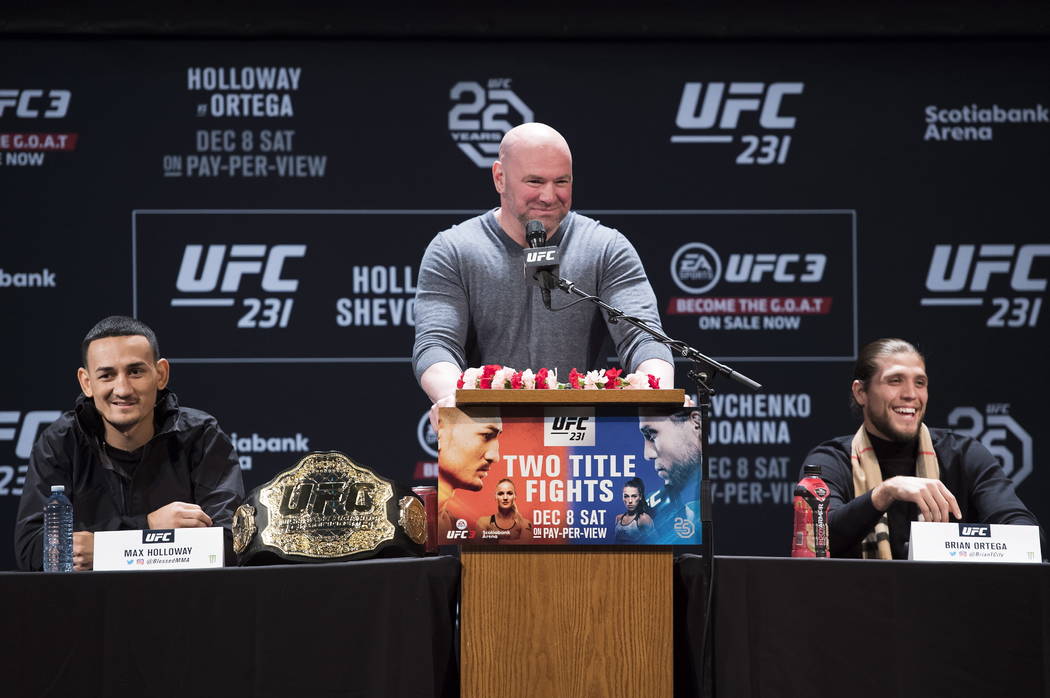
The first of two important UFC PPVs happens tonight in Toronto, Canada, with UFC 231, co-headlined by two title fights that will help set up their respective divisions for 2019.
As always, we have some questions, some answers, and some predictions about the event, and Greg Hardy isn’t part of any of them. Helping me dissect them are website writers Ryan Frederick who is in Toronto for the show. Paul Fontaine, who joined me on this week’s JNPO to kick off my MMA year in review series, wasn’t able to contribute but is working on his picks for MMADraws.com as we speak.
But first, the card:
UFC men’s featherweight champion Max Holloway vs. Brian Ortega
UFC vacant women’s flyweight title: Valentina Shevchenko vs. Joanna Jedrzejczyk
“Cowboy” Alex Oliveira vs. Gunnar Nelson
Hakeem Dawodu vs. Kyle Bochniak
Jimi Manuwa vs. Thiago Santos
Claudia Gadelha vs. Nina Ansaroff
Katlyn Chookagian vs. Jessica Eye
Eryk Anders vs. Elias Theodorou
Oliver Aubin Mercier vs. Gilbert Burns
Devin Clark vs. Aleksandr Rakic
Brad Katona vs. Matthew Lopez
Chad Laprise vs. Dhiego Lima
Carlos Ferreira vs. Kyle Nelson
What are you most looking forward to?
Ryan: It’s the main event between Holloway and Ortega. On paper, this might be the best fight of the year. You have Holloway on a 12-fight win streak trying to hand Ortega his first career loss while Ortega has finished every opponent across the Octagon from him. They are two of the most exciting talents in the sport, and the two best at 145 pounds. This is such a great fight.
Josh: Yeah, it’s gotta be the main event. It’s so rare where paths cross so perfectly with two young fights both peaking at the perfect time. This is truly how stars are made and I think with a great fight, this bumps both guys up quite a bit. The Holloway to lightweight narrative dropped by Dana “I’m done talking about it” White is interesting and it feels inevitable considering Holloway’s weight cuts were a big topic all week.
Anything being slept on?
Ryan: I like the welterweight main card bout between Oliveira and Nelson. I’m not sure it’s being slept on totally, but it should be getting more attention than it’s getting. Oliveira has been solid at 170 pounds and is a proven finisher while Nelson is a quiet threat anytime he’s in the Octagon. This could be high-level grappling, but don’t sleep on the power both men have. This has potential to be great.
Josh: No specific fights, but there’s a lot of rising talents looking to end their year the right way like Eryk Anders (former main eventer), Claudia Gadelha (former title challenger), and both Jimi Manuwa and Thiago Santos who are trying to find their footing in an increasingly interesting light heavyweight division.
Anything not doing it for you?
Ryan: There’s not really anything I dislike on this card, aside from maybe needing earplugs when both Valentina Shevchenko and Katlyn Chookagian fight. It’s a great card all around.
Josh: Everything seems to be in its place. Even the Fight Pass portion has a few familiar names. Overall, this looks like a good show…I hope.
What will be people talking about most after the show is done?
Ryan: We have a new king at 145 pounds in Ortega, we’ll be seeing Holloway at 155 pounds and in some fun fights, and that Shevchenko is the woman to beat at 125 pounds, but that she is beatable and by no means going to be a dominant champion.
Josh: To echo Ryan, it will be the new featherweight star in Ortega, a still very bright future for Holloway in a new weight class, and a lot of questions about how to get Joanna Non-Champion back on track.
Who wins?
> Ryan: Ortega, Shevchenko, Nelson, Manuwa, Gadelha, Eye, Anders
> Josh: Ortega, Shevchenko, Cowboy, Manuwa, Gadelha, Chookagian, Anders
For Paul’s picks, be sure to check out MMADraws.com later on today.
Editor’s Note: Larry Matysik, host of Wrestling At The Chase, the right-hand man of legendary St. Louis promoter Sam Muchnick, and frequent Wrestling Observer Radio guest, submitted this story to us about the machinations behind the 1973 NWA title match between Harley Race and Bruno Sammartino.
As smart, stiff, and stubborn as the competition was during the struggle for the NWA throne between titleholder Harley Race and challenger Bruno Sammartino on June 15, 1973, the politics that made the showdown possible were just as stressful. Not a shoot (they didn’t happen anymore) and thanks to the pressure packed disagreements, Race and Sammartino believed each had something to prove when the bell clanged.
The calculating maneuvers deeply involved the Funk family, particularly Dory Sr. and Dory Jr., along with NWA president Sam Muchnick, Tampa promoter Eddie Graham, Jack Brisco, WWWF boss, New York promoter and Sammartino booker Vince McMahon Sr., and several discontented NWA promoters who agreed with the views of Dory Sr.
There were two lines of politics at play: one was in the National Wrestling Alliance involving the Funks, Brisco, and Graham plus a couple other big players. The other was not between Sam and Vince Sr. – they seemed content with their relation at the time – but rather sending Muchnick and McMahon against a crew of particular promoters apparently on the opposite side of Muchnick.
And where were Dory Sr. and Sam? For years, those two had been allies. Now, nobody was sure anymore and the game changed nearly every day. It’s easy to see why consternation inside the wrestling business was boiling. No wonder Sammartino and Race felt the pressure to perform at the highest level in their historic contest. At their prime, they were two proud and talented competitors. The tension was not lessened one iota even though the quarrel had apparently been solved.
Like all wrestling disputes, however, finally settling the political arguments was never easy to do, especially this one. It wasn’t a shot, but darned if it didn’t mean something to everyone involved.
**********
The entire matter began when Dory Jr. captured the World Championship as recognized by the National Wrestling Alliance on Feb. 11, 1969, in Tampa. Major decisions like this were made by the NWA Board of Directors, a tidy group of seven. Within, there was some scuffling about the choice of Funk to replace Gene Kiniski. For one, Cowboy Bill Watts wanted the role. Adding to the debate was the fact that both Dory Jr. and Watts had been busy in St. Louis working for Sam Muchnick, the NWA president and the most influential member of the board. Another clever manipulator on the board was Dory Jr.’s rugged father, Dory Sr., who had become a close friend of none other than Sam.
In the end, Watts got only one vote from Tulsa promoter Leroy McGuirk, Watts’ business partner. With the pushes of Sr. and Muchnick, Jr. received the remaining tallies and was picked as the youngest champion aside from Lou Thesz in 1937. Dory Jr. turned out to be a highly successful kingpin, working wherever Muchnick booked him, big markets or small. He learned the tricks of a champion, to make a challenger look capable of winning. A fine football player in college with a deep knowledge of wrestling thanks to his dad, he could take care of himself and even be sort of a heel when it was worth it.
Most of all, he consistently drew big crowds, earning good money for promoters and wrestlers alike. I always felt that part of his appeal was that Dory was so young that many fans attended figuring a more experienced, most nasty foe would make an exciting title change likely. That didn’t happen, though, and admiration for Funk grew. Dory dressed the part and conducted himself like a professional champion and his rivalry with Jack Brisco, another young superstar, became known worldwide. Every fan knew about Dory’s spinning toehold.
But the reigns of all champions eventually come to an end. After a little more than four years, Dory had turned back most of the leading contenders in the NWA. Likewise, some of the attendance figures had slipped somewhat. They were not bad, but were not as outstanding as earlier. When the Board of Directors decided those reasons meant it was time for a new champion, Sr. balked. Some promoters needed to develop new challengers, he said. Muchnick’s booking of Jr. was unimaginative and repetitive, Sr. claimed, especially the finishes Sam would allow.
Nonetheless, Jack Brisco was selected to take Jr.’s position as World Champion in Houston on March 2, 1973. Eddie Graham was a strong advocate of Brisco getting the crown, which led to the end of Graham’s friendship with Dory Sr. When Jr. was bidding for the title, Graham pushed for him. Muchnick respectfully agreed it was time for a change, voting for Brisco and that swayed some others.
Here’s where it gets thorny.
Some promoters then and historians now feel that Sr., and perhaps Jr. as well, rejected the plan of Jr. losing to another babyface like Brisco. That rather old school theory said that a babyface should lose to a heel and a heel should lose to a babyface. There are those followers of Brisco who thought that the Funks didn’t want Jr. to be beaten by a past NCAA wrestling champion like Brisco because it would detract from Jr.’s noted scientific skills. (Jack himself may have felt that way.)
And a small, but determined, part of the disagreement was that maybe time had passed Muchnick by and it was best for him to go and Funk to stay with a new president. There definitely were angry arguments within the NWA depending on the different viewpoints.
How do I know all this? Well, I was working as a publicity man in Sam’s office and had earned his respect. Sometimes, I was invited into his room to listen to his telephone discussion about the hullabaloo. Sometimes, he just wanted to talk about the situation, and he talked with me. On some occasions, Wild Bill Longson, Sam’s minority partner in the St. Louis Wrestling Club, told me how frustrated Muchnick was and why. Remember, Muchnick and Longson both had lengthy and knowledgeable histories in the politics of wrestling. Both of them, and Sam in particular, had heard, seen, and probably done it all.
In this case, what brought everything to a head was the truck wreck Jr. had on Poppa Funk’s ranch on February 28. The timing was such, only two days before the match with Brisco was scheduled, that many skeptical wrestling insiders questioned if there really had been an accident and Jr. really had been injured. Paul Boesch, the Houston promoter, was especially unhappy and disbelieving since he had to refund tickets for what he had plugged as a major show.
Muchnick set a record for being neutral as he tried to balance all the emotional reactions. He requested and received written description of what had happened in the accident and how long the injuries would sideline Jr. Sam distributed that news to all the NWA membership, dubious or not as he worried about keeping the NWA together.
He also worried about St. Louis, his own town. With Dory and the champion out of the picture, the bouts Sam and booker Pat O’Connor had planned were down the drain. As usual, meticulous planning had it set up for Brisco vs. Dory’s brother Terry, Brisco vs. Gene Kiniski or Harley Race, and Brisco in a rematch vs. Dory Junior. The last thing Muchnick needed was an NWA collapse and the departure of some key performers.
This, however, was a big-time political game.
In this case, it gave Muchnick a reason to call Vince McMahon, Sr. At that time, Vince Sr. was running the World Wide Wrestling Federation, which in essence was the public name of his promotion for Northeast towns he owned like New York, Boston, Baltimore, and Philadelphia. Vince was also an NWA member.
In a dispute about the title in 1963, McMahon had departed the NWA and, with a win over Buddy Rogers on May 17, 1963, named Bruno Sammartino the champion of the “new” WWWF. McMahon returned to the NWA when his organization was challenged by a lucrative independent promotion. That was no big deal, because McMahon and Muchnick had remained good friends, despite any business differences.
Meanwhile, Sammartino had developed an amazing reputation over eight years as Vince’s champion. He also had good rapport with Muchnick, who found Bruno a gentleman and a businessman. The politics clicking in Sam’s head as the Funk-NWA controversy evolved led to him booking Sammartino for St. Louis. McMahon told Sam that Bruno would regain the WWWF honor in later in 1973.
Sam put two-and-two together. When Jr. sent word he could get back in action, the Funks had agreed for Jr. to drop the NWA prize to Race in Kansas City on May 24. This would be before bad guy Race had agreed to lose that belt to Brisco in Houston on July 20. KC was an NWA stronghold, plus it owned minority interest in St. Louis. Surely, it could be trusted to keep its word and make Funk lose to Race.
But if any hint of a double-cross got in the wind, Muchnick wanted it known that thanks to his relationships with Vince and Bruno, Sam might pull St. Louis out of the NWA and join the WWWF. Now that was hardball politics.
To play it safe, Sam booked Race against Sammartino in St. Louis on June 15 which allowed him to go either way with the finish. While Muchnick expected smart local fans to know all about the mighty Sammartino, he made sure by giving him a series of triumphs over Ivan Koloff, The Invader (unmasked as Dick Murdoch), Rip Hawk, Dan Miller, and George Steele. It would still be a remarkable match either way.
When Race and Sammartino squared off that night, they both knew what the deal was. The mat world would remain basically the same. By autumn, Brisco would dethrone Race and Sammartino would upend Stan Stasiak for their respective championships. Sadly, Sr. passed away on June 3rd. Muchnick clearly was in charge of the NWA, and actually thought very highly of Dory Jr.
Thus, the only question remaining was how Sammartino and Race would conduct their one-hour draw. Neither side wanted to devise a finish that would restart the problems there had been. Now, all the politics and psychology were dropped in the competitors’ laps: two out of three falls, one hour time limit. Pat O’Connor, who had told me this tale before he departed for New Zealand in 1982, had said, “Do the right thing. You’re both smart enough.”
It was just the correct basic advice he’d passed on to Sammartino and Race in 1973 and said it would be true for me even a decade later if I was working with the correct combatants. Listen to the crowd. They’ll lead you, tell you what to do. For what ever difficulties O’Connor sometimes had, he was right on the money with that advice.
**********
To the match itself for those who have never seen it, here was my own notes:
“Slow start, felt out each other. Big crowd settling in. A couple tests of strength with wristlocks, and handlock tests, after pretty even duels won by Bruno. Race got in control with chin locks, pulling tights, and mainly choking. Just when Harley opened up with punches and headbutts, Bruno fought back with forearm smashes and reversed a whip into the corner. Race tried his suplex, but Sammartino blocked it getting a two-count after his own body slam. More tests of strength with Race getting nailed by body slams. Reverse neck breaker by Race. Two flying tackles by Race, but Bruno stood his ground and flattened Harley. But then Race got Bruno in a front rolling cradle. Bruno kicked out at two. Race punched after delivering a headbutt to jaw. Bruno fought back, but missed a shot. Race went behind and hit one, then two atomic knee drops, lifted and then twice jammed Bruno’s tailbone into his knee. Race got the pin for the first fall in 17:12. Now the fans were into it.”
The battle sped up quite a bit, plus another element was added in the second fall. It was extremely hot in the building, nudging just over 100 degrees. (Even though Kiel Auditorium was air conditioned, the equipment was not working well.) Another problem was that smoking was still allowed, so the interior was not only boiling hot, but permeated with smoke. Clearly, Sammartino and Race were more comfortable working with each other, each taking impressive bumps from slams and arm whips, but the pair was visibly soaked in sweat.
As the fall neared an end, Race and Sammartino both looked as though they were standing in a hot shower, sweat pouring down their faces. Race seemed to have the edge, especially dropping diving headbutts from mat level into Sammartino’s muscular chest and neck. Then, Race banged his knee into Sammartino’s forehead. Sensing a final opening, Race went up on the top rope to unleash his most potent diving headbutt. But, that backfired when Sammartino plucked Race off the top, hoisted him high into the air and scored with a spine rattling body slam, followed by two more awesome body slams.
Sammartino bounced Race off the ropes and trapped Race in his famous bearhug. Squeeze, squeeze, squeeze, and finally Race realized escape was impossible thanks to Sammartino’s raw power. Rather than risk injury, Race submitted the second fall in 11:53.
When the bell sounded for the final fall, more than 20 minutes remained in the 60 minute time limit. Thus, few spectators in the capacity house expected a draw with that much time left and the majority was yelling for Sammartino, but still, plenty were for Race and his NWA connection. Yet, it seemed both Sammartino and Race cranked up their offenses to demonstrate why they were ranked as the best. The heat and smoke ramped up, too, leading to some of the sharpest wrestling gossip in years.
Both combatants were sweating constantly. Later, after the contest was finished, Race noted he didn’t train hard and smoked regularly. To the contrary, he pointed out, Sammartino did not smoke, was a heavy weightlifter, and took care of his cardio with regular running. Nonetheless, said Race, Sammartino was pouring sweat and puffing when the two locked up. Race also claimed that Sammartino was so dehydrated that he licked the sweat off Race’s neck, chest, and arms to get some water.
These two had a lot to prove to each other and to fans as athletes and performers. They knew what they were doing, but pride was on the line. Naturally, Sammartino responded by saying that it was Race who was so dehydrated that he greedily tried to get moisture by licking the sweat off Sammartino’s body. Nobody will ever know the truth, and it might be partially in the favor of both. This much, however, is fact: neither man held back one bit despite terrible conditions and each proved himself truly unique in the wrestling world.
That final fall was loaded with everything from some wrestling holds and moves, rough-and-tumble back and forth, Race scoring with his suplex and Sammartino unable to keep Race trapped in again in the bearhug. Race failed to pin Sammartino after a diving headbutt from the top turnbuckle. Sammartino tried the hanging backbreaker, but Race kicked off the rope to land a back bodydrop. Sammartino’s strength had him up before the two count. Those twenty-plus minutes passed like lightning.
I was the ring announcer and called, “One minute left”. Race hooked Sammartino’s head to try another suplex, but Sammartino broke free. Race hit the ropes, charging forward with a flying tackle, but Sammartino ensnared him with another bearhug. Only seconds remained before the one hour time limit expired and Race was not conceding. Even without the orders of a booker, Race and Sammartino had managed to subdue their substantial egos and engineer an exciting one hour draw. The two superstars finished as the politics wanted them to: completely even, a draw.
**********
Race had the championship for just 57 days in between Funk and Brisco. Nonetheless, he earned plenty of favors for how he conducted himself and even for what he did as a former ruler after Brisco assumed the throne. Race and Bob Geigel controlled the KC vote, and didn’t stir up any trouble. Race dropped the crown to Brisco on July 20, 1973, in Houston.
Their vote was for Terry Funk to be champion, which Jr. wanted, when it was time for Brisco to move on Dec. 10, 1975. When Muchnick retired, feeling the NWA was in shaky condition, Geigel was satisfied to be the front man as NWA president. That put Jim Barnett as the powerhouse booking the champion and handling the funds. Race had favors returned when he knocked off Terry Funk on Feb. 6, 1977 in Toronto.
As for Sammartino, he dethroned Stan Stasiak on Dec. 10, 1973. The trails leading from both sides all lead to Hulk Hogan and eventually, the WWF/E. It can all be traced back to what happened when politics created the Sammartino-Race struggle, long after Buddy Rogers ran into Bruno Sammartino.
Truly, Bruno vs. Harley was a duel to remember for a number of reasons.
It has been a long time since I got the chance to wax rhapsodic (shoutout two years of AP English) about NXT, and man does it feel good to be home. It’s nice to know that no matter how laughably bad a majority of WWE is, NXT keeps churning out quality, ever improving content.
Most of the players from TakeOver: Brooklyn appear on this card, but in dramatically different situations. NXT Champion Tommaso Ciampa has moved past Johnny Gargano (for now) and on to Velveteen Dream. Dream himself has done, well, done nothing dramatically different and is now a pure face. Gargano is a complete lunatic now, and his run in NXT is unlike anything we have ever seen. Shayna Baszler is still there and still the scariest person in NXT regardless of gender. We also get to welcome back Aleister Black and Bobby Fish between the yellow ropes. What a time to be alive!
A lot has been going in WWE lately with most of it being less than great. There’s no need to dive into something that has been talked about constantly over the past few weeks and I’m not going to rehash it. But, I do want to share some great advice I got some months back. I was meeting with a professor of mine from grad school and I was talking about how I was incredibly unhappy in my job. She listened to me complain about how awful my direct report was, how bored I was, and how I could feel the unhappiness I felt at work bleed into my personal life. When I finished, she simply said, “If you don’t like your job, get a new job.”
It was a statement so small in length, but it carried so much weight. And that’s what I want to say about WWE. If you don’t like WWE, dont watch WWE. If you don’t like Raw, there’s always NXT. If you want your wrestling to be full of long-term nuanced stories, watch New Japan. If you want your wrestling to be full of insane matches and moves, watch PWG or any of the other incredible indie promotions across the world.
I’m not someone that has an emotional relationship with wrestling. Wrestling was never there for me when I was going through hard times, Daddy. That’s not to say that my fandom, or how I came into my fandom, is better or worse than anyone else’s. It’s just there; it just is. There is a lot, a lot, of crappy things happening in the world right now, and we should really embrace each other now more than ever. Just because someone likes wrestling in a different way than you doesn’t make you right and them wrong. It just is. Embrace those people and each other. Open yourselves up to accept and enjoy other ways of thinking. Yes, I know this kind of meandered off but I felt the need to get those thoughts out somewhere, and this seemed like as a good a place as any.
ANYWAY, Saturday’s card only offers us four matches, but all four would be the main event of any TakeOver. With the report that the fifth match was cut so these could get the necessary time, there is the possibility we are in for one of the best TakeOvers of all time with each match getting 20-30 minutes to really put on a show.
Now like we always do at this time, let’s run down this card match by match and see what NXT has for us on Saturday — this time with no Liv Morgan jokes! She’s actually okay now!
NXT Women’s Champion Shayna Baszler vs. Kairi Sane: 2-out-of-3 falls
Who says WWE can’t tell long term stories? This story started during the summer of 2017 and will, in theory, end a good year later. They have told the story in so many ways, which is a huge credit to the performers. Baszler has come so far in such a short time it’s incredible, and a true testament to the quality of the developmental system.
Sane deserves credit for her part in the story as well. Her gimmick is, in a vacuum, outrageous even for wrestling standards. She is a yachting enthusiast, who is also a pirate, who is also a princess, who comes to the ring with the wheel of a ship. In what world does that ever work? It’s like when you ask a 4-year-old what they want to be when they grow up and they say a pilot, a firefighter, a baseball player, and a strawberry. It doesn’t make any sense, but it makes all the sense in the world.
The reason it works is because the character fits the performer. Think of Randy Orton. Orton as a face is the dirt worst, just awful. That’s because it doesn’t fit with who he is as a person. Let’s be real, he is not the nicest dude around and it shows. So when he leans into his arrogant and cocky side, it works. It’s the same thing with Kairi. She’s a bubbly, effervescent person and it totally makes sense that she would like the ocean, pirates, and princesses. And I think that’s really makes this feud so compelling: the authenticity. Both Kairi and Shayna are staying true to who they are as people. Shayna is an IRL badass who can hurt someone bad, and I’ve already gone over Kairi. They aren’t being forced into a box that is uncomfortable, bu are given the room to let their characters breathe and succeed because of it.
NXT doesn’t usually mess around with 2-out-of-3 falls matches. They are saved for special occasions, and usually blow off a feud. The rub is that the feud needs to deserve the stipulation. It isn’t just thrown around to blow off TM61 and Heavy Machinery. The matches mean something and are usually incredibly well received. People still talk about Sami Zayn and Cesaro’s match from 2013. That was five years ago and GIFs of it still regularly circle the internet wrestling hive.
All of their matches to this point have been good to very good, but this has the potential to be better. All of their history means there is so much for them to draw on and call back to. It makes all the sense in the world for Shayna to lose the belt and move on to something involving Ronda Rousey and the Horsewomen, so let’s say Kairi takes this one. The next group of NXT women seem to be heels like Lacey Evans – who might be the new Liv Morgan of this column because she just doesn’t do it for me, and Bianca Belair who is a star waiting to happen. Let them come at the royal pirate and see what happens.
Johnny Gargano vs. Aleister Black
Hot take: Black was the worst NXT champion not named Bobby Roode. Follow up take: the, umm, ‘groin injury’ was best thing that ever happened to him. It’s weird that a character as objectively interesting as Black was so…boring? I think he just became what every standard WWE face is ‘supposed to be’. He made corny jokes about people’s height, mailed in a few matches, and everyone called it a title reign. He is capable of so much more, and what better opponent to bring it out of him than the 5-Star Lord himself?
Remember how I asked earlier about WWE being able to tell long term stories? So, about that, apparently this TakeOver is just all about proving that idea wrong. This Gargano rise and fall story started in 2016 in the second Dusty Rhodes Classic which started his ride in NXT. There is an argument, and it is the correct one, that he is the best performer in the history of NXT. When I say that, I mean just what he’s done in NXT, not other performers who have done big things elsewhere (Nakamura, Balor, etc).
Just look at what Johnny has done without a belt:
NXT tag team champion
Has the most Paramore theme song in WWE
Gone from the most popular babyface in the company to maybe the most hated
Got a haircut that defies physics and description
Had 4 of the best 10 matches in the history of the company
I’d say that’s a fairly exhaustive and impressive list of accomplishments, one that no one that can touch. This seems like the start of the last chapter in his story. He went from being the beacon of light and hope to someone lost in the darkness of their own heart. It’s appropriate that his first match as a fully recognized heel is against someone whose very character alignment is chaotic neutral. It’s actually a cool and fairly layered character matchup: someone who has just embraced their inner darkness against someone who is wholly unafraid of the dark.
It feels repetitive to say ‘This match is gonna be great’ at the end of all of these write ups, but ¯\_(ツ)_/¯. It will be, it’s going to be, and I can’t wait. If it was up to me, I’d have Johnny lean into his newfound wicked nature and steal a victory here. I can see this being the beginning of a run that ultimately ends up with him main eventing the TakeOver before Wrestlemania and having a sendoff fitting of the best performer ever to wrestle in the yellow ropes.
WarGames: The Undisputed Era (Adam Cole, Bobby Fish, Roderick Strong & Kyle O’Reilly) vs. Pete Dunne, Ricochet & War Raiders (Hanson & Rowe)
Before I get into how much this match is going to rule, let’s talk about the War Raiders. Are they really doing it for anyone, anywhere? Even when they were with Ring of Honor, or wrestling as singles, they never really set my world on fire. The best thing I could say about them is that they were always fine. Their matches were always solid, but very rarely approached spectacular.
There is nothing wrong with that! Wrestling needs plenty of solid workers who can wrestle different styles. But with NXT essentially being an all star team of pro wrestlers, is that enough to matter? They don’t have the magnetic personalities to make up for that. I couldn’t tell you one ‘classic’ EC3 match, but that doesn’t matter. His personality is so spectacular that he can get by on less in the ring. But if you aren’t spectacular in the ring, or on the mic, or with your character, there’s a better than average chance you’ll get overlooked. And yes, I realize I just wrote like 150 words about an average tag team but whatever, it’s my column.
Four guys who emphatically do not have the problems that plague the War Raiders are the Undisputed Era. With Bobby Fish returning, the Era’s final form can truly take shape. The most unintentionally (or intentionally?) GIF-able group in wrestling heads back to WarGames looking for a repeat of last year’s result. The match fits their strengths perfectly, allowing them to run around stringing moves together and slapping their legs as hard as they possibly can. The only drawback to a WarGames match is that there are no stakes. Similar to how Survivor Series is for bragging rights, WarGames effectively means nothing but at least it’s an exciting nothing.
Last year’s WarGames match was absolutely fantastic and the competitors in this are even better. Any match is going to be massively improved when Ricochet and Pete Dunne are added to it, but still. A match like this is made for highlight packages, and really made for dudes like Ricochet. He’s going to jump off everything, onto everyone, and do a bunch of outrageous flips. It’s going to be great. There’s also like a 95% change he does some huge moonsault off the top of the cage onto the other seven dudes in the match. Let’s just say Undisputed Era wins for the second year in a row, but it really doesn’t matter as this is just fodder for spots and to set up the next tag team feud.
NXT Champion Tommaso Ciampa vs. Velveteen Dream
*Exhales slowly* Wooooo boy, is this gonna be good. I started and stopped this section at least three times and then decided to save it for last, mostly because I needed to compose myself before I just babbled for paragraphs on end.
If there was a phrase that summed up everything about this match — the characters, the stakes, the stage — it would be, ‘Who saw this coming’? Who saw Ciampa becoming goddamn Tommy Sports Entertainment aka The Greatest Sports Entertainer of All Time ™? His evolution from a decent worker to this supernova is beyond incredible. I’d say he has a unique type of charisma, but that description better fits his opponent in this match.
What he is, above all else, is convincing. The conviction in which he speaks, and the deliberate nature of his matches, makes you believe. He believes what he’s saying, so we believe it. He commands the ring every time he’s in it, and brings a kind of desperation to his matches. He was overlooked and underappreciated for such a long time, he doesn’t know how to feel any other way. Even at the top of his company, he carries that chip on his shoulder. He remembers that everyone thought he would never get here. He remembers that everyone said Gargano would be the Shawn Michaels of #DIY. He remembers everything and forgets nothing…plus he’s pretty good at this whole wrestling thing.
Do you remember where you were the first time you heard of Velveteen Dream? I don’t recall exactly, but I do remember my reaction. I have a running Gchat with some of my wrestling bros and vividly remember saying “How is this anything but an NXT gimmick?” It reeked of Tyler Breeze, it stank of Adam Rose. It had all the makings of something that might be popular in NXT, but would shrivel up and die on the main roster. I was wrong. I was wrong in every way. And you know what? I don’t feel bad about it.
I’m not mad that I missed this, because again, who saw this coming? Who saw a dude who had good mic skills on Tough Enough – heck who even watchedTough Enough? – and said “This guy is going to be the best thing in pro wrestling.” Patrick Clark has transcended what it means to be a superstar. It has been years since there has been anyone like him and years since there has been anyone with his talent, his skillset, and his unique gimmick. But there he is and here we are. We are living in the Dream’s experience; let the purple smoke envelop you and take you away.
The build has been as standard as can be, and honestly, even a bit lackluster. Heel champ comes out to cut a promo, and the other guy comes out and challenges him. It’s been done for years and will be done for years after I’m done getting column space on the world wide web. But they put their own spin on things, they gave it their individual accents and made it into something special and into something I can’t wait to watch. It still seems too early for Ciampa to lose the belt and for Dream to ascend to his rightful place as the King of everything the light touches, so look for the belt to stay where it is…unless Johnny Wrestling gets involved and costs Tomasso the belt, setting us on a course for the last chapter in their rivalry, one that ends WrestleMania weekend.
Editor’s note: Sean recently reached to us with a concept: an in-depth and analytical look at infamous matches from MMA, boxing, pro wrestling, kickboxing, and mixed match fighting to determine whether the controversial and contentious bouts were shoots (real competition) or works (predetermined result).
If you’re not familiar with his work, Sean is an MMA, boxing, and combat sports television commentator, having broadcast over 3200 bouts across 21 countries. He’s also the chairman of the ABC’s MMA Rules and Regulations Committee, a commission member of the Kansas Athletic Commission, and a former licensed professional boxing referee.
His first one: Andre The Giant vs. Chuck Wepner from New York’s Shea Stadium on June 25, 1976.“
Overview
Andre The Giant vs. Chuck Wepner was the headliner of a then-WWWF pro wrestling card dubbed “Showdown at Shea,” promoted by Vince McMahon, Sr. The event was held at the then home of the New York Mets—Shea Stadium—in conjunction with the Muhammad Ali vs. Antonio Inoki bout, which was taking place at Budokan Hall in Tokyo. The two wrestler vs. boxer matches were marketed under the banner “War of the Worlds” and were shown live on closed circuit television across the US, and internationally, including in Canada and the UK.
Immediately after “Showdown” had concluded, the New York crowd of almost 33,000 were able to watch Ali vs. Inoki live on a three-sided video screen, placed on the baseball infield. I’d love to write about that infamous mixed match fight, but Josh Gross’ outstanding 2016 book on the subject now stands as the definitive word on the subject and he leaves absolutely no doubt that Ali vs. Inoki was a shoot.
Yet 42 years later, Andre vs. Wepner still has an air of unsolved mystery about it. The waters are made murky by numerous major media outlets that treated the mixed match fighting spectacle as a completely legitimate sporting event, Wepner’s multiple conflicting statements on the bout, and the fact that Andre never broke kayfabe, ever. And then there is the surviving video, which can be charitably described as low-resolution, making the differentiation between real and imagined that much more difficult.
At the time of the match, Andre was firmly entrenched as one of the genuine superstars of pro wrestling. He had just turned 30, and was without question, one of McMahon, Sr.’s biggest draws in the WWWF, and the numerous promotions, foreign and domestic, where Andre went on loan. Billed as “The Eighth Wonder of the World,” and in advertising material for the Wepner match at “7’5, 463 lbs,” Andre was clearly the A-side of the main event at Shea.
The B-side was then left to Wepner, known as both the “The Bayonne Brawler” and perhaps more appropriately, “The Bayonne Bleeder.” His 15th round TKO loss to then WBA and WBC World Heavyweight Champion Muhammad Ali one year earlier, is widely acknowledged as Sylvester Stallone’s primary inspiration for “Rocky”. By the time he entered the ring vs. Andre, Wepner was 37 years old, and in the closing stages of his boxing career. But he was still a formidable heavyweight at 6’5, 232 lbs, with 33 pro wins—including a 2nd round knockout of Tommy Sheehan the month prior. While never a full-blown star in boxing, Wepner had fought—and lost to—some legitimate greats like Ali, George Forman, and Sonny Liston.
The rules for the match were fairly straight forward: Andre could execute anything in his pro wrestling arsenal, but would have to release Wepner, and any hold applied, whenever the boxer touched the ring ropes. Wepner would wear boxing gloves, and would throw punches as his only strikes, and, indeed, his only offense.
The bout was scheduled for 10 three-minute rounds with referee John Stanley, and judges Al Lee and Harry Lewis all keeping scorecards. The possible outcomes were pinfall, submission, knockout, TKO, decision, draw, countout, or disqualification.
The Match
Completely bare fisted and in his standard pro wrestling attire, Andre immediately moved forward in a poor man’s Archie Moore cross armed striking guard, while keeping his chest square to the target. Wepner, dressed like he would for any pro boxing bout, quickly went to work with his left jab from the outside in his orthodox (right handed) stance. On the first clinch, a bear hug by Andre, Wepner fell back into the ropes, and then grabbed the top rope with his left glove. Per the rules, referee John Stanley called for the break, a recurring theme.
Next up, we get an Andre side head lock, Wepner into the ropes, and the break. Then, another Andre bear hug, Wepner into the ropes, and the break—this time met by a chorus of boos from the Shea Stadium crowd.
As the first round progressed, Wepner established his jab from range, and at times made Andre look really slow and somewhat uncoordinated. Absent was the big man grace that Andre exhibited so freely in this era during his pro wrestling matches. There were some very slick and subtle feints by Wepner with his left, for which Andre had no answer.
In center ring, with space between them, Wepner’s boxing looked sharp and repeated jabs to the body and the head land. Wepner, thought, threw limited right hands to the body, and failed to throw a single right to Andre’s head during the entire round. The pro wrestler’s offense in Round 1 came in the form of closing the distance and then clinching or locking up—always immediately countered by Wepner moving to the ring ropes to force the break.
In the final minute of the round, Andre came inside looking to hit a single leg takedown. Wepner quickly clinched, hooking his right arm tightly over Andre’s head in a very savvy boxing move. Andre then released Wepner’s left leg as his opponent fell into the ropes for yet another break.
In the round’s closing seconds, Andre again moved forward, this time snatching an arm-in front facelock. Wepner attempt to defend by throwing his free right hand to Andre’s body. Eventually, Wepner walked himself backwards and put his right hip against the middle ring rope. This forced—yes, you guessed it—a break, just before the bell to end the round.
Between rounds 1 and 2, Vince McMahon, Jr., who was doing play by play commentary with an almost inaudible Antonio “Argentina” Rocca as his color commentator, gave a live read stating that “The champion of the ‘War of the Worlds’ will be awarded a new Harley Davidson motorcycle,” as the SS 250 was shown parked on the Shea Stadium infield dirt. I remain unclear if McMahon meant that the winner of Andre vs. Wepner and Ali vs. Inoki would both be given the Harley, or if perhaps some victorious wrestler—maybe Bruno Sammartino, who earlier that evening had defeated Stan Hansen in the co-main event — might claim the prize. I also remain unclear if anyone at Harley Davidson or the WWWF ever considered how Andre would be able to fit onto that motorcycle.
In a moment of lax officiating by Stanley, Andre was allowed to start round 2 dead center of the ring, rather than in his corner. Wepner visibly protested to no avail, immediately angled to his left, and missed with a jab to the body. Soon after, Andre came inside, and Wepner moved back against the ring ropes for the break. Rinse and repeat.
After the separation, Andre walked forward with his cross armed defense, and go caught high on the chest by a clean Wepner left jab. Andre then changed levels, and grabbed a high crotch single. Rather than looking for the takedown, Andre seemed intent on dumping Wepner over the top rope. The boxer regained his balance and footing, and began to land big right hands directly to the back of Andre’s head. Andre countered with an overhand right to the back of Wepner’s neck, which drew a hard warning from Stanley.
Taking advantage of the reset, Wepner then moved forward, and landed a right hook to the unprepared Andre’s body, causing the wrestler to immediately tie up. Wepner responded by—wait for it—moving back into the ring ropes for still another break. After another jab and move, clinch, and break from the ropes sequence, Wepner threw a hard jab to the body, stepped back and then landed a left hook flush to Andre’s head. Andre immediately applied another arm-in front facelock, and then connected with a clean knee to Wepner’s stomach, causing McMahon on play by play to blurt out “Oh no!”
Stanley confusingly deemed the knee an illegal blow, and separated the fighters. On the restart, Andre moved forward and got double underhooks, which he then used to hit a fairly well executed lateral drop, landing in side control. The position is also one from which Andre could get the 3 count, but Wepner negated the pin by draping his right leg over the bottom rope.
Upon being stood up by Stanley, Wepner started shouting at Gorilla Monsoon, sitting at ringside wearing sunglasses for the night time event, and working as Andre’s chief second in the bout. Andre moved in to take advantage of the seemingly distracted Wepner, who quickly hooked the top rope with his right arm, and clinched the wrestler’s head with his left arm. Seconds after the break was ordered, the bell sounded to end Round 2.
During the one minute rest period, McMahon did a live read for JVC as a still photo of the then state of the art Model 3050 combination TV/radio was shown. It appears to be only slightly smaller than the Harley, and perhaps weighs a bit more.
Wepner came out for Round 3 with an increased urgency and went to work with his left jab. Andre closed distance, and Wepner maneuvered himself back into the ropes. But before Stanley couuld order the break, Andre pulled Wepner center ring with a fully locked bear hug. Wepner’s defense quickly turns to offense as he started throwing jackhammer right hands to the side and back of Andre’s head. The onslaught caused Andre to duck, release, and attempt a head butt from an almost Thai plum.
Wepner immediately moved backward out of range, but Andre followed and again got inside. From there, the wrestler grabbed Wepner’s head, dropped levels, and moved behind his opponent. Andre then lifted Wepner’s full body straight up off the canvas from a belly to back position for an attempted, but ultimately unsuccessful, atomic drop. Wepner landed firmly on both feet, but then turned directly into a straight-on head butt from Andre.
Seeing his opponent fall back into the ropes upon impact, Andre quickly moved in, and scooped Wepner up with his right hand into a body slam position. Moving first towards the ring ropes, Andre then changeed course, and positioned the now aerial and immobile Wepner horizontally in his arms as he walked towards the center. Andre changed direction again, moved back towards the edge of the ring, and threw Wepner over the ropes. On the way out, Wepner overhooked the top rope with his right hand, and got his right leg caught between the middle and top rope. This caused the boxer to fall first onto the ring apron, before finally tumbling onto the Shea Stadium infield.
Rather than give Wepner 20 seconds to get back into the ring—as was then and is still the rule for professional boxing when a fighter falls out of the squared circle—referee John Lewis started the standard pro wrestling 10 count. A melee ensued around Wepner, which included Monsoon and Wepner’s manager Al Braverman in the quickly formed group. Both Wepner and Braverman later claimed that Monsoon put his foot on Wepner’s chest in an effort to keep the boxer from getting up off the ground.
While Wepner was still down, the bell rang which gave Andre the victory at 1:17 of Round 3 via countout.
The Case for a Shoot
Throughout the bout, Wepner cleanly throws and lands his left jab. Rather than pulling his punches, Wepner consistently turns them over. He feints, sticks, and moves; at times almost toying with Andre in the center of the ring. In round 2, Wepner lands big right hands to the back of Andre’s head, when the wrestler is looking for a takedown. The right handed blows to the side and back of his opponent’s head are even more ferocious when Andre grabs a bear hug in round 3. In this sequence, Andre ducks and eventually releases the hold in an effort to get away from Wepner’s punches. Then, there is the shovel left hook to Andre’s face landed by Wepner in the second round, which lands flush.
For his part, Andre connects on an overhand right to the back of the neck and a knee to the body on Wepner in round 2. Andre applies a heavy arm-in front facelock in both the first and second round, and hits a lateral drop from double underhooks in round 2. And in the closing sequence of the bout, Andre throws Wepner messily over the top rope, which causes the boxer to become tangled on the way down.
The flow of the entire match largely revolves around Wepner grabbing or falling into the ropes to force the break when Andre moves inside. This makes for clunky, stop-start pacing which belies proper orchestration and cooperation between the two men.
And not that this means anything really, but the mainstream media definitely seemed to think that the bout was on the level. The New York Times ran both a preview and a review of the mixed match fight with the day after recap story containing the headline “Wepner Throttled by Andre”. The New York Daily News quoted both men in their next day story on the match, with Wepner saying “I figured I’d work on his stomach. He hit me wih an illegal shot. I could beat him.” Andre countering, “I could’ve knocked him out in the first round, but he kept holding on the ropes.”
Five years after the bout, in a profile on Andre for Sports Illustrated, Terry Todd wrote, “In the third round…Wepner really clocked the Giant as they broke from the ropes. Whereupon Andre, in a more than usually fell swoop, angrily snatched his smaller opponent into the air and pitched him forthwith over the topmost rope, ending the bout.”
In 1986, HBO included Andre vs. Wepner in their special “Son of the Not So Great Moments in Sports,” in which host Tim McCarver stated, “Without his normal script, Andre the Giant just went after Wepner. Seriously. Serious mistake for Wepner.” And Wepner’s manager Al Braverman said in the program, “Chuck hits this guy a terrific jab—a jolt— right on the schnoz. Full face. I see the Giant, he just went ‘huh!’; and I seen Chuck’s face change a little bit. This was something wrong.”
For those who cling to the belief that Andre vs. Wepner was a legitimate fight, the brawl which took place in the closing seconds and immediately after the bell sounded—and which moved from the Shea Stadium infield into the ring—is almost always cited. There are definitely a few random punches, as well as a lot of pushing and shoving in the mass of bodies that includes Monsoon, Braverman, and Wepner’s entire camp—as well as Andre and Wepner themselves. The wrestler and boxer go after each other post-fight and Wepner absolutely nails Andre on his left shoulder with a windmill overhand right when both men are back in the ring following the count out.
This all has the look and feel of a completely unscripted and chaotic occurrence, with tempers flaring across the board.
The Case for a Work
Let’s start with the third man in the ring for Andre vs. Wepner. At the time of the fight, John Stanley was a regular WWWF referee. Surely Wepner’s corner would have vehemently protested this assignment to the New York State Athletic Commission if the bout was legit. And for all of his clean jabs from the outside, and hard right hands while being held by Andre, Wepner doesn’t throw a single right hand to his opponent’s head from range. Not one.
While Wepner wasn’t seen as one of his era’s big punching heavyweights, he had recorded knockouts in all six of his previous pro boxing wins as he entered the bout vs. Andre. Over the course of the match’s seven minutes, 17 seconds, Wepner lands exactly one hook to Andre’s head from range, and it’s with his left hand. Wepner only throws his right to Andre’s head after being clinched or otherwise tied-up. His straight right, right cross, right hook, and right upper cut are all entirely absent.
Absent for Andre is much of an offense in the entire bout. Andre botches the atomic drop on Wepner in the second round, and he stomps the mat with his right foot as he lands the overhand right to the back of Wepner’s neck in Round 2, creating a sound all-too-familiar to pro wrestling fans. While Andre does execute a lateral drop in that round, it’s obvious that he doesn’t put his full body weight down on Wepner, while seeking the pin from side control.
During the third round, in a move highly recognizable to all Andre fans, the wrestler clearly headbutts his own hand, rather than Wepner’s skull. When Andre lifts Wepner into his arms in the closing stages of the fight, he elects to toss his opponent over the ropes, rather than hit a body slam—a trademark Andre move.
In round 2, after Andre’s pin is negated by Wepner’s foot on the ropes, the boxer stands up, turns his back on Andre, and starts arguing with Monsoon, who is ringside. At the time of this bout, Wepner had been a professional boxer for 12 years. It’s simply not conceivable that in a legitimate fight, Wepner would focus his full attention away from his opponent while a round was in progress, and be so easily distracted. The thought of Wepner turning his back on Muhammad Ali during their world title bout to yell at Angelo Dundee or Bundini Brown is laughable.
And then there are the words of the later-in-life Wepner, which are diametrically opposed to what he said at the time of the mixed match fight. Last year, Wepner stated in an interview with entertainment writer David Onda, “We met at a hotel and we practiced some of the moves, because it is, you know, show business. I talked them into letting him just throw me out of the ring, and then I don’t make it back in. And that’s what he did.”
And Wepner told Josh Gross in an interview for his 2016 book on Ali vs. Inoki, “Of course it was show business, so nobody was going to get seriously hurt.”
Wepner also described to Gross the post-fight fracas which offers further evidence to the choreographed nature of the bout, and the entirely unchoreographed nature of what followed immediately after Wepner was counted out: “It got very heated. Some of the wrestlers were jumping into the ring. Gorilla Monsoon was throwing around guys like rag dolls. We were in there to put on a show and give them a good time. A real fight over this? It was crazy.”
The Verdict
This match is without question a work; it just has a lot of probably unplanned strong style moments. I say unplanned because of the utter lack of Wepner’s pro wrestling training and experience. Andre was notorious for getting rough when opponents worked stiff, and meaning to or not, Wepner worked stiff throughout this bout. The boxer didn’t know how to pull his punches, his sense of pacing was horrendous, and he didn’t seem to understand how to sell anything that came his way from Andre.
The most potent strike landed by Andre in the entire match—the knee to the body in round 2—occurred directly after Wepner landed his best punch of the fight, a left hook to Andre’s face. The knee by Andre looked real, because it almost certainly was, and came as a receipt—an immediate payback to Wepner for his previous hard punch.
The ending is completely botched because Wepner doesn’t know how to take a bump out of the ring, and panics at the last second by flailing with his legs, and grabbing the top rope with his right glove.
In all likelihood, Wepner’s corner legitimately became enraged when Monsoon touched their fighter, and the melee that followed was almost certainly a shoot. But this could have immediately evolved into a worked shoot by Monsoon and his WWWF compatriots, as they reflexively sensed a prime opportunity to further enhance the moment.
While neither as famous nor infamous as its counterpart Ali vs. Inoki, Andre vs. Wepner rightfully deserves to hold a very high place in the history of mixed match fighting. Although it lacked flow and any sense of real drama until the very end, the bout was still a great deal of fun. And it had an ending that was awkward and chaotic enough to cast further doubt as to what exactly was going on that night in New York.
That Andre the Giant’s victory over Chuck Wepner absolutely fooled a huge number of people—mainstream media members included—makes me like it that much more.
Get out your party hats and Royce Gracie t-shirts as it’s the UFC 25th anniversary show, live from Denver featuring….not Gracie and probably not any of the original combatants on that fateful night so many years ago.
Let’s face it: star-wise, this show isn’t much of a celebration. Even with Frankie Edgar out with an injury, this is more of a “Well, there’s a few good fights” show than anything else.
Helping me discuss some of the questions about the event, in addition to a few historical ones, are our friends Ryan Frederick and Paul Fontaine.
**********
Full Card (FS1 and UFC Fight Pass)
Chan Sung Jung (aka The Korean Zombie) vs. Yair Rodriguez
Donale Cerrone vs. Mike Perry
Raquel Pennington vs. Germaine de Randamie
Beneil Dariush vs. Thiago Moises
Maycee Barber vs. Hannah Cifers
Mike Triziano vs. Luis Pena
Ashley Yoder vs. Amanda Cooper
Chas Skelly vs. Bobby Moffett
Davi Ramos vs. John Gunther
Devonte Smith vs. Julian Erosa
Joseph Morales vs. Eric Shelton
Mark de la Rosa vs. Joby Sanchez
What are you most looking forward to?
Ryan: The top two fights on the card. Zombie against Rodriguez (both out more than a year) is really a perfect return matchup for both and makes more sense than Frankie Edgar for Jung. As for Cerrone vs. Perry, that has fireworks written all over it. It also has the underlying story of Cerrone’s current feud with coach Mike Winklejohn, who will be in the corner of Perry, so there’s lot of intrigue in that one as well.
Paul: I’ll go with the three women’s fights on the card as all three feature fighters at very different stages of their careers and could represent the past, present, and future of women’s MMA. You have a former title challengers in Pennington and a former champion in de Randamie on the main card, two highly touted prospects in strawweights Barber and Cifers, and two journeywomen who could be fighting for their UFC lives in Yoder and Cooper.
Josh: Same as Ryan, it’s the main event and the co-main event. I don’t think the results of either will make a huge difference going forward, but with a Cerrone loss, that would be five out of his last six which isn’t good.
Anything being slept on?
Paul: Chas Skelly vs Bobby Moffett. Moffett really impressed on the Dana White Contender Series and Skelly is a post-fight bonus machine. This fight has action written all over it and could steal the show.
Ryan: I don’t know that it’s being slept on since she’s getting a lot of hype from the MMA media, but be sure to pay attention to the UFC debut of Barber. She has serious star potential, is just 20, and there are some serious expectations that she could be a future UFC champion. We should slow down that talk for now because she is way young and way early in her career. The potential is there though, and she should impress.
Josh: Not really. This is one where pretty much everything feels right in terms of importance and the push, so to speak.
Anything not doing it for you?
Josh: From a more macro view, this whole show is disappointing considering what it’s supposed to represent. I’m a big fan of celebrations of milestones and achievements, so I hope the presentation at least tips its hat a bit more toward the fact UFC has been around for 25 years. The names on this show, however, make this feel like more of an afterthought than well-thought out presentation. I understand MSG was last weekend, but did they have to do an event every single weekend from here through the end of the year to lessen the pool they could use?
Ryan: Pennington vs. de Randamie as I think it will be the most boring fight on the card as the styles both have don’t mesh well together. The fact that both are coming off loads of injuries with de Randamie being out of action for 21 months will have a lot of impact on how they perform. It’s far from the best fight on the card.
Paul: The two flyweight fights on the Fight Pass portion are completely pointless since that division will cease to exist shortly. They might as well move up to bantamweight now and try to establish themselves in that division.
Where’s the intrigue?
Ryan: The top two fights as they both could be late entries into the fight of the year race, and there’s intrigue in prospects like Barber, Devonte Smith, and Luis Pena. It certainly represents a lot of present and future aspects of the UFC, fitting for the 25th anniversary event.
Paul: All of the fighters that are making their UFC debuts like everyone Ryan mentioned as well as Thiago Moises. You’ve also got “Juicy J” Julian Erosa getting a second chance after an impressive run years ago on TUF. John Gunther and Davi Ramos looked very impressive when they debuted in UFC and hope to keep the momentum going with a strong performance.
Josh: The co-main event and whether it will be as entertaining as everyone hopes it will be. It’s fun that they make these “fan service” fights, but sometimes they don’t turn out as good as we’d expect. I hope this is an exception.
What will be people talking about most after the show is done?
Paul: It will be talk of Cerrone re-emerging as a possible title contender after he scores a minor upset and beats Perry. Cerrone probably takes the mantle formerly held by Michael Bisping as best to never hold a title and it won’t take much momentum for UFC to work him into a title shot.
Ryan: It will be talk of a title eliminator fight for the Korean Zombie, how much fun the Cerrone against Perry bout was, and the intrigue of what is to come for Barber, Pena, and Smith.
Josh: That the young kids made a good accounting for themselves up and down the show, and that people will be disappointed there wasn’t more of a 25th anniversary feel to the show.
What’s been your favorite fight of the first 25 years of the UFC?
Ryan: Robbie Lawler vs Rory MacDonald 2. It had everything you want in a classic fight, and it happened to be on a major event. That one really stands out to me.
Paul: Michael Bisping knocking out Luke Rockhold to win the middleweight title. It wasn’t the “best” fight but it was certainly my favorite moment in all my years of being a UFC fan.
Josh: Jon Jones vs. Alexander Gustafsson. We were all groaning at the build for that show, but that fight was just so great, so close, and so gripping. There’s a reason many say it’s the best fight in UFC history, which is arguable, but it’s my favorite. I am every excited for the second one at the end of the year, assuming we don’t get a damn injury or something.
What’s been your favorite memory of the first 25 years of the UFC?
Paul: Being in the crowd when Chris Weidman knocked out Anderson Silva for the middleweight title. I was sitting at the very top row of the arena and wasn’t even sure if I’d seen what I’d just seen. Then, it was a mixture of joy and sadness sweeping over the entire crowd. The person I was next to and I just started jumping up and down and hugging and in the next section, while there were people who I assume were Brazilian with their heads in their hands and literally weeping.
An honorable mention would be walking through the MGM Arena after Conor McGregor knocked out Chad Mendes and taking over an hour to get through the arena and casino with the Irish fans singing constantly and drinking non-stop.
Ryan: It has been the rise of Conor McGregor. We haven’t seen a fighter in this sport transcend it the way he has, both in good and bad ways. But it always feels fun when he is around, and I hope he sticks around for a while because he makes this wild and crazy sport just a little more wild and crazy.
Josh: A few come to mind. The rise of the UFC in the first few years of the post-TUF era were something we’ll likely never see again, but were so awesome to go through. To have friends and friends of friends interested in the sport and intrigued by this “new” thing was such a great feeling. I will never forget being at a party with 10 or so law school kids (my friend was at school, not I!) watching the TUF finale with Rich Franklin vs. Ken Shamrock as a headliner. It was such a mix of men and women and everyone was intrigued.
Another would be sitting with my friend Sully at a bar and watching the Anderson Silva-Chael Sonnen fight and the gut punch feeling when Sonnen lost. At the same bar, he and I watched the Dan Henderson vs. Shogun Rua classic. Now, he doesn’t watch anymore which is indicative of how the content era just drove so many people away.
Finally, I’d say some of the events I’ve covered and the people I’ve met. From my first show in Charlotte (Kenny Florian vs. the debuting Takanori Gomi!) to the first UFC event in Boston (Randy Couture vs. James Toney!) to the debut of FS1 to even Stipe Miocic vs. Francis Ngannou this year, it’s been a fun ride and I’m looking forward to more in the years ahead. Maybe I’ll even get out to Vegas one of these years…
The first of the final three UFC PPVs of 2018 comes to us tonight from Madison Square Garden: the snakebit UFC 230 show that has seen more changes than a Broadway show.
Helping me dissect this show a bit for our dear readers is our event recapper duo of Ryan Frederick and Paul Fontaine.
The card:
UFC Heavyweight Champion Daniel Cormier vs. Derrick Lewis
Chris Weidman vs. Jacare Souza
David Branch vs. Jared Cannonier
Karl Roberson vs. Jack Marshman
Derek Brunson vs. Israel Adesanya
Jason Knight vs. Jordan Rinaldi
Sijara Eubanks vs. Roxanne Modaferri (Eubanks missed weight by 1.2 pounds)
Julio Arce vs. Sheymon Moraes
Ben Saunders vs. Lyman Good
Matt Frevola vs. Lando Vannata
Shane Burgos vs. Kurt Holobaugh
Brian Kelleher vs. Montel Jackson (Kelleher missed weight by 2 pounds)
Adam Wieczorek vs. Marcos Rogerio de Lima
What are you most looking forward to?
Paul: The main event fascinates me. If both guys were 100%, I feel like the result would be more of a foregone conclusion but Lewis just took one of the worst one-sided beatdowns of any heavyweight in history and then won, while Cormier admittedly couldn’t even make a fist three weeks ago. Conventional wisdom says Cormier wrestles him to death but at some point, Cormier could catch with that overhand right and if so, we have a new heavyweight champion. Even if it’s boring, it won’t be because Lewis could lmake a comeback at any time. And the fact it’s 25 minutes long means he has just that much more time to do.
Ryan: The main event is intriguing especially given the circumstances. Both men clearly aren’t at their peak when it comes to having a proper training camp and proper preparation for this fight. When that happens, you have to favor talent, and that is Cormier all the way. Lewis absolutely has a chance because he hits so hard, but I see Cormier being able to have his way in this one. I also like the fact we have sort of a middleweight tournament going on with the main card.
Josh: I’m going to diverge a bit from the top billing and go to the simmering feud between Israel Adesanya and Derek Brunson which will finally boil over in just a few hours. These two have been at each other for a few months and you can tell it’s not made up; there’s legit heat. I didn’t think Adesanya could get past Brad Tavares and he did. Brunson hits hard but always seems to make a mistake. I’m excited to see how this plays out tonight.
Anything being slept on?
Ryan: I can’t really say it’s being slept on, but Brunson vs. Adesanya should be fireworks and isn’t getting near the amount of attention that I expected. It’s a huge stepping point for Adesanya, but Brunson doesn’t always deliver when there is pressure on him. It definitely could be the fight of the night.
Paul: Julio Arce vs. Sheymon Moraes, both with sparkling records, should be a fun fight with two future contenders at bantamweight. Arce has only lost twice in his career, coincidentally both times to Brian Kelleher, who also fights on this card. Moraes is a former title contender in WSOF.
Josh: For a former champion that defeated one of the greatest of all-time, I don’t sense a lot of buzz about the return of Chris Weidman. There’s just this thing about him where people are either super high or meh on him. Then again, it could be the time off he took or it could be the fight itself which I’ll get to right now…
Anything not doing it for you?
Josh: I am not excited about Weidman-Souza at all. It’s been more than a year since the former champion was back in there with a big win over Kelvin Gastelum and while I understand Luke Rockhold had to pull out due to injury, Souza isn’t the guy I really want to see him fight. In his last outing, Gastelum dominated him and is getting a title shot this February. He’s 3-3 in his last six and I fear his title shot opportunities have passed. So yeah, I’m not excited about the co-main tonight.
Paul: The heavyweight fight opening up the Fight Pass prelims has the potential to put someone to sleep before the card even starts. I’m not expecting much at all from that one.
Ryan: I’m not really looking forward Eubanks vs. Modafferi, and that has a lot to do with Eubanks. She was originally going to be getting an undeserved title shot on this card, but it was then pulled for various reasons. Not only does she start complaining loudly about it, but then she goes and badly misses weight for a non-title fight on this card. Imagine if she had still been in a title fight. Then, she goes and acts like it’s no big deal that she missed weight and continues her act of being mad about having a title shot taken away. Her attitude towards everything has completely taken away any interest in seeing her fight.
What’s the intrigue with the show?
Paul:That Lewis can become the most unlikely UFC champion since Matt Serra would have to be it. If he does, he could be a potential breakthrough star and I think a fight between he and Brock Lesnar would have genuine crossover appeal and do great business.
Ryan: It is definitely the main event. Lewis even said it himself: if he becomes a UFC champion, everyone should be ashamed. It’s not that he doesn’t have heart and ability, he’s just being real with himself about his current standing in the sport. I’m also intrigued in the co-main between Weidman and Souza, mainly to see if Weidman still has what it takes to be a title contender.
Josh: It’s what happens with Brock Lesnar, or even Jon Jones, if Cormier loses. This is a big risk for Cormier and with a loss, his leverage is lessened into picking his spot for one last fight before retirement. I said on my podcast this week that I feel like Cormier is Danny Glover in Lethal Weapon, about to get out of the game but gets unlucky at the wrong time. I hope for our sake that isn’t the case for good ol’ DC, but I have this feeling it will be. If Lewis wins, I don’t think we’re getting Lewis-Lesnar.
What will be people talking about most after the show is done?
Paul: Probably who Lesnar will fight when he returns to the Octagon. After winning back the WWE Universal title at Crown Jewel, it would certainly be unique if he had a chance to pull off the rare double of holding the heavyweight titles in both pro wrestling and MMA. I’d say it’s a virtual lock that he challenges the winner of the main event.
Ryan: It will definitely be whoever wins the main event and what comes next. You assume it’s going to be Lesnar, but you can never be so sure with the amount of money the WWE continues to throw at him for doing minimal amount of work. After that, who knows what could happen. It’s also going to be fun to see how the contenders at middleweight shake out after this is all over.
Josh: That Cormier made a big mistake in taking this fight on short notice and that the Lesnar fight is gone. It sounds crazy, but given all the weird shit surrounding this card and how we got here, I have this feeling that our excitement about Cormier-Lesnar or Cormier-Jones III is going to have some cold water dumped on it. I hope I’m proven wrong.