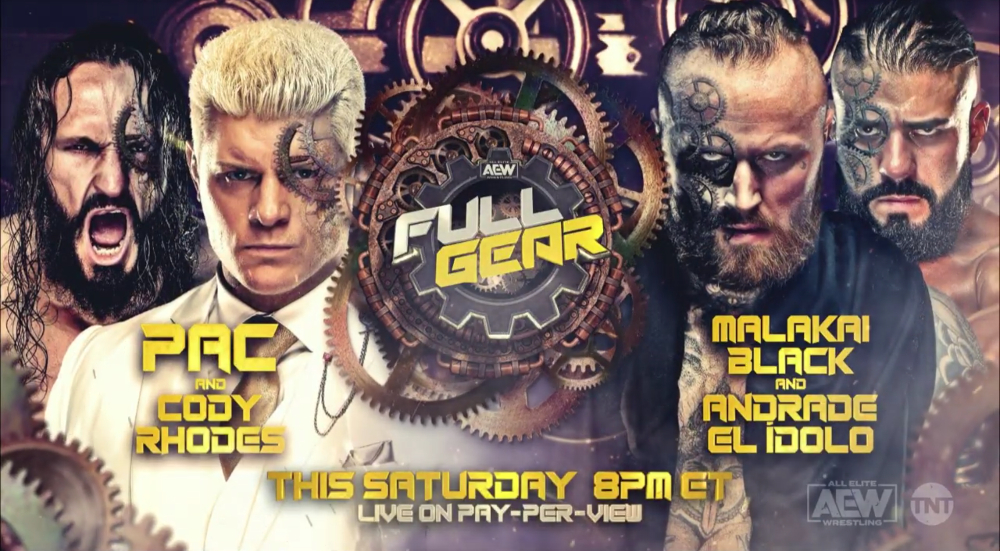
AEW Full Gear preview: Jericho-Cody headlines three title matches

If there’s a wrestling show on Wednesday night, then it’s only right that your favorite baby boy previews their big shows.

Hello friends and welcome to my first dance for AEW and their first show that is more than just a super indie show, and the first show where they have had to show their work and build primarily through TV instead of YouTube, social media, and the occasional press conference. Here is where it starts to get hard.

It’s one thing to have YouTube shows that build to a one off pay-per-view. It’s another thing to tell weekly stories that lead to a logical conclusion. One thing that’s worth saying here, and is something that I’ll repeat later, is that everything should be given time. This is the first major show after a month of TV. It’s not going to be perfect and it’s not going to be awful. There is a ton of grey area here, and it’s important to remember that.

AEW embraces that gray and doesn’t take itself too seriously. By doing that, they have created something that is easy to access. The overwhelming reaction from the non-wrestling fans I’ve convinced to watch Dynamite has been positive and sometimes, fun can be enough. WWE’s favorite thing is to remind their audience just how stupid they think pro wrestling is. By taking everything too seriously and constantly shouting at their audience, they have taken the fun and pageantry out of wrestling.

This isn’t a combat sport; it’s people doing performance art in their underwear. Something fun like Luchasaurus could never exist in WWE as any time he was on screen, the announcers and other wrestlers would be reminding us how stupid and silly a luchadore dinosaur is. Like an undead funeral home worker is so based in reality.

AEW has no middle ground. It’s almost unthinkable to have a mild take on it. You can’t criticize it without being a hater, and you can’t praise it without being a fanboy. Here’s the thing (and the thing is not new): you can critique something while still liking it. The company has had a month full of shows and, objectively, the good has far outweighed the bad. There are some things that haven’t worked out and the success of the company will hinge on their ability to pull the plug on those things.

They should embrace the growing pains. Failing, and failing often, is the quickest way to succeed. I just really hope they get their merch in order. Holy moly, almost all of the shirts are unimaginably bad. With the exception of the very okay Darby Allin coffin drop shirt, the rest of them look like something you’d see in a targeted Facebook ad. If you are trying to decide whether or not to buy the new Cody ‘shirt’, I’d encourage you to evaluate your most recent life decisions, and perhaps consider this instead.

So yeah, that was a whole bunch of words about AEW as a whole. I’m allowed to do that because it’s my column and I like to throw my thoughts at something new before I break it down match by match. None of the matches on this card are bad, they are all levels of good, and I’m excited to see what happens on Saturday. I don’t have TakeOver levels of excitement, but still, I’m excited. So like we always do at this time, let’s run through the card for Full Gear.

Pre-Show: Bea Priestley vs. Britt Baker

The three minute pre-taped promo Baker had during AEW Dark was very well done. It made me care more about her character than anything else she’s ever done. She’s angry at Bea, thinks she hurts people, and is coming for her. Simple, easy, awesome. Wrestling isn’t all that complicated. If the audience believe in the performers and the emotion resonates, that’s more than half the battle. No one wants to hear whether or not someone’s breath smells, or if they can’t sexually satisfy their partner, or any other juvenile scenarios. People understand the premise of “when you did this to me, I got mad and it’s payback time”. Everyone has wanted to give someone their comeuppance, so it’s easy to imagine ourselves in Britt’s role.

That promo might have been good, but Baker just not there yet in the ring. This isn’t an Adam Page situation where he’s close, but a situation where she is nowhere near ready. She has the look and the presence, but still needs loads of seasoning between the ropes and on the mic. And honestly, how can anyone expect anything else? She’s only been wrestling for a few years and has balanced it with school and dentistry. Not everything happens right away, so give it time. Give this whole thing time.

The unfailable wrestling internet tells me that Priestley might be…the worst? I truly don’t know enough to form an opinion, but she’s certainly being positioned as unlikable here. It makes sense for Britt to get her revenge in a quick, hard hitting match.

Joey Janela vs. Shawn Spears (w/Tully Blanchard)

I take it as a personal affront that this match was added after I submitted my column. No regard for professional journalists’ time SMH. If this feels tacked on, that’s because this was. It should work though. Spears is perfectly fine as a mid-card heel (sorry, Cody) and having Blanchard makes him seem just a bit more important than without him. People seem to think that if someone isn’t at the top of the card. they don’t matter, which is completely silly. Mid-card championships exist for a reason, and Spears would do well holding such a title if AEW goes in that direction. Plus, belts are cool.

In a way, I’m glad this match got added because it presents the opportunity to discuss Janela. There was no one hotter on the North American indies in the year or so leading up to the foundation of AEW. His Spring Break shows have been incredible and are everything pro wrestling should be. The worry is overexposure. Will Janela, on a weekly basis, still have the allure he did on the indies? It’s the big fish, small pond conundrum. It’s one thing to run your own GCW show, it’s another thing to be across the ring from Pac, Mox, Omega, Cody, etc. week after week. It’s great that he’s shared the ring with those guys and kept up, and looked great in the process. I’m excited to see him push his character to a broader audience and see where he goes from here. 

This match belongs as the main event an episode of Dynamite. It’s a perfect example of a feud that could have existed entirely on TNT/Dark and wouldn’t need a PPV match. But since it’s here and this column is about predictions, Spears really needs to take this one. He could really use a signature to win establish him as someone meaningful.  

Young Bucks vs. Santana and Ortiz

It’s so great that Santana and Ortiz are getting this level of shine on such a large platform. Being at the top of Impact for a spell is one thing, but being in a feud with the Young Bucks on a nationally televised wrestling program is something else entirely. They have been excellent for years, are always improving, and never mail it in. Both of these guys are great, but Santana is coming off like an absolute star. The parallel here is Montez Ford from the Street Profits. Both teams have something special, but it’s very clear who the real star of the team is.

This is yet another feud involving the Bucks and who the best team in the world is. Totally fine, I get it. But if wins and losses matter in AEW, isn’t the best team in the world the ones that just won their tag team tournament? The tournament that had ‘the best tag teams in the world in it? The same tournament that saw the Bucks losing in the first round? This might be splitting hairs here, but it sort of makes the tournament feel less important. I kind of hope this never stops and every time the Bucks wrestle, it’s for the completely fabricated title of best team in the world.

This match actually has had some sort of a build, and has clearly positioned faces and heels. As much as I’d love to cheer the shit out of Ortiz and Santana, that just isn’t going to happen. Considering the Bucks are obsessed with losing to put newer teams over, look for them to take the pinfall here with The Inner Circle getting involved.

Pac vs. “Hangman” Adam Page

I don’t quite understand why they’re running this one back so soon. Was there really an outcry for another one? Is there really enough heat here? Asking your audience to remember a months old match that was pretty good is a fairly big ask, even for a rabid fanbase like this. A fair criticism of AEW is that they don’t give matches enough time to feel big. The names are big, but the builds are lacking. Moxley/Omega runs into the same problem. They haven’t done nearly enough to make the match more than a first time dream match, so they slapped a no DQ stipulation on it. This should feel more like a rivalry than it does. One thing that might help with that is announcing matches more than two weeks out and letting the beat build more organically.

Here is a question only for people who don’t have prowrestling tees dot com as their home page: What is your favorite Adam Page match? I watch too much wrestling and am entirely too online, but I can’t name one of his matches that really blew me away. His match with Jericho was fine, and his match with Pac was also fine. He’s just fine. That doesn’t mean there isn’t another gear for him to hit or a level for him to reach, but the current state of Hangman Page isn’t at the same level as Neville Pac. That’s kind of a shame, because Page is a delightful weirdo on Twitter.

I guess saying Hangman isn’t at Pac’s level isn’t really fair. Pac is just in a whole different stratosphere as a performer right now. Everything works: the character, the look, the fractured speaking pattern, the moves, everything. He is a consistently great performer who makes everyone he works with look like a world champion, Pac is the wrestler AEW should be strapping the proverbial rocket to, not the horse guy. I can see a world where Hangman gets his win back so they can build towards a rubber match with some sort of stipulation, but I just don’t think Pac should be losing much, if ever. Pac wins and makes a run at the big boy belt in the near future.

Dean Ambrose vs. Kenny Omega unsanctioned match

Omega continues to be very much on his bullsh*t. My man busted out an Undertale costume on a nationally televised wrestling show and really does not care what you think about it. He still really has yet to bring out the full ‘best bout machine’ experience in AEW, but his matches with Janela (a sentence that is wild to write) have been closest. He also seems to have taken the poses and outrageous anime poses to new lengths. Do you, Omega man, do you.

While Kenny’s performances and motivations have been questionable in 2019, the opposite is true for Moxley. Mox is free and feeling himself, and do we love to see it. We have all had jobs that suck out our souls, jobs where we have to give ourselves a pep talk in the parking lot every morning just so we can walk through the door. Most of the jobs don’t come with a seven figure salary though, and that money can be tough to walk away from. Shoutout to Jonboy for doing it his way, for leaving on his own terms and rekindling the passion that was stifled for so many years. Imagine listening to this guy talk for more than 30 seconds and thinking the best use of him was as a prop comedian.

These frequent lights out matches are weird. They seem like a way to work around the whole wins and losses mattering thing, which no one asked for in the first place. If your wrestling company is a month old and you already are trying to book your way out of some weird self-imposed standings system, you might want to reassess some things. I will say as someone who lives his life by the mantra ‘nothing matters’, seeing a company just say “Hey, here’s a match but it doesn’t count or matter” is right in my wheelhouse.

This match is built on the sheer star power of both guys, wwo transcendent performers who have sold this match on their presence alone. All signs point to Mox winning and Kenny continuing his search for inspiration in AEW.

AEW Women’s Champion Riho vs. Emi Sakura

For someone so young, it is frightening just how much Riho gets being a pro wrestler. When I was 22, my main concern was if I had enough money to go to the Pizza Hut lunch buffet and five-dollar movie night on the same day. You forget just how small she is, because her connection with the crowd is just so large. Being the first ever AEW women’s champ placed a pretty big spotlight on her, and she hasn’t shrunk from it. She is clearly a star and was a great choice as the inaugural champ.

Sakura trained Riho at one point, and that’s enough of a hook right there. My first exposure to her was at the AEW show in Boston and she was enjoyable as hell. The Freddy Mercury/frontwoman gimmick has no business working but it sure does. Plus her tiger driver rules, and I will always pop for a good tiger driver.

This is way too early to take the belt off Riho, partially because she’s had it for like a month, and partially because she is such a good opponent for so many of the women in the company. This should be a fun match with the champion retaining.

AEW World Tag Team Champions SCU vs. The Lucha Bros vs. Private Party

This column was just about done before Wednesday night when this match was announced. I’m never going to complain about a match that should be tons of fun, but, like the matches previewed before this, it’s another example of something with no build. But hey, there’s nothing wrong with a popcorn match that looks as good as this does.

What it has going for it is the recent history of the teams involved. SCU beat Lucha Bros in the tag team tournament in a fine match that deserves a runback. AEW, if nothing else, has proven that they know how to make tag team wrestling work, and a sprint with these six guys will be well put together and well worth our time.

Since I don’t have a ton to say, I’ll talk about Rey Fenix for a second. Fenix is, in my mind, one of the five best wrestlers in the world. An invested Fenix is something spectacular, and is firmly in the unnecessary but fun ‘best in the world’. He’s been the clear MVP of every match he’s been a part of in this company, and is someone they should be building around. With the depth of the tag division, seeing both Fenix and Pentagon wrestle more singles matches would really help round out that side of things.

It would actually be hilarious if SCU dropped the belts after having them for like 10 days. Since I doubt that happens, SCU retains over in a match that should open the show with a bang.

AEW World Champion Chris Jericho vs. Cody

It’s easy to say that Chris Jericho is doing the best work of his career because everything he does is incredible. His constant reinvention is exhaustively documented elsewhere and isn’t something I’ll get into here, but just when you think we’ve seen peak Jericho, he goes and does it to us one more time. His claim to being the best of all time grows with each promo, and with each stroke of eyeliner. I know people are already trying to ‘cancel’ Jericho for his most recent podcast guest, but if we had to cancel every conservative leaning wrestler, then there would not be much wrestling left. It’s an unfortunate truth of our time, which is also the worst time in human history.

Cody isn’t the best of all time, or even in the discussion, but he certainly deserves a ton of credit for making you care about his matches and for telling a great story in the ring. The man knows his ethos and pathos and can tap into the emotions needed to tell the best story. A frequent complaint is about the lack of storytelling in American wrestling, but Cody really wants you to care. He really, really wants it. He really, really wants you to care about a match when you really, really don’t. The best example of this is him getting people to even remotely care about a Shawn Spears match. Cody’s matches mean something in a time where most matches don’t. Oh, and his promo on Wednesday ruled. What a talker.  

The build to this has been fine. It’s not anything we haven’t seen before, and it doesn’t have to be. The stipulation they added Wednesday night certainly added some stakes, and I like how they are openly addressing the management being wrestlers. I genuinely like Cody but I’ll never forgive him for the introduction of the Cody listening gif that shows up in every reply to any somewhat newsworthy wrestling tweet…ever. Jericho leaves Baltimore strapped up, remaining Le Champion heading into 2020.

Mike DellaCamera’s favorite day of the week is now Wednesday and he loves leftovers. Find him on Twitter.
WWE 2K20 review: A complete mess

When I saw the first trailer for WWE 2K20, I had a relatively simple question: will it be fun?

The reason is that the 2K series has struggled to deal with that answer with its last few entries and while some dismiss the series in total, I go into each new release in the series hoping key changes are made.

Unfortunately, that wasn’t the case this year.

2K’s rollout of information pertaining to WWE 2K20 was frustrating. In hindsight, it probably was a sign. The roster, downloadable content, and special editions were rolled out over time, but we didn’t get an official trailer highlighting gameplay until three weeks before launch.

The Glitches

WWE 2K20 is a broken, disjointed, buggy mess of a game. While other entries in the 2K series have had their share of bugs that have been shared on social media over the years, 2K20 takes these long-standing issues and cranks them up to 11.

Several times during gameplay, I had to restart a match because the characters involved got stuck in an infinite loop hitting each other with the same offense over and over. The game is prone to crash as well. In one example, I had spent about 30 minutes creating a moveset for my create-a-wrestler only for the game to crash when it couldn’t load the preview of one of the moves. I soured on the creative aspect of the game pretty quickly after that.

There were other weird technical issues I experienced as well. One time during an entrance, the camera panned to the crowd and half of one section didn’t load. Another time, a character’s story mode came out looking like she had a skin disorder because the lighting was all screwed up.

There’s also this involving Finn Balor never breaking a pin and suddenly becoming impervious to interference. And really, this is just the tip of the iceberg compared to otherglitches and bugs that have been shared on social media. 

Some of this can be attributed to Yukes, the longtime developer of the series dating back to the first SmackDown game on the PS1, not taking part in the development of this year’s game. I’m not sure if they joined development and left or just didn’t contribute at all, but it’s clear there were development issues as they are plainly visible for everyone to see.

2K is aware of these issues and released a statement saying that they will have an initial patch released in the next two weeks. I am hopeful that this fixes the more glaring problems that have been described.

The Gameplay

Beyond the glitches, the actual gameplay remains a mixed bag. Something that had been a thorn in my side for years was the reversal system as the game punishes you constantly for either hitting the reversal button too quickly or too slowly. That has been toned down considerably in 2K20 which is a welcome addition.

Still, much like previous entries in the series, playing matches in 2K20 tedious. Some match types, particularly multi-man ones like triple threat matches, take way too long to clear. The game’s AI doesn’t really help matters much either. Whenever I laid a wrestler out, they take way too long to recover. Sometimes, they just stand around and attack the air and other times, they suddenly become ultrasmart, reversing any offense and suddenly taking control for long portions of the match. To say that it is inconsistent is an understatement.

The Characters & Story Mode

One of the positives of the 2K series is that there are no shortage of wrestlers to choose from. There are well over 200 characters on the roster this year, including some that haven’t been in a WWE game in years like Chyna.

However, the character models this year look way off compared to previous games in the series. Take a look at some of the models. That looks nothing like Dusty Rhodes. And holy hell, what is with Kurt Angle? Are we sure that’s Molly Holly? The character models in these games are never 100% on point, but this year’s entries look far worse than last year’s release.

I do have to give praise to MyCareer, the game’s story mode. It follows the careers of friends Red and Tre as they recount the story of their career as they prepare to be inducted into the WWE Hall of Fame. They start from the bottom, traveling to Canada for their first gigs to eventually joining NXT, getting to the main roster, and encountering all of the big WWE stars.

It’s definitely corny at times, and somehow despite taking place over a number of years, both Tre and Red never actually age. But the characters and story are endearing in their goofiness and it compelled me to play further. There’s also a few cool cameos from past and present WWE stars that are a nice addition. If anything, this was the highlight of this year’s release.

Showcase mode, where you play and recreate matches from the past, focuses on the Four Horsewomen from their time in NXT to their individual runs in WWE. I think the idea and the topic are fantastic, but in execution, it can be kind of a chore. In order to advance, you have to complete a series of objectives, mostly those that relate to the actual real-life match. That structure (which is also in the story mode) can be suffocating at times, and, as mentioned earlier, can take a very, very long time to actually accomplish.

Final Thoughts

It’s easy to show bugs and glitches on social media and come to the conclusion that this is a bad game. Now that I’ve spent time playing it, I can safely say that WWE 2K20 is a seriously flawed mess that highlights all of the series’ worst problems. There’s actually a fun game deep down in here somewhere, but in its current state, it’s absolutely not worth the risk. On the Meltzer scale, it’s somewhere around the * range.

Jake Hager talks his two careers, what’s at stake at Bellator 231

Image: Lee South

When Jake Hager, the man formerly known as Jack Swagger, gets into the Bellator cage on Friday night, he’s facing a different kind of pressure.

Hager has two careers going right now, and losing right now would be very bad for both.

Jack Swagger, his previous being and the name he’s still best known as, was known as “The All-American American” for years in WWE. He had a catchphrase, “We the People,” which he would shout out with the fans. When he came out for his first Bellator fights, there was a “We the People” chant from the crowd.

“The All-American American” name came because he placed in the 2006 NCAA wrestling championships as a heavyweight from the University of Oklahoma, thus earning All-American status.

His pro wrestling days aren’t over, and in fact, he’s hoping that the consistent level of stardom as a pro wrestler that eluded him in WWE can be achieved with his new employer, All Elite Wrestling. And unlike most who have crossed over from MMA to pro wrestling, or in the other direction, Hager is performing on two television platforms concurrently. And the two are tied together.

On October 9, one week after Hager’s appearance on the AEW debut show, he was in the ring backing up Chris Jericho, one of AEW’s flagship performers. Hager is Jericho’s backup muscle, the guy who interferes to make sure Jericho stays World Champion. As Jericho was talking, the fans in Boston loudly chanted, “We the People,” Jericho paused, and in a classic impromptu and unplanned moment, went off.

Jericho said that “We the People” is dead, it was a bad idea from bad creative, and declared that the former Swagger’s real name was Jake Hager and he’s an undefeated MMA fighter. He pushed that Hager was the baddest man in pro wrestling. Hager quickly realized with his new gimmick, losing right now would not be a good thing.

The entire crowd was stunned at Jericho’s off-the-cuff remarks and it was something of a magic moment for Hager, who was standing there.

“Oh man, I get goose bumps just thinking about it,” Hager said. “I think this is the perfect example on why you don’t need everything scripted out in wrestling. If you are talking and the fans react in a certain way, and you can’t react back, it falls flat. Chris, like no other, has the uncanny ability to know what to say and the timing. No one else can do what he did. That’s the single biggest advantage AEW has (in trying to compete with WWE). is Chris Jericho, because of moments like that.”

The crowd went crazy, as in the competition of a wrestling war, the AEW fan base is largely anti-WWE, which gave him the previous gimmick.

“I left that company two-and-a-half years ago,” he said. “They didn’t want me. They didn’t value me. Now we’re here. For me, everything is fair game. It’s nothing personal. It’s all business. If you thought that was a special moment, get ready. It was just the beginning.”

But now he has to live up to the moniker of being an MMA superstar, which isn’t easy for a fighter with just two fights under his belt. Even with his football and amateur wrestling pedigree before pro wrestling, his size and 81-inch reach, he’s also a few months from his 38th birthday.

It’s an ominous number, because of the eight heavyweight All-Americans in that 2006 tournament, four went into MMA. And the other three are gone. Cole Konrad, who won the tournament, was a heavyweight champion in Bellator, and has long since retired. Steve Mocco, who placed second and was a former NCAA champion and Olympian, did not have a great career as a fighter and has also retired into coaching. The other All-American from that year was Cain Velasquez, who placed fourth, and has just retired from fighting to go in the opposite direction, starting pro wrestling on national TV at 37.

“Yeah, absolutely,” Hager said about how this new wrestling persona has made his fight Friday even bigger for him in both the worlds he’s competing in. “This is a very big chunk I’ve bit off and it’s big enough to scare me. I wanted to prove to everybody who Jake Hager is. Now that the (AEW) debut has gone well, yeah, there’s more pressure on me not only to win, but to make a statement. This is where I rely on my background. This is where having been to the NCAA Division I championships and wrestling (in WWE) before 80,000 people helps out. It’s scary. I’ve got a lot on my plate, but I can handle it. Dealing with pressure is a good thing. It’ll make you work harder and make you focus even more.”

Hager (2-0) faces Anthony Garrett, an unknown heavyweight with a 3-1 record who, unlike his first two opponents, can match Hager’s size. Garrett is 6-foot-5, like Hager (who was billed at 6-foot-7 as a pro wrestler), and cuts to make 265 pounds. Hager has been fighting at 238 to 240 pounds.

“I’ve seen a couple of his fights on YouTube,” said Hager. “We’re really big into film study. We also watch ourselves and see a lot of things. He’s all of 6-foot-5. This will be my biggest test coming. As a heavyweight, you always want to rely on your size. It takes the least amount of energy to lay on someone. I’m going to have to use technique, footwork, head motion and close the distance and get him into the position I want. From what I can see, he wants to get you up against the cage and get the takedown.”

Hager suffered no significant injuries in his first two fights, so he’s never had to take real time off training after fighting.

“Honestly, this has been a one year long training camp for this fight. I’m not going to get tired. I can go 35 minutes.”

“I’m looking to give him no windows, I need to not make any mistakes and give him the opportunity to beat me. That’s using the striking with the wrestling. I don’t want him on top of me at all. If he tries to wrestle with me, I’m all for it, but I’ll be quick to get out of there if he’s trying to throw his weight around.”

Hager debuted as a surprise at the end of AEW’s debut television show on October 2, as part of the lead heel group in the promotion called The Inner Circle, with Jericho as the mouthpiece and star. It’s something of the role that Arn Anderson played in the old Four Horseman group, with Jericho as its Ric Flair.

Hager agreed to terms with AEW owner Tony Khan over the summer, but both sides kept it a secret until his run-in. With Khan wanting Hager as the big surprise debut at the end of the first show, Hager had to do a unique training camp for Friday’s fight.

“This is where I wanted to be, but be careful what you wish for,” he said. “The balancing act is little tough. I knew about AEW all summer. I was preparing for this fight early. When October 2 came around, my training camp was mostly done and then I had three weeks to go. I feel ready and prepared for the fight. After this, I’m going to continue to wrestle and that’ll be a juggling act. I’ll take Wednesdays and Thursdays off (AEW tapes television every Wednesday). I’ll train every day from Friday to Tuesday, and fly out Tuesday night. That’s what I’m planning on, doing both right now. It’s a great thing, but it’s a lot.”

Hager did say he’s got the blessing of Khan, who is an MMA fan, if he were to need time off in the future. For this fight, the agreement was he’d do television every week except for fight week, but wouldn’t do his first actual match until after the fight. While he’s already been in some short brawls around the ring, he said the last thing he wanted to do was risk an injury at this time.

“Bellator’s been great, allowing me to do certain things with AEW,” he said. “They’re very excited about it. I’m waiting until after the fight because I don’t want to blow an ankle or something silly that can be hindering in the fight. I want to make the first match in AEW mean something.”

“It’s going to be a work in progress. We’re definitely going to have to see what’s in store for AEW and what we’re doing. From the very first phone call with Tony Khan, he said, `Please win and if you need time off, let me know.’ From a boss, it was awesome. I’m going to take him up. We might need a whole fight camp for two months and be off TV, and we might be there every Wednesday and work through it. This fight will be a good gauge for next year.”

But Hager is all smiles when he talks about his other new job, where he said people will eventually see, because of the schedule, a better product than the competition has.

“There were points in my WWE career where I was very excited to show up and excited about what I was doing and actually excited about being there and there were times when all the love was gone,” he said. “They do that on purpose. Right now, I feel I’m in a different place. All the bitterness I had from WWE, it doesn’t matter anymore. We’re onto the next one. To bring that with me would be silly. There’s so much excitement here, so much to be excited about. It’s really fun. The best thing that will keep that excitement going and you’ll see it translate on the screen is working one day a week. We’re showing up for TV. One day is so much better than doing five days a week grinding, driving rental cards, getting no sleep. We’ll all be more healthy and you’ll see that wellness translate into our product.”

A live perspective from the AEW Dynamite premiere

Images: Jeremy Peeples

The first night of the Wednesday night wrestling wars is in the books and the DC market played host to history having the first episode of AEW Dynamite.

The Capital One Arena used to be the Verizon Center and in the WCW days, it was the MCI Center and became the home base for WCW’s Starrcade events. Since then, there haven’t been many major shows here, makining the Dynamite debut probably the biggest wrestling event held at the building since the final Starrcade.

The street in front of the building was completely blocked off on each side by police cars, making it seem like an even bigger deal. Outside the building before the show, it was a sea of humanity in black t-shirts with lines that snaked around the building with few exceptions.

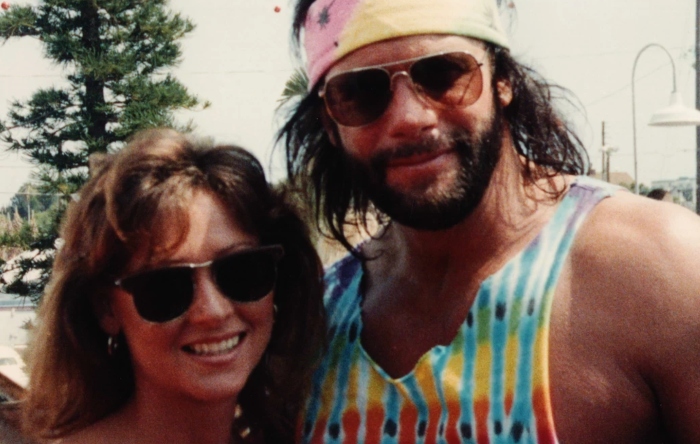
One big exception was a man named Marcus dressed in Randy Savage’s WCW debut attire that Jay Lethal paid homage to at All In. I had a chance to talk to him and he (seen below) not only did a dead-on Macho Man impression, but was a really chill dude. I was amazed in watching the show back on TV that he wasn’t shown on-camera. Justin Roberts was the emcee and one of the few people who could be heard by the crowd throughout the evening. While he and Chris Jericho could be heard, the Kevin Smith and Jason Mewes interview and the Lucha Bros promo/brawl early in the broadcast, the live audience didn’t heard anything. Thankfully for the latter, brawling is a universal language.

Roberts talked about dark matches after the show and the spacing out of them was a bit odd. There was one pre-show dark match with CIMA taking on Darby Allin and Allin winning with the coffin drop. Allin was over huge and it was cool to just see CIMA live. Having one pre-show match and three post-show matches is something I hope they don’t do again. Having an even split of two before and two after the show is probably best because folks were either leaving or pretty tired for the post-show matches.

As an overall value, they provided far more for the money than I was expecting since none of the lineu-ps were announced beforehand. Going in, I bought my ticket not expecting to see the Lucha Bros. live, and not only got to see them, but also saw Private Party face off with them a bitt which is going to be a hot program one day. Live, Private Party is simply incredible and while they have rough edges, as an act, they’re perfect for the younger demo that AEW is chasing.

The sheer amount of talent on the show was unreal and while the eight-man tag with the Lucha Bros and Evans/Angelico vs. Best Friends and Private Party was short, everyone had a chance to shine. The women’s tag match between Bea Priestley and Penelope Ford facing Allie and Britt Baker was an iffy choice in theory that worked out in execution. Allie’s ability to play a great face in peril while doing a fiery comeback makes her great to watch live as you just naturally get into the story of her matches. Priestley was a good opponent for her in that regard since she’s such a stiff worker. Britt winning with what was basically PAC’s finish earlier was a bit odd, but did help in the sense that it showed the move is a killer no matter who does it.

The show-closing Jurassic Express vs. SCU match reaffirmed something from when I saw SCU live at the ROH Fairfax tapings last year: they are the absolute best act in wrestling that doesn’t need to be in any kind of title hunt to provide value on the card. Sky and Kaz fly around well and Daniels is a perfect base for everyone in this match. He worked great selling for Stunt as the least physically-imposing member of the team, and both Jungle Boy and Luchasaurus were over huge.

Luchasaurus was getting huge reactions for all of his athletic stuff and it is impressive to see this giant of a man who in a prior generation would just be doing tree slams and is instead doing flying kicks, spinning hook kicks, and standing moonsaults with ease. Thank god the Lucha Underground crowd chanted “Luchasaurus” at him or else he might have never had this run, but he and Jungle Boy have great chemistry and worked nicely with this veteran team. It’s the kind of match that allows everyone to look good and with SCU being a glue team that can work with anyone, giving them a win here helps them out and doesn’t really hurt the Jurassic Express.

Merch lines were at least three rows deep before the show and remained pretty long after the show and that’s what impressed me the most. ROH had a lot of this same roster of core star power for the Fairfax tapings and there wasn’t even a merch setup after the show. Here, they not only had things set up, but had plenty of merch available and should have made a killing. In the section I was in, people would leave during promo portions that couldn’t be heard and come back with a bag or two of new merch and just put it in chairs nearby that were empty.

The buzz for the show was something you could feel throughout the event and having Cody start the TV show off was a perfect move. He was the singles star that people wanted to see the most and got a massive reaction. He ate up the cheers and was a perfect babyface. There’s something that is just unlocked with him when he’s got the blonde hair that just makes him click that doesn’t work when he’s a brunette. I think it’s because his facial expressions shine more with the blonde than the darker hair and the blonde blends with his face better. He just gets the crowd on their feet doing anything and the attack on him by Jericho with the AEW belt let him be a great sypathetic babyface.

One thing that was made clear is that AEW needs to get replica belts out there ASAP because bootleg belts are already out there via Ebay and are shockingly good. There’s a market for them and it’s an area that can be quite profitable especially amongst the company’s fanbase where money just isn’t an object at all when it comes to supporitng the product. In my section, people talked about doing bulk orders of merch on PWTees and using things like Paypal Credit to pay for them. It’s a fanbase that is willing to go into debt if need be to show their dedication.

The crowd was electric throughout much of the night and ticket resellers absolutely lost their asses. I originally had an obstructed-view seat for $30 that was a $20 seat normally. So, for $10 more than face value, I was at least able to get a ticket for the show. However, with bad vision, that just wasn’t going to work so I grabbed another ticket on the day of and was amazed to see what you could get for so little. For only $40, I was able to get a ticket valued at $90 and be in a perfect spot to shoot photos of just about anything.

The company getting a deal on TNT tied it into history right away thanks to the Turner-run history going back over 30 years and instantly gave them a sense of credibility. TNT definitely poured some good money into the production too. Pyro was used and it looked great. TNA used pyro before, but never to this degree for its biggest shows. It was also used wisely as you didn’t have random acts getting it, but only the biggest stars so it still seemed special.

As a live outing, AEW Dynamite was something I will never forget and it showed off just how much fun wrestling is in person. Acts like PAC shined so brightly because they worked for the crowd and in his case, he did so many little things to piss the fans off that it led to his match playing a bit flat on TV. Him just teasing a second rope taunt before the match got a reaction as did all the stalling to get in the ring. Riho vs. Nyla also played better live than it did on TV although even in the crowd, people were wondering why she was grabbing a chair if it was no DQ and it was hard to see her big bump live unless you were facing that section directly.

One great thing about the TV setup is that there were screens all over the place to see the action. You could have a cheap seat in the upper bowl and watch the ceiling-mounted screens or just be in a lower bowl and watch the two outer screens for backstage stuff. The Moxley/Omega brawl did make the actual main event of the show harder to watch and definitely hurt it.

Otherwise, the first episode of Dynamite was a solid foundation for the future and a satisfying night of action live. There’s room for improvement when it comes to audio especially, but they are super-serving their fanbase and that’s something I wasn’t sure would continue with that mentality going from The Elite doing it to an entire company being framed around it.

A case for George Kidd as a Wrestling Observer Hall of Famer

Editor’s Note: The following was submitted by wrestling historian Bradley Craig.

Who is the greatest professional wrestler you ever saw perform?

It is one of the ageless questions which will always be relevant while pro wrestling exists in some form. Almost everyone from every era around the industry has asked it at some point. From those who have only spectated a handful of bouts, to ardent followers, to those who have reported on wrestling or competed in a match, everyone has their own opinion, regardless of their standing within the industry or outside of it. 

As the legendary commentator of the World of Sport era, Kent Walton was a credible candidate to give his own view on who the best really was. A sports broadcaster employed by ITV, and not by the cartel of promoters who actually produced what was happening within the ropes, he was as impartial a voice as you could get within the lexicon of professional wrestling.

For over thirty years, Walton would narrate the action within the most prominent national timeslot that wrestling would ever receive in the United Kingdom in a career which earned eventual recognition within the Wrestling Observer Hall of Fame. Every week, he would be on the call, methodically describing the matches of everyone who mattered on the domestic scene in his trademark calm, whispery voice that suited an understated British style of grappling and escapology. 

It was a product which largely focused on hold and counterhold in which matches were fought in rounds and where two falls, two submissions or a knockout would declare a winner. There was some room for showbiz theatricality, but the solid fundamentals of matwork were key to any performer who was deemed ready for television exposure within British shores. 

And, although the traditional Lord Mountevans rules of British professional wrestling have since become largely defunct, the legacy of the British style remains alive. Indeed, its influence still exists: from the fluid submission sequences that have become a mainstream staple of the WWE women’s division to the Wigan influence that permeated puroresu thanks to the teachings of Snake Pit shoot veterans Karl Gotch and Billy Robinson. 

But, there was one revered master of escapology, dubbed “the Houdini of the mat”, who earned the most respect from his peers of that era known for extracting chain wrestling elements, submission holds, and weaving them into highly intricate sequences. The result was an often-emulated, breathlessly entertaining art form in which the mat wrestling element of the match became the real focus of crowd fascination. 

Above all others, this innovator was the consummate professional whom Walton held in higher regard than all the rest.

Short in stature, but a genius in invention, his name was George Kidd. 

Some British experts have argued that the series of matches between Mark “Rollerball” Rocco and Marty Jones fused transatlantic influences to create the foundations of the modern junior heavyweight style. Others will claim this revolution took place when the Dynamite Kid and Tiger Mask had their series of matches on both sides of the Pacific in the early 1980s. But within the shores of the United Kingdom, the age of the smaller athlete was somewhat formalised prior to the 1946 establishment of official rules of professional wrestling, which included the recognition of seven different weight divisions as part of governmental reform of the business. Wrestling championships in various weight brackets had existed since the 1800s, and exploded in prominence during the interwar era. 

It was in the lightweight division where the 5’6” George Kidd established his niche, and found outstanding title glory in the aftermath of the second World War. Following his training under the tutelage of Norman Morrell, his first taste of championship success came when he ousted Tony Lawrence in the finals of a one-night tournament for the Scottish Lightweight Championship on December 16, 1947. He was rapidly elevated to the status of British Lightweight Champion in short order. On October 25th, 1949, the 24-year-old Kidd became the World Champion of the division with a win over Rudy Quarez at Caird Hall in his home town of Dundee. He would later defeat Mick Manus for the European lightweight crown before embarking on highly publicised travels to France in 1951 and a 1952 tour of Mexico (including EMLL) in a quest to unify further prominent versions of the strap from claimants such as Rene Ben Chemoul and Catarecha I. 

Solidifying his standing as a credible athlete, Kidd took his role as champion seriously, and worked to elevate the sport on an equal standing to other combat sports. He was known to arrive at the arenas in punctual fashion, dressed in business attire, with a brown leather briefcase which carried his silver-plated championship belts, glittery black robe, trunks and boots. Remaining an avid follower of boxing and how it was presented to the public, there are historic similarities in the build up to his title defences to how boxing is presented in the mainstream. 

One example can be studied in the lead-up to his July 17, 1956 world title defense against Bernard Murray. Set for a major show in Pittodrie Park (a soccer stadium which was home to major Scottish team Aberdeen Football Club), Kidd and Murray were engaged to a formal weigh-in at the famed Aberdeen Music Hall, which itself became a highly-publicized public event on the night before the match. Years later, the Scottish ITV franchisee Grampian would send sports reporter Frank Gilfeather (himself a local boxing great) along with a news crew to follow Kidd during his training regimes in preparation for a major title defense. His workouts, which showcased his flexibility and hatha yoga techniques, became a unique television spectacle. 

When wrestling became a regular television fixture in the late 1950s, the armchair audience had acquired a greater appreciation of smaller men such as McManus, Jackie Pallo, and Kidd, who all worked to redefine the parameters of a crowd draw. By presenting a more dynamic style that could not be replicated by the heavyweights, the doors had been truly opened for the smaller athlete to enter the industry. Although Kidd was personally hesitant about the potential overexposure of weekly television coverage of professional wrestling, he adapted well and remained a top draw. His sporadic appearances were impactful enough that he remained one of the few stars to have successfully transitioned from the music hall era to the small screen one. 

Beyond his skills as a television wrestling star, he made a name for himself as a presenter. As a location host of The Wednesday People, Kidd showcased his improvisational skills in live broadcasts. It earned him plaudits, and it was not long before he was given his own national talk programme, The George Kidd Show. Interviewing the likes of pop icon Lulu and other prominent celebrity personalities was effortless for Kidd. As a famous owner of two public bars, the skills of conversation came naturally to him. He would later front a third show, Ask George Kidd, and remain a favourite guest host from events as diverse as Miss Swimsuit 1964 to after-dinner speaking events such as The Policeman’s Ball. In 1965, his popularity and standing had grown to the point that he was voted the 1965 Grampian Television Personality of The Year by the station’s viewers. 

In addition to his crossover success on TV, Kidd would also receive Royal acclaim for his efforts in the ring. After being requested to perform at a major card at the Royal Albert Hall in London on May 22, 1963, he was presented with a commemorative medal by Prince Philip, Duke of Edinburgh. It was later reported that the Prince was a longstanding admirer of Kidd’s technical brilliance. 

Beyond his scientific skills, Kidd was a formidable draw. He was always provided prominent billing, and was responsible for sellout venues across the country. It mattered not whether he was at Nottingham Ice Rink facing a colourful star like Pallo or pitted in a human chessmatch versus Zoltan Boschik, the brand of Kidd proved reliable at the box office. 

Kidd retired on March 2nd, 1976, in a match against Steve Logan at The Caird Hall. Injured from an earlier match with Mark Rocco, he taped his ribs and wore a t-shirt to conceal the injury. He was adamant that the public has paid to see him at his best and competed against the wishes of his family. It was his 49th and final defence of the World Championship, and he retired undefeated. One final time, he pleased the crowd, and the audience cheered the name ‘Geordie’ long beyond the final bell. 

In the light of Kidd’s retirement, promoter Max Crabtree attempted to fill the void with a new breed of lightweights. Adopting a new style and utilising many of the tricks that Kidd employed, Johnny Saint was pushed as his successor. This elevation was further reinforced when Saint was elevated to World lightweight champion. In-ring, Saint’s homage style included spots such as rolling into a ball before arm-trapping a confused opponent (now known as the lady in the lake), the surfboard hold which Kidd popularised (some argue that La Tapatia was brought to Mexico by Kidd, not Romero), and other emulations of Kidd’s flawlessly choreographed tactics and sequences. Kent Walton noticed the similarities and would mention Kidd’s name in almost every televised Johnny Saint match that he called. 

21 years after the death of Kidd on January 5th, 1998, the George Kidd style still has an imprint in pro wrestling. From small joint manipulators like Zack Sabre Jr. to Marty Scurll to Pete Dunne, a class of new practitioners in the art of chain wrestling have ensured that the legacy Kidd built continues to flourish in modern times. 

When The Professional Wrestling Hall of Fame for Scotland was established in 2015, there was little debate on who should be its first inductee. On August 7th, a civic ceremony was hosted at Caird Hall, Dundee to recognise his induction, at a reception hosted by Bob Duncan, the Provost of the city. As part of the induction, a commemorative plaque was installed in the venue which summarises the life and accomplishments of Scotland’s greatest wrestler. 

Across the globe, there are a small number of professional wrestlers who have solidified their legacy to be remembered as true cultural icons in their respective home countries from demigod characters such as El Santo in Mexico to Rikidozan and Antonio Inoki in Japan. In the U.S.,, this pattern can be traced to include enduring historic figures as Jim Londos and Lou Thesz right through to generational pop culture stars such as Gorgeous George, Hulk Hogan, Steve Austin, and The Rock. 

In Scotland, there was one performer who transcended the industry to become a bonafide national hero and one of the most innovative contributors to the art form of matwork, and ushered in a new era for the industry. As an in-ring chain wrestler, he had no equal. His influence also created opportunities for the smaller, more talented athlete. He was an enduring draw with broad national appeal who performed at the top level of his industry for over 25 years.

People might debate the question on who the best wrestler of all time truly was. But there is no question that George Kidd belongs in the Wrestling Observer Hall of Fame.

Bradley Craig is a British wrestling historian and founder of The Professional Wrestling Hall of Fame for Scotland. He is also the co-author of Through the Shattered Glass, the autobiography of Jeanie Clarke. 

NXT TakeOver Toronto preview: Cole vs. Gargano, Baszler vs. Yim

Joni Mitchell has a great quote about things going stale: “My name had gone stale, and no matter how progressive I got, it was my time to die.”

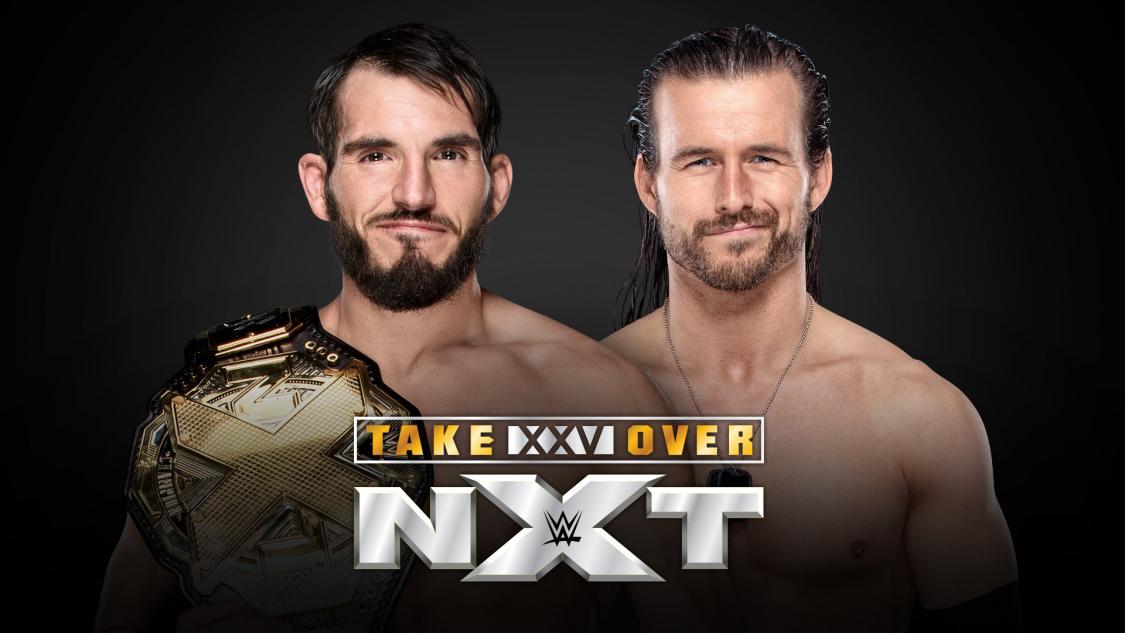
Like any truly great quote, it’s a bit over the top, but her message is true. No matter what Johnny Gargano does on Saturday, it’s time for his NXT run to end.

There’s a reason that most people like an artist’s early work. Besides being new and fresh, they still have plenty to say, haven’t told all their stories yet, and their gimmicks haven’t become overwrought and cliche. But, even the best artists run out of meaningful things to say. Kanye West’s last three albums have been real bad because he’s just a rich and successful guy now. What’s his struggle? We already heard his story. We’ve already heard Gargano’s story, and that’s a problem.

Minus the War Games TakeOvers, Gargano has been in the main event of the six of the last seven TakeOvers. Even on the one that he didn’t main event, he won the North American title and still closed the show on stage. This is John Cena levels of oversaturation. Imagine if there wasn’t so much time between TakeOvers? What if they ran every few weeks like the main roster did? The internet wrestling hivemind would be coming undone about something like that (and they already kind of are). If the matches weren’t, you know, good (but tiresome and long), the backlash would have started long ago.

So, why is this happening? Did Tomasso Ciampa’s injury and the call-ups of Ricochet and Aleister Black actually send everything into such chaos that they decided to just keep running Gargano out there to close shows? Was he actually supposed to be on the main roster now? The answers to these questions might be fun to know, but they don’t matter. Playing the what if game is fun, but inevitably pointless. For the past few years, all roads in NXT led to Johnny Wrestling and it’s time for something different.

TV Tapings

NXT Breakout tournament finals: Jordan Myles vs. Cameron Grimes

This tournament was a fantastic idea and a great way to introduce a whole bunch of new characters to NXT. I especially liked that not everyone in the tournament was great or is even expected to be great. PWG runs the best independent wrestling tournament every year in The Battle of Los Angeles and every year it’s incredible. I went to the 2018 version and it should be on every wrestling fan’s bucket list. My only problem with it is that it can be too stacked. They bring in the cream of the crop, and only one person can win it. In the past, there has been very little chaff so weird things would happen like Ricochet losing in the first round back in 2015.

What NXT did differently was to include guys that didn’t have a realistic shot at winning which freshened everything up. If people like Matt Riddle and Keith Lee were in the tournament, it would be kind of obvious who was going to be in the finals. But since dudes like BOA, Bronson Reed, and Dexter Lumis were in there, it created a nice dichotomy of talent levels and oh my god I am such a nerd.

Another thing this tournament did was give guys screen time immediately, and it was clear who had a presence and who didn’t. The actual breakout star was Angel Garza who isn’t in the finals, but should immediately be on television regularly. The two guys who advanced are realistically the best choices to put on a live special. Myles has wrestled all over the world and is more than comfortable working in front of a huge live crowd. The same is true for Grimes, a television veteran and as natural a heel as there is. Neither of them had an actual breakout performance so far in the tournament, but if they’re given 10-12 minutes, they could really show out here. Babyfaces almost always win tournaments like this and Myles is the logical pick to win here. 

Main Card

Candice LeRae vs. Io Shirai

It feels good to see a TakeOver with two women’s matches on them. My infallible research tells me the last TakeOver with more than one women’s match was TakeOver Brooklyn II, which had Asuka vs. Bayley and Ember Moon vs. Billie Kaye, almost three years and 15 TakeOvers ago. Unacceptable might seem like an overreaction, but it isn’t. If there is enough talent to have a women only PPV, there surely is enough to have multiple women’s matches on TakeOvers.

The arrival of LeRae as a fully formed character in NXT is long overdue. For too long, she was Johnny Gargano’s wife who also wrestled instead of Candice LeRae, the wrestler who main evented PWG cards. Even if it took awhile to get here, we still got here and I’m so glad we did.

Unfortunately for her, she is running into the fully realized heel and fully leveled up version of Io Shirai, a woman who is so preternaturally gifted that she doesn’t need any friends, and certainly doesn’t need any of us. She is wonderful and she is perfect. You can tell NXT is serious about this because they immediately gave her new theme music after she turned on Candice.

And on Saturday, she is going to do more than turn on Candice; she is going to do everything she can to end Candice. Io winning is a fait accompli. She is more than the genius of the sky. She is the star of stars who is the future of the women’s division in NXT. Candice may put up a good fight, but will be nothing more than a speed up on Io’s road to the top.

NXT North American Champion Velveteen Dream vs. Pete Dunne vs. Roderick Strong 

Guys in this match who have said ‘ain’t no laws when you’re drinking the claws!’ unironically, ranked:

  1. Roderick Strong
  2. Roddy Strong
  3. Rod Strong

As they say on the internet, that’s it. That’s the list. This match, more than any other, shows the difference between NXT and the main roster. This match would never happen on the main roster mainly because this collection of characters would never exist on the main roster. 90% of the guys on Raw and SmackDown are just various shades of gray. They all blend together, and very few stand out. The standouts are the ones who really stand out: The New Day. Bray Wyatt. R-Truth. They all do something so different than everyone else.

Kevin Owens is playing a face battling against the bad authority figure, just like everyone else in wrestling history. Even Daniel Bryan, one of the greatest wrestlers of all time, was part of the same story idea. Those two elevate that blase level of storytelling because of their talent, but not everyone can do that. NXT allows the characters to breathe. They let even a cookie cutter character (Roddy) be themselves in some way. They’ve invested in the characters so the audience will invest in them. It’s not that hard.

I realize that whenever I write up a Dream match I inevitably talk about character, but that’s the entire point of him. He’s a larger than life character that just happens to be a wrestler. Just because he’s larger than life doesn’t mean he’s unbelievable. We’ve seen him establish himself as something serious (his match with Aleister Black) into a true champion, and it’s been a fun ride. Roddy has tread a similar path in his own way, going from a happy-to-be-here family man, to turning on his tag team partner so he can hang out with his bros in the back of freight trucks.

Even Pete Dunne whose emotions range from ‘angry’ to ‘more angry’ is showing signs of being more than that. Did he leave NXT UK because he couldn’t beat WALTER? Did he leave because he wants to payback Roddy for turning on him? Or did he leave because North America is bigger than the UK and he wants a bigger stage? We don’t know yet, but the seeds to develop those aspects of his character are there.

It kind of makes sense for Roddy to win here and for the Undisputed Era to leave with the belts. If he loses here, that’s two TakeOver losses in a row and it would be hard to rationalize him getting another singles match during the fall TakeOver. Dream doesn’t need this particular belt, and if Pete is sticking around NXT proper, he and Roddy would have a banger of a match at any point in the near future.

NXT Tag Team Champions Street Profits (Angelo Dawkins and Montez Ford) vs. The Undisputed Era (Kyle O’Reilly and Bobby Fish) 

The Profits finally winning gold, and celebrating in the crowd was one of the best moments of the year and they’re following that up by leaving NXT. This is the second time in a row that the NXT Tag Champs have left for the main roster before formally dropping the belts. I suppose that kind of thing comes with the territory when we are watching developmental. One of the reasons it works so well is that acts typically cycle through, keeping the card fresh. But can we please just leave the good tag teams in NXT so they can actually wrestle? I was real excited to see Montez Ford confront Drake Maverick about not having sex with his wife on Monday. We live in the stupidest time in human history. Imagine watching Ford this week and not seeing the biggest star in the company? The promo he cut was just spot on and proved he can cut any type of promo they ask of him. He’s turning drinking milk out of a solo cup into must see television.

If this is the end for the Profits, it makes sense for them to drop the belts to Fish and O’Reilly, two incredibly good workers who can make anyone look good. The tag team division in NXT is a bit thinner that it has been in awhile. Using Fish/O’Reilly as pseudo gatekeepers while new face tag teams get built up will make for a lot of fun. The only team with a believable shot at taking the belts are Oney Lorcan and Danny Burch, two dudes who can really go but seem destined for a mid-card run at best. All that matters is that MY president Kyle O’Reilly is walking out of Toronto. I know he’s Canadian but I don’t care. Our world is falling apart and only Kool Kyle can save us.

NXT Women’s Champion Shayna Baszler vs. Mia Yim

The second women’s match on the card is also the second most exciting women’s match on the card. I guess thems the breaks when Io Shirai achieves her final form and Candice LeRae is finally given the platform she deserves.

We are supposed to buy into this idea that Shayna Baszler is scared of…Mia Yim. Shayna Baszler, the forever NXT Champion, the SHOOT BADASS, is afraid of Mia Yim? It just does not compute. There is a disconnect in this story somewhere and I just can’t quite place it. I don’t think the dialogue has done her any kinds of favors. The line “game recognize game and you look real unfamiliar right now” was supposed to sound tough, but it just came across as all sorts of cringey. I mentioned it last time when I said Yim just isn’t for me. She is very good and very talented, but she just doesn’t get me excited to watch her.

On the other hand, Baszler is very much for me, but she is also very much not for a lot of people. She only wrestles one style, and that style isn’t exactly over the top exciting. Her presence and her character continue to carry her matches. The same issues that plague Gargano could theoretically apply to Baszler as well. She’s been the fulcrum of the women’s division for years now. The story they’re telling is one that leads to a believable win for Yim. The crowd is behind her, but I just can’t help but think she’s not the won to send Baszler out of NXT.

It took a Mae Young Classic winner (Kairi Sane) to take the title from her once, and Yim just isn’t quite there yet.

NXT Champion Adam Cole vs. Johnny Gargano: Two-out-of-three falls match

Here we go again. In the words of Ric Flair, “One more time, I’m gonna show ya how to do it.” Did I rework this intro more times than I want to admit just so I could shoehorn that reference in there? You know I did but that doesn’t make it any less true. Before WWE got real horny for two-out-of-three falls matches for the past month, NXT established that type of match as the ultimate payoff to a feud. It’s just real strange because…they already wrestled this match in April. If people are already tired of Cole and Gargano wrestling each other, letting them wrestle what is essentially three small matches at once is an interesting choice. This has to be the end. This has to be it. It’s high time for a new babyface to hang out at the top of the NXT card.

This is going to be the shortest capsule I’ve ever written about a main event on a TakeOver. Everything that needs to be said about Cole/Gargano has already been said, and already been seen. The match will objectively be good, but is it actually going to be something that you just have to see? I just can’t see it. Much like I just can’t see a world where Gargano somehow closes the show as NXT champion again. We don’t need anymore vignettes. We don’t need to know how much this means to him. We know it does. We don’t need to see a legacy cemented because it already has been. We know his story, and it’s time for something else. 

Curt Stallion Q&A on his influences, goals, and favorite moments

During EVOLVE’s 10th anniversary weekend, our JJ Williams caught up with Curt Stallion on how his career got kicked off, some of his favorite matches, and his goals for the future

JJ Williams: Where are you from and what got you here?

Curt Stallion: I grew up in Crane, Texas. You can Google it for perspective. I was a juvenile delinquent that graduated high school at the very bottom of my class, yet was in the top 5% for academic testing scores out of the entire school district. I was bullied as a preteen for being white in a Mexican dominated community. That is, until I started to fight back. 

Outside of grade school, I’ve been shot at, had guns to my head, knives at my throat, and partook in more street fights than I care to recall, more than often pitting me against more than one person. I’ve got more dead friends than most anyone I know and I’m definitely not bragging about it. I’m a firm believer in honesty and being true to oneself, regardless of circumstance.

JJ: What lured you into becoming a professional wrestler?

CS: Professional wrestling captivated me at an early age during a time when I was so conflicted about growing up and what my life would become. With assumptions of working the rest of my days away in the oil fields like everyone that came before me in Crane, Texas, my aspirations and goals seemed limited and, even worse, not my own. That’s where pro wrestling came in and changed everything. I knew my life needed professional wrestling because I’m not wired to be a robot and the oil fields were too life consuming for my tastes. Being programmed for oil production did not work on me because I knew from the time I was ten years old what I was going to dedicate my life towards. There were many speed bumps along the way, but here we are now.

JJ: When did you start training?

CS: I got a call from my friend Cristobal Salcedo one day telling me that I need to cancel my plans of going to a tech school and move back home because he found a pro wrestling school a mere thirty miles away. I legitimately packed everything and a week later, I was home and training with Old School Wrestling in Odessa. Texas, under the late great Fred Urban III and Jastin Taylor. This was in October of 2012. My first match in front of a live audience was on July 20th, 2013, in Andrews, Texas.

JJ: Who are some of your biggest influences?

CS: On screen, Goku, Han Solo, Randy Orton, Katsuyori Shibata, Chris Benoit, Eddie Guerrero, Stone Cold Steve Austin, Shawn Michaels and Triple H. In person, ACH, Michael Elgin, Matt Riddle, Kyle O’Reilly, Silas Young, Mark and Jay Brisco, Rey Fenix and Pentagon, and even though he’s younger than me, Trevor Lee.

JJ: What are some of your favorite moments of your career thus far?

CS: My first big match and that it was against ACH, my first round trip flight being bought by ROH, being in the 2017 ROH Top Prospect Tournament as well as making it to the semifinals and getting to work at the Manhattan Center in NYC, Paul Turner taking me up to the Hammerstein Ballroom where the first ever Monday Night RAW took place was the cherry on top of that night too.

Being in the first class of the NJPW Los Angeles Dojo under Katsuyori Shibata, Rocky Romero, and Scorpio Sky in March of 2018, wrestling one on one with former ROH TV Champion Silas Young in San Antonio, Texas, at the Aztec Theatre in front of friends and family, signing with EVOLVE, wrestling live on the WWE Network for EVOLVE in the famous 2300 Arena in Philly on my 29th birthday, and wrestling Matt Riddle for EVOLVE in Boston the day after the WWE Network special.

JJ: After all of that, what are your current goals?

CS: Gain some weight, PWG, work overseas in the United Kingdom, Australia and Japan, bring professional wrestling to prominence in places it doesn’t have much viewership, sign with WWE, and main event WrestleMania.

You can follow Curt on Twitter and check out his shirts on Pro Wrestling Tees.

NJPW Best of the Super Juniors 26: The must-see matches from 2019

Image: NJPW

There were 88 matches over the course of 15 nights of action in this year’s NJPW Best of the Super Juniors 26 tournament. But if you’re planning on catching up or want to do a binge watch, you certainly don’t need to watch all 88.

Through my coverage for the website, I watched everything and give you my best of the best in order of when they happened (with spoilers).

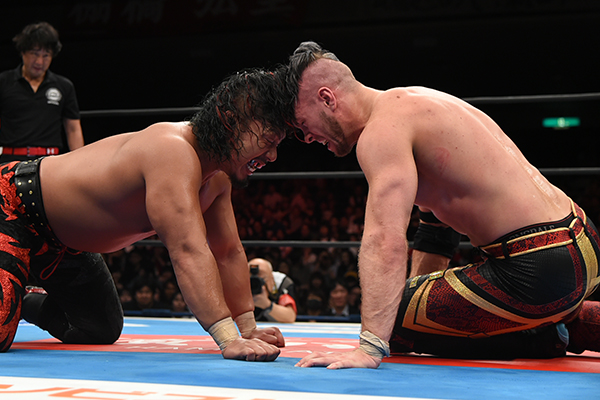
Night 1: Shingo Takagi vs. SHO

The semi-main event stole the show on the first night of the tournament. SHO kicked out of Shingo’s Pumping Bomber twice, but had no answer for Last of the Dragon. 

Night 4: Robbie Eagles vs. Ren Narita

Eagles and Narita faced off in Narita’s hometown of Aomori on night four. Narita had his parents in attendance, and there were signs passed out to the crowd to support him. Eagles ultimately won with his secondary finisher (Turbo Backpack) but not before the competitors had the crowd believing that a Young Lion could pull off the upset. 

Night 4: Will Ospreay vs. Rocky Romero

The main event on this show was Ryusuke Taguchi vs. DOUKI. DOUKI. He had no hopes of following Romero and Ospreay who tore the house down for more than 25 minutes. 

Night 8: SHO vs. Marty Scurll

SHO makes his second appearance on our list, this time with the leader of Villain Enterprises. They went on in the middle of the lineup, but had a match that would not have been out of place in the main event spot on most shows. In most tournaments, this would have been a best match candidate. Instead, they just had a great match on a great night of action. 

Night 8: Will Ospreay vs. Bandido

This was everything you would expect from two of the top guys in the world. Both are on the cutting edge when it comes to innovating moves, and they delivered a state of the art performance in the semi-main event. 

Night 8: Shingo Takagi vs. Dragon Lee

They had the unenviable task of following a Will Ospreay match. Still, the then-unbeaten Shingo and the IWGP Jr. Heavyweight Champion turned in a classic performance in Korakuen Hall. 

Night 9: Will Ospreay vs. Ren Narita

This was the Eagles vs. Narita match turned up to eleven. Ospreay gave Narita a lot of offense, and the crowd in Korakuen absolutely bought a backslide from Narita as a potential finish in the closing exchange. 

Night 9: Shingo Takagi vs. TAKA Michinoku

TAKA’s tournament was cut short due to injury, but not before he turned in a great performance against The Dragon. They worked this as a sprint, going just over a memorable seven minutes. TAKA broke out a moonsault off the post before falling to the Last of the Dragon. 

Night 9: Dragon Lee vs. Titan

It was an up-and-down tournament for Titan. He had some good matches, but also a series of forgettable ones. This one was the former as he worked with a familiar opponent who was well-equipped to work his style. After not seeing him for a couple of tours, I had forgotten, and was reminded, that Dragon Lee is one of the best guys in the business.

Night 9: Rocky Romero vs. El Phantasmo

In what was billed as Romero’s first singles main event in Korakuen Hall, the veteran created a night to remember. They nearly went the full thirty minute time limit before Romero pulled off a bracket-busting upset. Technically, there may have been better matches in the tournament. Emotionally, there may not have been. 

Night 10: Robbie Eagles vs. Will Ospreay

I came into this tournament with one impression of Eagles and left with a completely different one. 

For lack of a better term, I had thought that he was just a warm body that could do a 450 splash. As it turns out, he is as fundamentally sound as anyone and a spectacular worker. If you know the story of Ospreay and Eagles, and how Ospreay got him into NJPW, this probably meant more to you than if you were watching without that backstory. If you watched the last match these two had in Australia, even more so. 

Night 11: Taiji Ishimori vs. Tiger Mask

The psychology of this match was excellent. Ishimori needed a win to stay alive, Tiger knew that, and threw everything he had at him. It felt as though these were two athletes trying to win a legitimate competition. 

Night 12: Will Ospreay vs. DOUKI

By this point in the tournament, I had my mind made up on DOUKI and thought he was easily the weakest performer in the tournament. After his match with Ospreay, I decided that he can be carried. This was just another day at the office for Ospreay, but he probably gave DOUKI the best match of his life. Again, Ospreay stole another show in the semi-main position. 

Night 13: Dragon Lee vs. Marty Scurll

Only Takagi and Ishimori were still alive in A Block by this time. Still, Dragon and Scurll put forth a great effort on the final night of their block. Scurll is very detail-oriented as evidenced by the series of intricate counters, reversals, and teases on display here. While it may not strike you at first, Scurll is also an awesome base for high flyers like Dragon. 

Night 13: Shingo Takagi vs. Taiji Ishimori

Ishimori injured his neck earlier in the tournament in a match with Scurll when he landed awkwardly on a botched move. That injury played into the story of the match. Despite being clearly banged up, Ishimori kept pace with Shingo, and they had a speed vs. power battle for the right to advance to the final. 

Night 15: Will Ospreay vs. Shingo Takagi

They had to follow the debuting Jon Moxley and Juice Robinson who pulled out all the stops and did everything imaginable in their match. Still, they were more than up to the task. Ospreay knocked off The Dragon, won his second BOSJ, and finished one of the best tournament runs of all time, all while cementing his reputation as an elite big match performer. 

The first NXT TakeOver: Where did everyone end up?

May 29, 2014.

No, it’s not the last time Adam Rose won a match. (Well, it might be, but probably not.)

Instead, for only the second time in their then-young history, NXT streamed a live special on the WWE Network. Following in the footsteps of a critically acclaimed NXT Arrival special three months earlier, the stars of developmental geared up one more time for something called NXT TakeOver.

Five years later, TakeOver has become the hottest regular special on the Network. Playing to sold out arenas in Brooklyn, London, Dallas, Toronto, San Antonio, Orlando, Chicago, Houston, Philadelphia, New Orleans, Los Angeles, Phoenix and Bridgeport, CT, this past Saturday, it has become an elite level event.

But, it had to start somewhere.

Full Sail University in Winter Park, Florida, had just passed the two-year anniversary of their relationship with WWE and believe it or not, once upon a time they not only had trouble filling that tiny little arena, they had trouble even getting people to stay for the entire television taping. Regularly, they would give out far more tickets than available since many free ticket holders didn’t even bother to show up. That would eventually cease to be an issue.

Now that 25 TakeOvers are in the book, what better time to go into the Wayback Machine and look at the very first TakeOver event and what eventually happened to the 12 men and women who graced the ring that night? 

Adam Rose pinned Camacho in 5:08
(Dave Meltzer’s rating: *1/4)

Rose was the repackaged Leo Kruger, who had just debuted on the main roster in a gimmick that didn’t have much of a chance; a more talented version of No Way Jose with only slightly more credibility. He would eventually turn heel and form the Social Outcasts with fellow NXT failures Bo Dallas, Curtis Axel and Heath Slater before requesting his release in May 2016 following an arrest for domestic abuse. The charges were later dropped and Rose continued working independents for the next three years. He has since announced his retirement with his final match set for mid-June 14 against fellow NXT alum Bull James (Bull Dempsey).

This may not have been Rose’s last win, but it was the last televised match for Camacho who got fired that June. He spent a year in TNA before crossing the Pacific Ocean to join New Japan as Tanga Loa. He has since become a five-time IWGP tag team champion, a 3-time NEVER Openweight 6-Man tag team champion, and an ROH tag team champion. Needless to say, he is one of the successes, albeit inadvertent, coming out of this show.

With that said, the biggest stars in the match were not the people inside the ring, but a few of them outside the ring. As mentioned, Rose was the original No Way Jose and with it came his own band of weirdly dressed misfits who just happened to be a lot of developmental wrestlers and a few random locals. Mixed in with Justin Gabriel in a bunny suit and Simon Gotch, you also had Braun Strowman, Alexa Bliss, and one of only two people on the entire show to be in the main event of WrestleMania: Becky Lynch.

NXT Tag Team Champions The Ascension defeated El Local & Kalisto in 6:17
(Dave Meltzer’s rating: *1/4)

Oh, The Ascension. They were tag team champions for an entire year, which sounds sort of impressive until you realize they literally were the only team in NXT for over six months. They had a weekly gimmick where they would issue an open challenge to any team in the world, which was usually just two random developmental guys teamed up. Long forgotten is that they also had a win over Davey Richards & Eddie Edwards and the hardest thing to believe, especially given how WWE is now, is that they didn’t offer contracts to either man, who eventually both went to TNA.

The Ascension got called up in December 2014 and it’s debatable whether or not they had the talent to go anywhere, but it can be argued that they were sabotaged from the start as the announcers were instructed to bury them from the word go. It didn’t help that they were scripted to mock the Legion of Doom which got the wrong kind of heat with a lot of people, especially those who should have known better. They would go on to be poster boys for NXT failures. Even more insane is since they teamed with Cody Rhodes to win a six-man tag on the 2015 Night of Champions pre-show, they have only won three matches as a team. At this point, neither has wrestled since the night after WrestleMania 35 where they lost a WWE Main Event match to Heavy Machinery.

El Local is a name that probably won’t ring any bells, but you know him better as Ricardo Rodriguez. After finishing up his run as the ring announcer for both Alberto Del Rio and Rob Van Dam, Ricardo donned a mask and tried to take over the NXT tag team division. That didn’t work out and he was released two months later.

Kalisto had a bit of success after forming a team with Sin Cara. They were NXT tag team champions as the Lucha Dragons and had a decent run on the main roster. Kalisto would go on to become a 2-time U.S. Champion (including defending the title at WrestleMania) and cruiserweight champion.

Tyler Breeze pinned Sami Zayn in 15:54
(Dave Meltzer’s rating: ***1/2)

In some ways, Breeze’s run on the main roster is an even bigger disappointment than The Ascension’s. In NXT, he was a top of the card heel, almost always in the NXT title picture, and was the one chosen to face Jushin Thunder Liger when Liger came to NXT for that one-off performance.

Breeze would have one great match after another with just about everyone on the roster from Zayn to Neville to Finn Balor to Hideo Itami. After being called up to the main roster, he had a brief fling with Summer Rae and proceeded to go nowhere for over three years. The only whiff of success he had was when he formed a team with Fandango and was part of a seven-month long storyline in 2017 that paid off by being squashed by the Bludgeon Brothers. Can he reclaim what he had with his return to NXT?

Zayn was NXT’s Daniel Bryan: an incredibly talented, incredibly well liked, main event loser. He lost far more often than he won, but his failures and the story of him overcoming those losses made him even more beloved and sent the NXT crowd into a tizzy when he finally won the NXT Championship. He has had a decent amount of success on the main roster, but seems to lose his momentum with multiple injuries. However, he has wrestled on the main card of two WrestleManias, including in a top match at 34 when he was part of the aforementioned Bryan’s return match.

Before the next match, Lana came out and introduced Rusev to the world. He had just joined the main roster and began his year-long undefeated streak. As Lana put Vladimir Putin over, they were interrupted by beloved babyface Mojo Rawley. Mojo challenged Rusev to a fight, ran to the ring…and Rusev laid him out quite easily. Mojo couldn’t have been a bigger loser and even his biggest win on the main roster (the 2017 Andre The Giant Battle Royal) only happened so they could get on ESPN following Rob Gronkowski’s inclusion.

In the finals of the NXT Women’s Title Tournament, Charlotte (w/Ric Flair) pinned Natalya (w/Bret Hart) in 16:54
(Dave Meltzer’s rating: ****)

This is not to be confused with the 2016 embarrassment when they had the same match on the main roster and made Bret Hart stand at ringside as they re-enacted the Montreal Screwjob in front of him. Without exaggeration, this match, more than any other, is what led to the women becoming main event stars. Yes, Paige and Emma already had their match, but that was a better-than-average match in a world where WWE women’s matches were unimportant three minute affairs. Even when they would have a great match (see AJ vs Kaitlyn at Payback 2013), it led to nothing. This match led to change. Every great NXT woman’s match you saw since is a direct result of this match. On this night, it was the perfect match in front of the perfect crowd. You had Bret and Ric down there to add star power and while Ric was insane, he didn’t steal the spotlight from the girls.

Charlotte would go on to become one of the best women’s wrestlers on the main roster, having a two-year long PPV winning streak and winning nine women’s titles before main eventing WrestleMania against Becky Lynch and Ronda Rousey. Natalya has had an 11-year (and counting) career on the main roster and while it can be argued that she should be used better, she has been a Divas Champion and SmackDown Women’s Champion.

There was a long forgotten plot hole with this match. Paige had been WWE Women’s Champion, but had been stripped of the title by GM JBL because no one could handle the schedule of being on the main roster and NXT at the same time. The problem is the ensuing tournament featured four women from the main roster…and Natalya had reached the finals. Using prior logic, if Nattie had won, she then would have been stripped of the title to set up a new tournament.

NXT Champion Adrian Neville pinned Tyson Kidd in 20:55
(Dave Meltzer’s rating: ***1/2)

With his career floundering on the main roster, Kidd moved to NXT for six months to refresh himself. In that time, he turned heel and became a top- evel star. He would return to Raw and SmackDown that fall, forming a team with Cesaro. However, just as Kidd started getting his biggest main roster push, tragedy struck as he was badly injured in a dark match with Samoa Joe. Kidd would be forced to retire, but continues to work with WWE behind the scenes.

Neville would go on to have a bizarre run on the main roster. He debuted by losing his first name while gaining a cape. He would go back and forth on either coming close to superstardom or being a forgotten member of the undercard. Despite his push (or lack thereof), he was always one of the more popular wrestlers. Even during his run in cruiserweight purgatory, he is the only champion to consistently get main roster crowds to react to his actual matches. However, cruiserweight purgatory is still cruiserweight purgatory and he joined the list of people to leave WWE instead of being the king of 205 Live. Of course, we know the story these days and he has since gone back to being PAC and is the current Dragon Gate Champion.

**********

The last 90 minutes of the show were especially well received as you can imagine, and it is one of only a handful of shows to receive a 100% thumbs up reaction in the subsequent Wrestling Observer Poll. Out of the 12 people to wrestle on the show, six of them went on to have bigger and better careers in wrestling, whether on the WWE main roster or worldwide

24 TakeOvers and 121 matches later, we have seen dozens of legendary matches and memorable moments which continues today and into the future. Where will the stars of this past weekend be in five years? It’s impossible to tell, but if history is any indication, it will still be just interesting to see what paths they take.

NXT TakeOver XXV preview: Gargano vs. Cole, Baszler vs. Shirai

Welcome cats and kittens to yet another NXT TakeOver preview. Saturday’s show comes to us LIVE from the beautiful, scenic, city of Bridgeport, Connecticut: a locale so beautiful and so picturesque that it’s not even in the title of the event.

Things are just a bit rushed this time. Part of that is because there was less time between events, part of it has to do with some unexpected roster changes, and part of it is because this is a standalone event, one not attached to a massive PPV weekend. Tickets didn’t even go on sale for this until the second week of May when TakeOver during SummerSlam weekend already has tickets on sale.

While it feels rushed, that isn’t to say the quality is going to be bad or that the card isn’t strong. NXT has proven that they produce the consistently strongest live specials of any brand under the WWE umbrella.

Every title is on the line, a returning hero comes back to NXT, plus Johnny Gargano and Adam Cole have another chance to make magic in the main event. There is tons to look forward to as always, but there just hasn’t been as much time to be excited for the card as others. So, like we always do at this time, let’s run through the main card.

Matt Riddle vs. Roderick Strong

I am, admittedly, probably a bit too excited for this match, even though it’s nothing but filler; incredibly well-wrestled filler, but still filler nonetheless. Roddy is not everyone’s cup of tea personally, or in the ring, but I don’t think anyone can argue with his ability as a worker. His matches might not resonate, but he can really, really go in there. If this opens the show, it should look a lot like a 12 minute PWG sprint, and in no way is that a bad thing.

The story for the match is there, but it’s flimsy and kind of doesn’t matter. This is just going to be a showcase for Riddle to look great, Roddy to look great losing, and to allow for Matt to move on to a feud for the big boy belt. It doesn’t matter who comes home with the title in the main event, because Riddle can easily feud with either. If Cole wins, Riddle can continue his feud with the Undisputed Era and come for the belt. If Gargano retains, Riddle’s right there to be a more aggressive Bro and challenge him.

That’s what makes him so great. He plays such a neutral characte  that it doesn’t take a large switch in character to fit into either the face or heel dynamic. Small tweaks in aggressiveness, word choice, and tonality let him exist on either side of the aisle. There doesn’t seem much reason to keep him down in NXT. Heck, he might not need an NXT title run before he tries to retire Brock.

Ladder Match for the Vacant NXT Tag Team Championship: Undisputed Era vs. The Street Profits vs. The Forgotten Sons vs. Oney Lorcan & Danny Burch

This is definitely a match that was planned out far in advance and is in no way of scrambling after the Viking Experience/Raiders/Whatever got called up to Raw in order to not be used on Raw. Great. Awesome. Cool ‘sport’ I’m following over here. Things like that make it so much harder to invest in these characters only to see them fall by the wayside once they leave the safe space of NXT.

The main roster really is the Sunken Place of WWE, which is really unfortunate considering it is 90% of WWE. It’s becoming harder and harder to get really invested in NXT talents if they are going to go up to the main roster to just do nothing. It’s the equivalent of watching Judd Apatow movies. Most of them are really good for the first two acts, but when the third act comes around, they lose the audience and kind of meander.

That’s what happens when wrestlers go to the main roster. They just kind of do nothing. They might exist, but they have no purpose, and it’s actually sad.

Ladder matches always rule and this one will rule. Three out of the four teams in the match absolutely rule, and the other team is the absolute dirt worst. I enjoy lists more than any well adjusted 33-year old man should, so here is my super official rankings of how much I enjoy the teams in this match with some hard hitting analysis:

  • The Undisputed Era: Perfect assh*les, incredible workers, an absolute delight.
  • Street Profits: Montez Ford is incredible, more on him below.
  • Lorcan and Burch: Two great performers with undeniable energy.
  • Forgotten Sons: How are they actually this bad?

This is a great opportunity to reset the tag division to set up the rest of 2019, and I can’t think of a better team to lead that division than the Street Profits. Ford is a SUPERSTAR in all capital letters, and is someone who the company should be planning to build around. He and Bianca Belair is an unfairly beautiful and talented couple. He has everything you want out of a modern wrestler. He has the look, personality in spades, and is still getting better. What more could you actually want? He is a fantastic example of the relationship between NXT and EVOLVE working together. He got to work a whole bunch of different matches and styles in EVOLVE and that really shows in his performances. Angelo Dawkins is there too.

The first three teams listed above all have a case to take the belts. The Sons are the rare example of an NXT misstep happening at the top of the card. If they actually hopped on a rocket destined for the sun, I don’t think anyone would even notice or care. I like the Profits to take this one and look forward to the Montez Ford Experience getting bigger and better every week.

NXT North American Champion Velveteen Dream vs. Tyler Breeze

Honesty and transparency is paramount in any relationship, but none more important than the one between an Internet columnist and his audience. Here is my honest confession: Tyler Breeze has never been my bag, baby. It’s one of those situations where you can recognize something is good, but just fundamentally not for you. A good example of this outside of wrestling is Forrest Gump. Forrest Gump, objectively, is a very good movie. A great movie, even. It won six oscars! And, I absolutely hate it. It’s not for me and is not for my brain. My brain is not wired to truly enjoy something like that.

Not everything is for everyone and, like I find myself frequently saying, that is okay. Not everyone likes the same things, nor should they. It’s the differences that allow for individual types of fandom to exist, and without those we would be in a society where everyone thinks, feels, and wants the same things. That is not ideal. Me being super excited about Matt Riddle and Roddy more than this is my personal preference, one that is admittedly a bit odd, but still my preference. I was just never invested in the story of the Breeze character and performer, all the while respecting and appreciating the story of Breeze, the character and the performer.

If Breeze was ever going to come back to NXT, there isn’t a more tailor-made opponent than Velveteen Dream. Two of, if not the most, NXT characters in the history of the brand: a male model consumed with being better than everyone and a Prince impersonator that wrestles like it’s 1989 all over again. In a vacuum, it’s perfect. Breeze is one of the first larger than life characters NXT ever had, and Dream is arguably the most over the top character they’ve had. Trying to accurately define or even describe him is truly a challenging task. It says something when Dream can make the ‘hillbilly swamp cult leader’ gimmick look relatively normal by comparison, but that’s wrestling in 2019. What a time to be alive.

Since it’s WWE, it’s not immediately clear what Breeze’s status actually is. Is he full-time in NXT? Is he only down for this match? Is he only down for a few months? It would be cool if he came back down and stayed, but doesn’t that kind of defeat the whole purpose of this being developmental? Not to be a wrestling fan on the Internet, but isn’t he ‘taking the spot’ of one of the many guys they have just waiting to start? (Editor’s note: HHH said this week Breeze is full-time with NXT.)

My personal preferences aside, this story is good and they’ve done a great job making me care. The video package that ran on this week’s NXT was wonderful, as they so often are. It would make a ton of sense to have Breeze win and give a sense of legitimacy in his return to NXT. It would establish that returning stars are exactly that, returning stars. I just don’t think it’s time for the Dream to be over, so the Dream needs to go over.

NXT Women’s Champion Shayna Baszler vs. Io Shirai

I’m pretty confident saying that we have reached critical mass when it comes to Baszler and her run at the top of NXT. As much as I love her and as great as she’s been in NXT, it’s high time for her to move on. She has dominated the women’s division since she debuted at the end of 2017. That’s like 18 months of the same person at the top of a division without a long standing rivalry. Sure, John Gargs and Tommy Champs were at the top of NXT for what feels like the past decade, but that is the exception rather than the rule.

I get the idea of keeping Baszler around to try and to establish Marina Shafir and Jessamyn Duke. That would make sense…if it had worked. But those two are, unfortunately, completely devoid of heat and still, quite clearly, green in the ring. I also get the idea of keeping her around if there was a big babyface to build up who would eventually beat her and ascend to the top of NXT. But they haven’t done that either. Did they not think anyone was ready? There’s just no way that’s true, not with all the female talent on the roster. I guess I’m a bit confused about the why of things in this case. None of this is to say the decision was wrong, but I couldn’t get this out of my head when I was writing this preview.

Io Shirai is ready. She was ready before she came to NXT, and certainly doesn’t need a dude on the Internet to say that. But it was an easy transition sentence so here we are. She needed no grand introduction to the NXT audience and no extra pomp and circumstance. She arrived as a fully formed final boss. The genius of the sky deserves every accolade she’s garnered over the course of her career, and then some. She can usher in the next generation of women in NXT and bring them to new heights.

It’s been time for Shayna Two Time to be done with NXT. There is a shocking lack of female heels on the main roster, and if she’s not going to slide into one of those spots now, when will she ever? I’m kind of sick of writing that last sentence as it seems like I’ve written it ad nauseum in just about every TakeOver preview that she was a part of. If she doesn’t drop the belt here, when will she ever drop it? It’s time and it’s been time for awhile now.

NXT Champion Johnny Gargano vs. Adam Cole

I can’t quite put my finger on why, but I’m not exactly over the moon excited for this title match. It feels weird to say that, especially with how great their match at the last TakeOver was, but maybe I can get there by typing a whole bunch of words into this Google doc? Sound good? Okay, great. Let’s go.

A lot of the problem is ‘Johnny Champion’. I’m not used to seeing him on top. For his entire NXT career, he’s been chasing: a roster spot, chasing a title, chasing Tomasso, chasing something. This is a new version of Gargano where he doesn’t have to chase anything, because all the somethings are chasing him. He’s the king of the NXT mountain (shout out Jeff Jarrett). He’s the top guy and everyone has to come for him.

Let’s be real about something. The chase is always the best part. It’s ingrained in our nature to crave the chase, to want the challenge. It’s why we change jobs, change relationships, and root for the underdog. It’s the allure of something new and exciting. We don’t want to see Johnny keep the belt, we want to see him chase the belt. As I type that out, I’m realizing that’s what my issue with this match is. I’ve been so used to seeing Gargano fight from the bottom that I don’t know how to see him at the top. Wow. That felt good. Thank you all for being a participant in my therapeutic process.

Cole has been a consistent top of the card presence since he debuted last year. He has always felt like more of a star than any of his actual achievements. Sure, he won the first North American championship but it feels like more, doesn’t it? Part of that is because of how present The Undisputed Era has been all over the card, and part of that is because of how much Cole carries himself like an absolute star. He was born to play this type of heel, this type of over the top jerk. He was dropped into NXT fully formed in this role and has excelled in it. Giving him the title won’t validate him, because he doesn’t need it, but it sure will give him something else to gloat about.

Does it make sense for Gargano to lose his title in his first defense? Probably not. But if Cole doesn’t win here in his second consecutive title match, what does he do? If Undisputed Era is really coming for all the belts, shouldn’t it start with their leader? Shouldn’t he be the one to lead them on their quest for every NXT title? Maybe. Probably. I don’t know. Hot potatoing the title is something NXT has done a good job avoiding in the past, and having three different champions to close out the last three TakeOvers probably isn’t the best idea. Look for Gargano to retain in another 25 minute near classic.

Mike DellaCamera is a sometimes writer, frequent technology consultant, and always hungry. You can find him on the Internet, tweeting infrequently @_DellaCamera

Viceland’s Gino Hernandez documentary a strong and mysterious watch | Opinion

As the Dark Side of The Ring mini-documentary series on Viceland prepares for its finale this week, last Wednesday featured one of its strongest, and most mysterious, efforts to date: the life and death of WCCW star Gino Hernandez.

Other than hearing his name frequently through the years, I went into ‘The Mysterious Death of Gorgeous Gino‘ with virtually no knowledge of Hernandez’s backstory or even how he died. Coming out of the near 48-minute feature, that story and the questions around his death feel like they deserve a deep dive Serial-style podcast series.

What’s In This Thing?

The first 15 minutes of ‘Gorgeous Gino’ are electric. After a tease about odd circumstances around his death, we meet Hernandez’s mother, Patrice, and his sisters who flip through some photos and joke about how hard it was to see their brother as a heel. It may sound odd to call his mother the star of the documentary, but she was. Even 30 years later, the pain of losing her son is still front and center and to hear the state in how the single mother lived her life since his death is painful, yet understandable.

The Viceland team did a really good job here getting the right people to talk about Hernandez’s past in Jake Roberts (who tagged with him), WCCW promoter and referee David Manning, Bruce Prichard, and Jeanie “Lady Blossom” Clarke. They all add different perspectives at different points of his young life. As Roberts alludes to, it is wrestling so you’re always searching for the truth but as a viewer, you don’t feel like you’re being fed a total line of b.s. by any of them. Maybe I’m just naive though.

What struck me was how much Hernandez (born Charles Wolfe) comes off like a dark haired Ric Flair with the suits, the cars, the promos, and the women. Manning puts him in the promo category with Flair and Michael Hayes, adding that he truly lived the gimmick in and out of the ring. 

We eventually meet both his first (and only) wife, Janice, and their daughter, Lisha. This was another good get for the Viceland team as they provided another non-wrestling person to relate was it like to have a home life with a budding wrestling star. The stories are what you would expect, but they help illustrate how quickly things went downhill and why.

As you might expect, Hernandez met drugs which eventually took him down the road to his unfortunate demise. Manning describes a scene in Las Vegas where he saw Hernandez with some unsavory characters that become part of the eventual mystery, enhanced by Roberts who is reluctant in answering a question about those men, only to say “some dangerous and powerful people.”

We learn about Hernandez’s growing paranoia, his desire to own a gun, and his mother describing what happened the last time she saw him. Eventually, he was found in his apartment in February 1986 after being dead for nearly five days, suspicions raised after he missed two bookings and went missing.

This is where the mystery truly begins and questions about unlocked deadbolts, incorrect police reports, and suspicion of a staged death come bubbling up in the aftermath. 

There’s a lot to sift through but essentially the story comes down to this: did Hernandez simply overdose on way too much cocaine or was he murdered by someone involved with this heavy crowd he was hanging with? His mother tells of a man (John Royal) that comes over to the house after Hernandez’s death and says that while Hernandez owed him a lot of money, he was going to pay for his funeral. She said she was scared to death following the conversation which led her to fear reprisal for something she wasn’t involved in. 

Prichard describes the funeral as “weird” with Royal giving a speech about times he and Gino had. The wrestling people there didn’t know who he or any of the “rich people” that attended were, adding to the intrigue. We learn that Hernandez never even had an autopsy because his body was too badly decomposed, but the report of his death and details on that report are fraught with so many errors, it caussed his ex-wife to question whether he staged his own death. As his mother said, everything was guarded around his death which was strange.

After more conspiracy theories and a funny story about how Chris Adams was suspected by fans due to a heated angle at the time, Viceland completes the great interview trifecta by tracking down Royal himself, somewhat fresh out of prison after serving time due to drug related matters. He admits to paying for the funeral, but denies that Hernandez ever owed him money. He said the last time he saw Hernandez alive was at the club that night when the 29-year-old left with some airline stewardesses. He denies being involved and says that at his trial, it was fabricated that he gave Hernandez drugs. He could be lying, but the interview is over the phone, making it hard to read body language.

We then get a bit of a surprise in an anonymous drug trafficker that supposedly was involved with Hernandez. We have to trust the filmmakers that he is legitimate as he drops some news that is pretty key to the whole sordid tale. In an interview first played for his mother, the trafficker says Hernandez started taking drugs recreationally, but they “got a hold on him” and that his death was probably due to a mix of drugs and alcohol. He tells the mother to not being concerned as the situation wasn’t of her doing which puts her at ease. This is enough for her as she appears relieved with this answer and satisfied that his death wasn’t a murder. Others in his life probably don’t agree. 

What’s Missing?

Not a lot. I would have liked to go a bit more in-depth into the circumstances around the bizarre police report, but given the time constraints and its relevance to the story, I get what that didn’t happen. (Podcast anyone?)

Should You Watch It? 

Yes. Even if you’re a Hernandez newbie like me, ‘The Gorgeous Gino’ will give you everything you need to know about a story that truly is one that belongs to pro wrestling.

From All-Star through AEW: The history of pro wrestling on ITV

By Bradley Craig, British wrestling historian and author exclusively for F4WOnline.com

The presentation of All Elite Wrestling’s Buy In pre-show and its Double or Nothing pay-per-view marks British TV network ITV’s latest foray into professional wrestling.

Its last, launching World of Sport Wrestling as an in-house entertainment brand, was its first actual attempt to provide its own content. Unfortunately, the viewership rapidly declined over the course of its first series, and it appears that outsourcing is the direction that the network is looking to pursue through its broadcasting of an AEW product.

But, ITV has a long and established history of working with external wrestling content providers. 

Domestically, the channel partnered with Joint Promotions and later All-Star Wrestling to provide its content. However, the broadcaster has worked with global brands for its wrestling output, including stateside promotions such as WWE and WCW. 

Paving the way for commercial television throughout British shores, Independent Television network (ITV) was launched in 1955. Upon its inception, the channel was tasked to produce viable programming in competition to the BBC television service, and was the only alternative for viewers at the time. As Joint Promotions was formed as a monopoly wrestling organization in post-WWII Britain, it was inevitable that its status as the clear market leader would provide it with the greatest broadcast opportunities upon the advent of television. 

ITV quickly established a partnership with Joint, and their first collaborative broadcast of pro wrestling was held on November 9th, 1955. Eventually, this would lead to a weekly diet of matches by 1960, most notably on Saturday afternoons as part of a cluster of sports programming called Let’s Go. The coverage was a ratings success, the high point of which was a famed May 25, 1963, rematch between rival heels Mick McManus and Jackie Pallo, held on the same day as the FA Cup Final (the culminating match of the most prestigious knockout soccer tournament in England) which some insist to have attracted a television viewership of 16 million viewers. 

Within a few years, the Saturday afternoon schedule of ITV sports coverage was reconfigured. From January 2, 1965, the channel debuted World of Sport, a variety sports show that would continue to showcase professional wrestling as a regular fixture. Similar in format to ABC’s Wide World of Sports in the United States, it would remain an institution for domestic wrestling fans until its eventual cancellation on September 28, 1985. Nevertheless, professional wrestling would remain a part of ITV’s Saturday programming.

The standalone show, simply titled Professional Wrestling, would evolve into a rotation of footage provided by Joint Promotions, All-Star and, from 1987, the WWF (incidentally, one of the advertised matches set for UK broadcast was a match between Bret Hart and Tom Magee). In 1988, the show was axed, ending a tradition of 33 years of pro wrestling coverage on ITV.

After the cancellation of British wrestling in 1988, some regions within the ITV network did showcase other American promotions, but the most prominent of these was its deal with WCW which lasted from 1989-1995. In its early years, ITV was a commercial network consisting of several regional franchisees across the United Kingdom. Within this network, Grampian Television was the local broadcaster for the majority of northern Scotland from 1961 through 2006. And it was on Grampian that WCW was presented for the first time to a British audience with its initial transmission on January 10th, 1990: a Wednesday night at 1:30 AM.

Advertised on local newspaper listings as Superstars of Wrestling, the show was actually a repurposed version of WCW Pro Wrestling, created specifically for the international market. It was contained within a block of programming called Night Time, a nocturnal cluster of shows produced by the Granada franchise of ITV being broadcast to several regions across the network in England and Wales, as well as the Grampian region within Scotland. The shared production output between regional franchisees was essential; it was made in an effort to reduce budgets during their low-viewership late hours. 

A number of changes were implemented to ensure that WCW Pro Wrestling was immediately accessible to the British market during its initial run. Although it retained the same opening sequence and featured many of the same matches, new commentary was recorded by Lance Russell and later Eric Bischoff to specifically remove any references to upcoming PPVs or house show dates being promoted for the domestic circuit. In fact, the commentators would frequently refer to the show as “International Pro”, recognizing that it was an adapted version and not the original syndicated show that was transmitted across the United States. Almost all linking segments were removed, and replaced with additional matches from other WCW tapings.

Despite an unenviable late-night slot, and an irregular broadcast run in which the airing days and start times were frequently shifted, WCW Pro Wrestling was a success. Introducing a new audience to the superstars of WCW, its popularity steadily increased, which led to the inaugural 1991 tour of the United Kingdom and Ireland and opening up merchandise opportunities. 

As a result of the increased brand awareness, WCW was awarded a more regular fixture on ITV.

In addition to its established slot within the Night Time schedule, feedback to some sporadic weekend airings of WCW Pro Wrestling had been well-received. In response, the network had decided to give WCW the timeslot which was once synonymous with wrestling during the era of World of Sport. 

On May 29, 1992, WCW made the transition to late afternoons every Saturday with each episode usually starting around 3:50 PM and finishing before the release of the domestic soccer results. A key change was made to the wrestling programming. From its first Saturday broadcast, the international version of WCW Pro Wrestling was substituted in favor of WCW Worldwide, which had just been given a substantial production overhaul in early April. On commentary, long-time Worldwide host Tony Schiavone would be joined by Jesse “The Body” Ventura, their banter being a significant departure from the solo commentary which was prevalent on Pro Wrestling.

Furthermore, Worldwide was given a fresh opening title sequence and on-screen graphics, and various format changes to modernize the show. These included exclusive interviews with the wrestlers and, most notably, the addition of WCW Magazine newsflash segments which updated viewers on relevant storyline happenings within the promotion. Each episode would end with a teaser of the following week’s feature attraction main event in order to entice the viewer to return. 

Despite the shows being broadcast several weeks beyond their initial United States air date, the product appeared visually fresher than ever. The Turner production values were a sharp contrast from the Saturday afternoon fare that the British pro wrestling audience had accepted for years. In less than one year of securing the timeslot, the decision was made to tour the UK for a second time in March 1993. 

With the improved production values placing greater emphasis on the personalities of the talent, WCW was able to generate mainstream interest in its roster and be in a stronger position to launch its licensed products. One publicity tour in promotion of the WCW Official Video range featured Johnny B. Badd and Van Hammer on a number of media appearances including magazine and radio interviews, and were also the focus of a segment on the BBC daily lunchtime magazine show Summer Scene. However, it was another summertime event which truly illustrated both the live-event potential and the mainstream appeal of professional wrestling in the United Kingdom.

On August 29, 1992, WWF held its annual SummerSlam pay-per-view spectacular at Wembley Stadium in London. Headlined by an unforgettable Intercontinental Championship match between brothers-in-law Bret Hart and Davey Boy Smith, the show was an unparalleled success. Drawing a reported crowd of over 80,000 to the live show, it was a spectacular which likely prompted WCW to galvanise its efforts in the promotion of a second UK tour. 

By the autumn of that same year, the announcement was made. WCW was coming back to the United Kingdom, this time for The Real Event tour. With Bischoff promoting the tour in various market-specific WCW Magazine segments that were edited into the UK broadcasts of WCW Worldwide, the company was in a stronger position to communicate its return to its core television viewers. WCW Magazine, which occasionally modified its content for the UK market, ran adverts for the live events. By the New Year, ITV started to promote the tour, setting promotional interviews with Sting for Look-In, and its daily program, Good Morning Britain.

But it was the availability of another wrestling star who had an equally strong influence on the appeal of The Real Event to local fans. 

In the autumn of 1992, the WWF career of Davey Boy Smith had come to an end. Amidst a steroid scandal that rocked the Federation, Smith was one of several names who departed with the company as it came under increasing scrutiny from the mainstream media in the United States. However, in the United Kingdom, there was little to diminish the box office value of Smith. As the most prominent British wrestling star of his era, he was a proven commodity and had been cultivated by the WWF as the top attraction of its European tours.

His acquisition by WCW in January 1993 was timeous for the promotion of The Real Event as the national media heavily publicized the arrival of “The British Bulldog”. In WWF, the reach of Smith’s wrestling matches were constrained by the boundaries of its exclusive deal with satellite television provider Sky. For the first time since the 1980s, he could be appreciated by the larger ITV audience. Capitalising on his appeal, he rapidly became the key focus of WCW’s marketing adverts and press releases within local newspapers in an effort to build momentum in the weeks leading to the tour. 

But, at the same time, WCW was in the midst of a significant managerial change, due to the abrupt resignation of Bill Watts from the role of Executive Vice President of Wrestling Operations in February. As an interim solution, Wrestling Operations would be administered by Ole Anderson while the booking of talent was under the direct supervision of Dusty Rhodes. Despite the internal upheaval, the promotional appeal of The Real Event was unaffected. In fact, sales figures of tickets were indicating record business. 

It would later be reported that the company drew a record-breaking gate of 11,500 fans at its sold-out March 11th event from Wembley Arena, over 10,500 fans to its NEC Birmingham show, a capacity crowd of 8,000 fans to the G-MEX in Manchester, another 5000 person sell-out at the AECC in Aberdeen, and two crowds of approximately 3,000 to Kings Hall, Belfast and The Point in Dublin. 

Critical reviews of the tour were highly praised. Coming off the SuperBrawl III PPV, the roster appeared motivated to excel in front of some of their largest paid audiences on international soil. But the success was illustrated in the statistics. In terms of consecutive business, it was WCW’s most lucrative schedule of house shows that the company had promoted to that point.

WCW would retain this national timeslot within most of the ITV regions until 1995. With no major national broadcast shopfront for its product, the streak of commercially viable UK live events came to an end.

For ITV, there would be no significant national presence of professional wrestling on the network until the pilot broadcast of the domestic production of WOS Wrestling in 2016. 

However, a repurposed version of WCW Worldwide would later return to a national terrestrial audience in the summer of 1999 through a partnership with Channel 5, which lasted until the closure of the promotion in 2001. The timeslot proved somewhat successful as the novelty spurred another set of international tours presented by WCW which maintained box office appeal during a time when its domestic gate returns had shown sharp decline.

But it would not be long before the company’s prime competitor would secure a deal with a national broadcaster. 

In December 1999, when WWF’s partnership with Sky was set for renewal, the promotion secured a deal with Channel 4 to showcase WWF Heat on Sunday afternoons as part of a cluster of shows under the T4 banner (a programming block aimed at teenage and young adult viewers), together with five of its PPVs per year, commencing with the 2000 Royal Rumble. 

In terms of viewership potential, the presentation of AEW Buy In on ITV 4 presents the greatest reach for a US-based promotion since the WWFs deal with Channel 4 ended in 2001. But AEW’s Double or Nothing pay-per-view is being presented to a new audience via a broadcaster with a historic link to professional wrestling that can be traced back 64 years. 

In the short term, it is clear that ITV is willing to take a gamble with AEW’s debut at Las Vegas.

What remains a subject of speculation is the broadcaster’s commitment to professional wrestling as a long-term property and the international opportunities that might be born from that investment. 

A look back at the 2019 AJPW Champion Carnival

All Japan Pro Wrestling closed out their annual Champion Carnival round robin tournament on April 29th, wrapping an 18-day tour that pitted 18 of their best talents, divided into two blocks, against each other, racing for points and a shot at the prestigious Triple Crown Championship, currently held by Kento Miyahara, a 30-year-old unsung genius of wrestling.

2018’s tourney gathered the attention of many when All Japan brought in Pro Wrestling NOAH’s Naomichi Marufuji, who would go on to win the Carnival; and then-Dragon Gate wrestler Shingo Takagi. Both would help expose the high level of talent in the promotion to new fans of Japanese wrestling or All Japan’s lapsed fans that had been away since the talent exodus or inception of NOAH.

I had previous experience following the G1 Climax, the Best of the Super Juniors and even TNA’s World Title series, and this year, I embarked on watching my first CC tournament. I have been checking in and out of All Japan for about two years, never following a full tour, so I came in with a clean slate, not knowing much of how they planned out their tours, nor being fully familiar with the roster.

The Format: Positives and Negatives

My first impression of AJPW was how they seemed to keep the work inside the ring to the most basic use of psychology and wrestling moves, yet enhance everything with intensity, selling, and playing to the crowd. It’s like people say, “the little things”, but when you see for the first time how a young wrestler like Yusuke Okada fiercely applies a Boston Crab, you will not stop questioning when a top wrestler submits to a move that we have been conditioned to see as a rest hold. Another example: you do not question the 49-year-old Takao Omori’s offense.

The tournament was not different from other round robin tournaments in Japan. They start with strong shows in Tokyo and as they start touring the country, you have ups and downs because eventually the talent at the bottom of the totem pole must face each other. Furthermore, the points game was slightly more straightforward with having a couple of guys that all will go to the block finals. Thus, many matches lacked story and were just there for points.

In a way, the straight forwardness of stacking up points was a detriment as there weren’t many stories going on along with the tournament. I can pretend that Jake Lee and Nomura are fighting to show that they are the future, or that Aoki and Suwama are fighting to show that they still belong, but at the end of the day, I got nothing due to the lack of promos, commentary, or build to any match in particular. I recall that only one show had post-fight promos and even then, they were basic promos with a “You’re good, but I was better” formula to all of them.I don’t fully blame AJPW. For all I know, I was the one that completely failed to find such stories.

Point stacking became predictable once I start analyzing the numbers and looking at the future cards. I’m not saying predictability is a bad thing, but without stories and the uncertainty of points, I ended up watching the shows for the pure enjoyment of wrestling and in-ring performance, and so my interest in some wrestlers went up or down.

Another thing I noticed, which worked well sometimes and not on other occasions, was how tag matches were booked for the wrestlers who had days off. For anyone familiar with the G1 Climax, every time a wrestler has a day off from the tournament, they have a tag match that builds up their upcoming match. However, All Japan doesn’t follow a block per day program. They mix it up, so it’s not as simple to build such matches, nor do they try sometimes as we saw with some matches where tomorrow’s match pairing were a tag team today. It’s not really a detriment to not have those previews, but I do think it adds something to the match if there is a little bit of teasing.

That being said, the Champion Carnival does have many positives. The in-ring work was quite enjoyable with at least one or two strong matches per show. The undercard was mostly the same, but always managed to entertain me with a really strong group of up and comers mixing it up with talented veterans. Most shows ran around two hours with an intermission in the middle, so it became a pleasant and easy to watch routine every morning for me. Not a day went on where I felt I had wasted my time as there was always a lasting impression by someone. As usual with these tournaments, we always end up underestimating the blocks that look weak on paper.

As the tournament went on, I also started to find my favorite wrestlers. I was pleasantly surprised by some of the names, some who I never thought I would care for (hint: former WWE wrestlers). To a point, I was also brought down from the clouds on some who I had high hopes on. 

Block A Participants

Kento Miyahara

He is the All Japan “Ace”. There isn’t much to say about Miyahara other than his performance throughout the tournament was at a high level. He was constantly bringing out the best of his opponents, working hard during his off days, and straight up carrying this promotion. I expected Kento to have a strong run in his block, but with him being the champion, I surely did not expect for him to win at the end with the idea he could have set up several contenders that way. It speaks loudly that he went in and won the whole thing.

As mentioned, his losses came to Ishikawa, Zeus, and yes, Valletta, two men that are credible contenders, the former already being given his title shot as of this writing. I don’t expect Valletta to get his shot, especially with the idea of having a dirty tactics match in the main event, so it would have been nice for someone else to get the rub.

Match Recommendations:

– Zeus (4/9)

– Shuji Ishikawa (4/14)

– Ryoji Sai (4/24)

– Yuji Okabayashi (4/25)

Zeus

If Miyahara was the tournament MVP, Zeus, a jacked-up younger Tomohiro Ishii, was the best worker of the tournament. This man’s intensity in the ring has no equal in All Japan; if he was lacking, he would simply hide it with the sound of his knife edge chops. Throughout the tournament, Kento would take you on a trip with his matches. Meanwhile, Zeus was a straight destruction derby at 60 mph, and just like that, he became one of my highlights every time his name popped up on the tournament’s card.

Much to my disappointment, Zeus had four losses, leaving him out of contention at the end. But, the wins and losses were the perfect balance to keep him strong. He lost against top guys like Okabayashi and Ishikawa, and sure, he lost to Yuma and Sai, but he defeated Miyahara to make up for that. His performances alone should get him a title shot or I’ll riot.

Match Recommendations:

– Kento Miyahara (4/9)

– Dylan James (4/13)

– Ryoji Sai (4/14)

– Shuji Ishikawa (4/25)

Shuji Ishikawa

At 43 years old, Ishikawa was the oldest man in the tournament. He is the current AJPW Tag Team Champion along with Suwama, also the only two men that have won the Champion Carnival in the past that competed this year. He is a former Triple Crown Champion, and ever since announcing he had signed exclusively with AJPW, we have been counting the days until he recaptures that championship. If anything else, it made him a top contender to win the 2019 Champion Carnival.

Ishikawa’s win/loss record was quite similar to Miyahara in that he lost against the other top guys in the block, and one time limit draw with Sai numerically cost him the block. In addition, he defeated Kento, earning him a title shot. If not for the loss against Valletta, I’d say he had the strongest record in the tournament.

My one complaint was the hint he dropped right before the tournament began about revealing a new finishing move he had been working with his DDT friend, Kota Ibushi. Granted we saw him do Kamigoye, but it was nothing that lived up to the tease.

Match Recommendations:

– Yuji Okabayashi (4/4) 

– Kento Miyahara (4/14)

– Zeus (4/25)

Dylan James

Dylan James is a name I didn’t know much about coming in to the Carnival. I had heard his name around Zero1, but that was about it. My first impression was that he is built like a bull and can go. He could still work with his performance side of matches as his facial expressions and selling have to get beat out of him. If he were to improve that area, he could explode as a big star outside of Japan.

James’ tournament was strong with losses coming against Zeus, Miyahara, and the points spoiler of the block finals, Atsushi Aoki. The match that ended up making the most noise for him was his 30 minute time limit draw with Yuji Okabayashi. It was a match so stiff and in a style that would make no rational sense to go 30 minutes. Yet, they did and paid the toll, especially James who sported a black eye for the rest of the tournament. Dylan’s gimmick and style is that of a heel, but because of that performance, fans saw him as a total babyface as the tournament came to an end.

Match Recommendations:

– Kento Miyahara (4/11)

– Zeus (4/13)

– Yuji Okabayashi (4/20)

Yuji Okabayashi

Representing Big Japan Wrestling, Okabayashi is not unfamiliar to All Japan as of late, but now we had a chance to see him mix it up with a wider range of wrestlers. Okabayashi’s style is that of a strong style brawler, a super hoss whose chops are on par with Zeus or WALTER. He came in as one of the top contenders of his block given the reception he received after his AJPW Tag Team Championship run with Daisuke Sekimoto.

Okabayashi had his epic time limit draw with Dylan James, arguably the best, or most newsworthy, match of the tournament. He also had three losses including a strong one against Miyahara that no one would think ill of. However, the others were to Sai and Valletta, the latter once again playing spoiler to the top guys. Similar to Zeus, his performance throughout the tournament should give him the opening to return and make big challenges in the future.

Match Recommendations:

– Shuji Ishikawa (4/4) 

– Dylan James (4/20)

– Kento Miyahara (4/25)

Atsushi Aoki

Aoki was an interesting story as he wasn’t planned for the Carnival, but came in as a late replacement for the injured Kengo Mashino. He also was the smallest man in the tournament at 5’7″. He wasn’t the oldest man, but is up there with Suwama and Ishikawa. He was someone that there was no point in getting invested in, but boy, was I wrong as he ended being one of my favorite wrestlers.

Aoki was the one technician from Block A and positioned in the ‘Hoss Block’, giving him a good number of interesting match-ups. His role in the tournament was that of spoiler to Dylan James, and one of the guys that adjusted points in the block with wins ove Yuma, Valletta, and Sai who needed to be kept under the top contenders. Aoki closed the tournament earning a Junior Heavyweight title shot against Koji Iwamoto.

Match Recommendations:

– Kento Miyahara (4/4)

– Yuma Aoyagi (4/16)

Ryoji Sai

Sai is a 19 year old veteran that has mostly worked for Zero1, and after being inactive for some time after a run with NOAH, he started working with AJPW a couple of years ago. He is a great technician, a strong striker, and a unique character that still feels like an outsider. Sai was not positioned as a contender, but was there to give everyone a good match.

His tournament was interesting as he wasn’t working the filler tag matches and his matches were not being talked about much. He was a guy that I kept forgetting was in it until I saw him come out for a touney match. His role was being the spoiler of the top guys as he managed to get wins over Okabayashi, Zeus, Valletta, and a great time limit draw with Ishikawa. He is a guy that given the performance, I would want to see booked more often and turned into a good contender to bring the younger Jake Lee, Nomura, and Yuma up to their next level.

Match Recommendations:

– Shuji Ishikawa (4/7)

– Zeus (4/14)

– Ryoji Sai (4/24)

Yuma Aoyagi

Everyone likes to talk about Kento, Lee, and Nomura as the future of AJPW, but they fail to consider what Yuma brings to the table. He is only 23 and is already becoming a fan favorite with his charisma and flashy wrestling style. He was not a contender to win the whole thing, especially in his block, but with his quick rise, we were not wrong to believe that he was out there to raise his stock.

Aoyagi’s performance was good with his biggest win over Zeus, but he ended up falling to the top four men of the block. The best thing I saw of Yuma were his tag matches along with Yoshitatsu, becoming credible contenders to chase the tag team titles as they go on. Yuma was a guy that played best when he faced guys like Miyahara or Aoki where he wasn’t the babyface in peril.

Recommended Matches:

– Shuji Ishikawa (4/13)

– Atsushi Aoki (4/16)

– Kento Miyahara (4/17)

Gianni Valletta

Born in Malta, Valletta had to move to the United Kingdom to become a wrestler and ever since, he had only been a top wrestler in British Empire Wrestling. He came to AJPW last year and had a bad Real World Tag League tournament along with TAJIRI. His gimmick is yet another copy of Bruiser Brody, and if you know Joe Doering, you know that AJPW still loves those gimmicks which is the only reason I can think that Akiyama kept him close.

Valletta’s matches were all about brawling and cheating, and so, he was the foil to the top contenders as they could lose to low blows and chain shots and stay strong. He had wins over Kento, Ishikawa, and Okabayashi. Valletta was arguably the weakest wrestler of the tournament with the worst matches.

Match Recommendations:

– Atsushi Aoki (4/23) 

Block B Participants:

Naoya Nomura

Nomura debuted in 2014 and has had all his career in All Japan. He is already a former tag team champion with Jake Lee, who is becoming his biggest rival. In addition, he captured the All Asian Tag Team Championships with Yuma Aoyagi. Nomura is the third man that people talk about when there is discussion about the All Japan future. Nomura recently had a great title shot against Kento Miyahara, which positioned him as a top contender to win his block in order to build to another match with Kento, where he could either defeated Kento in a non-title match, or at least come closer and keep building to finally defeating him.

Nomura’s tournament started really strong with wins over Adonis, Suwama, Jake Lee, and Yoshida, three of those within the first four shows. Then, his tournament was somewhat quiet until the finals when he defeated Suwama to advance to the tiebreaker against Jake Lee.

Match Recommendations:

– Jake Lee (4/4)

– Suwama (4/28)

– Jake Lee (4/28)

Yoshitatsu

This is the same Yoshi Tatsu from WWE and NJPW, the same that broke his neck taking a Styles Clash. He has to be the man that I came in with the least expectations for, yet he exceeded those expectations the most. He wasn’t the best in his block by any means. He still lacks charisma and his wrestling is not top notch, but there is no denying he is far better than what I had ever seen of him. His Yoshitatsu Fantasy finisher, an STO transitioned into a Koji Clutch, was one of my favorite moves of the entire tournament.

His tournament performance had his ups and downs. He meshed well with some and not so much with others. He seemed to be getting placed on the top of the block for a while, but at the end, he just ended up in the middle. His biggest wins were against Joe Doering and Suwama. Similar to Yuma Aoyagi, the thing that I saw most promise in was his tag team work with Yuma and the prospect of them chasing the tag team titles.

Match Recommendations:

– Joe Doering (4/7) 

– Jake Lee (4/11) 

– Naoya Nomura (4/15)

Suwama

From the veterans, Suwama was the one top contender in Block B. He is the AJPW Tag Team Champion with Shuji Ishikara and a past Champion Carnival winner. Aside from Doering, Suwama was the one other big hoss in the block, but contrary to logic, he actually worked most of his matches as the babyface underdog coming back from being beat up. (I wasn’t a big fan of Suwama playing that role as it exposed him as looking old and gassed out.)

Suwama’s tournament was strong as expected with losses against Nomura, Yoshitatsu, Adonis, and Redman. He put over Nomura in the block finals and had losses to point spoilers along the way.

Match Recommendations:

– Joel Redman (4/20)

– Jake Lee (4/21)

Jake Lee

This kid is a prodigy and I hate him for it. I see him as the antithesis of Kento Miyahara. He is everything character-wise that Kento isn’t. He is the top of the class student that takes school and himself way too seriously, while Kento is the raw talent that doesn’t need to study to get better grades which eats away at Lee from the inside. All Japan has a pair of young wrestlers that are perfect compliments of each other and which can become a classic rivalry.

Jake ended up winning his block in a tiebreaker with Nomura, so we can say he had a good tournament. His losses came to Hashimoto, Suwama, and Nomura who ended up getting his win back. Jake would lose the tournament finals against Miyahara, but in a way that elevated him. That should push him into a darker side until he defeats Kento and captures the Triple Crown. Lee’s matches were, for the most part, enjoyable and worth checking out.

Match Recommendations:

– Naoya Nomura (4/4)

– Yoshitatsu (4/11)

– Naoya Nomura (4/28)

Sam Adonis

Adonis was the guy that we all wondered why All Japan would bring in of all people. He’s not exactly a great wrestler and not exactly making a lot of noise for good reasons. Most of his recent work comes from CMLL, New Japan’s sister promotion, and so, this was a head scratcher.

Having said that, he came in, put on his working boots, and ended up being one of the most enjoyable guys in the block. His charisma oozed out and was contagious with his opponents. Guys like Yoshitatsu or Daichi, who are charisma voids, showed so much more when they faced Adonis. By the end of the tournament, fans and I were seeing Adonis as a babyface. His role in the tournament was to take pins for the benefit of others, only getting wins over Doering, Hashimoto, and Suwama.

Match Recommendations:

– Joel Redman (4/10) 

– Jake Lee (4/24) 

Joe Doering

Doering is a Canadian with over 15 years of experience. It wasn’t until he went to Japan that he finally struck some luck and got over as basically the new version of Stan Hansen. Doering is a former Triple Crown Champion, and in 2016, he was diagnosed with a brain tumor which he got removed, eventually making a successful return to All Japan. From there on, he would recapture the championship for a second time, only to lose it to Miyahara a couple of months later. He was a top contender in the block, but not the most credible winner with All Japan’s current direction to make a star out of Lee and Nomura.

Doering was my biggest disappointment. He had the points, but his matches were not the all out battles I hoped to see. Him being placed in Block B meant that he was the one big guy and his big lads matches were limited to Suwama and the much smaller Yoshida. He was also a guy that played the line between babyface and heel depending on who he faced, so there was no personal investment in seeing him be either. Doering is one of those guys that i’m surprised not a lot of people have tried to bring in, aside from that terrible Moose vs. Doering match from Xplosion.

Match Recommendations:

– Yoshitatsu (4/7) 

– Joel Redman (4/24) 

– Naoya Nomura (4/10) 

Takashi Yoshida

The sole representative of Dragon Gate this year was Takashi Yoshida, formerly known as Cyber Kong. He trained for some time in the Inoki Dojo and the New Japan Dojo, but the bulk of his career had been with Dragon Gate under a mask. His style is that of a hoss, on the faster side of them, with a lot of reliance on cheating, given his size in this tournament. He was never a guy I particularly cared for in Dragon Gate, and that sentiment was the same here. I hoped to see him go all out on some fights, but I never expected him to be a block contender.

When it came to his matches, they really didn’t blow anyone’s mind as they were kinda just there. In the same way as I described Sai, Yoshida was that guy that you kept forgetting was there. He was the guy that helped adjust points in Block B with wins over Adonis, Redman, Hashimoto, and Yoshitatsu, pretty much everyone who needed to be kept in the bottom.

Match Recommendations:

– Naoya Nomura (4/6)

– Joel Redman (4/14) 

Daichi Hashimoto

Daichi Hashimoto, oldest son of the legendary Shinya Hashimoto, represented BJW. I thought he was terrible as this fruit fell far from the tree when it came to this tournament. I saw a kid who wanted to be his father, wanted to be a punk deathmatch wrestler, and wanted to be a strong style fighter, and failed on all accords. He had a history with Zero1, IGF, and BJW, and has his basics down, but you can tell he is lacking a developmental system or an overseas tour for him to really find himself and figure out who he is in wrestling.

I wasn’t a fan of his tournament. He defeated Jake Lee, Nomura, Redman, and Yoshitatsu, and I really only agreed on one of those wins. His matches were just not good and lacked story or intensity, no matter how much he screamed and shouted. His strikes and selling were subpar. Bless his heart, but I think he peaked with his 2011 WON Rookie of the Year Award.

Match Recommendations:

– Jake Lee (4/7)

Joel Redman

Formerly known as Oliver Grey, Redman is notable for being the first ever NXT Tag Team Champion along with Neville. He had been working with RevPro and other British indies since his release, and so, in a way, he was an odd addition to the tournament. He is also arguably smaller than most, but his wrestling style made up for it. I’d venture to say that he was the crisper and most fluid wrestler of the tournament. He was the technician of his group, and played quite well with everyone he faced. He was a clear-cut babyface, someone Ring of Honor would have made champion in 2007, always pushing for sportsmanship and respect.

I’d say that Redman had a great tournament, considering what he was given. His wrestling style shone out of its uniqueness in the block, and pretty much the whole company, and this is a crowd that appreciates a clean cut wrestler, working holds, and clean breaks. Redman had wins over Suwama and Nomura, two of the top contenders, plus Sam Adonis. I can’t say if his performance warrants him being brought back to All Japan, but the rest of the top companies around the world should give him a look.

Match Recommendations:

– Naoya Nomura (4/13)

– Suwama (4/20) 

Viceland’s ‘Montreal Screwjob’ a familiar spin on a tired story

The Montreal Screwjob is as famous (or infamous) a story as there has ever been in pro wrestling. It has also turned into one of the more exhausting stories in pro wrestling to keep talking about.

In the nearly 22 years since it happened, we has seen nearly every rock uncovered, nearly every question asked, rehashed, and asked again, and every participant/non-participant interviewed about what happened that cold Canadian November night. If you know the story, you have a take on it.

That meant the Viceland ‘Dark Side of the Ring’ filmmakers had a hell of a task on their hands with “The Montreal Screwjob” which debuted Wednesday night. While the documentary talks to many of the key players and has its moments in its near-50 minute runtime, it still struggles to overcome a fatal flaw: this story has been talked to death.

What’s In This Thing?

If you enjoy hearing from lots of wrestling luminaries, you get them here and then some. Several players from the Randy Savage/Elizabeth doc (Eric Bischoff, Scott Hall, Bruce Prichard) are back for “Screwjob” although Prichard and Bischoff come off as less charming and less trustworthy as in the Savage doc. Yes, I realize the ridiculousness of that statement as I type it.

But they are offset by the appearances of Bret Hart himself and Jim Cornette, a creative team member at the time. And then, there’s two surprise appearances but we’ll get to them in a few paragraphs.

After a breeze through Hart’s background and how he got to the WWF, we focus on the time after Hart defeated Ric Flair for his first WWF world title. Cornette and Prichard are strong here in explaining about what becoming a world champion means and help get over the significance of that honor historically. Prichard adds a foreboding quote about Hart: “You’ve got to remember that someone made you champion. You didn’t really beat anybody.” The look on his face and the manner in which he says this beg for a follow-up, but that is best saved for a deeper dive on a podcast.

We eventually get into the meat of “Screwjob”: the real-life feud between Hart and Shawn Michaels. Hart, Cornette, and Prichard recall their backstage brawl in Hartford that saw Hart rip out clumps of Michaels’ hair (“We were like two prostitutes fighting downtown or something,” Hart jokes), the backstory of Michaels’ “sunny days” comment, and the eventual financial decision McMahon has to make to let Hart out of his contract.

Likely the most talked about portion of the doc will be the discussion on how Hart was going to lose the title before leaving. We hear Hart explain how he didn’t want to drop the belt to Michaels, but we don’t get to hear his explanation of an alternate plan on how he wanted to go out.

Hart tells a story of how Michaels brushed him off when Hart said he would be professional in their Survivor Series match and to not worry about anything. I really wanted to hear Michaels’ side of the story as it makes him look terrible, But, it’s understandable why he didn’t participate in talking about all of this again.

Hart grows suspicious of how McMahon is going to screw him over at SS despite his creative control in the last 60 days of his contract. We then get our first interview with Earl Hebner, a sympathetic figure who calls the last 15 years post-Montreal “the sh*ts”. His inclusion is welcome and a key part of rounding out the tale sans Michaels.

Then, the screwjob happens with plenty of supporting footage from “Wrestling With Shadows” and WWE (listen to my interview with series co-creator Evan Husney for an interesting/serendipitous story on the sound man they used for the project).

But we need to move on because there’s some Vince Russo to get to.

Yep, the former WWF creative lead and lightning rod for controversy gives his side of the story, especially important and to where the idea to doublecross Hart came from. Cornette takes credit (if you can call it that), citing creative frustration and a challenge from McMahon to come up with an idea after they had exhausted all options. He used the original Montreal screwjob as an example, “The Battle of The Bite” that involved Ed ‘Strangler’ Lewis. Russo said he suggested the doublecross and didn’t hear it come from Cornette “unless I was in the bathroom when he said it.”

The final act focuses on what happened after the bell rang. Again, this is pretty much everything any wrestling fan knows about from Hart punching Vince to Michaels denying he had any involvement (no one believes it) to the controversy eventually creating the Mr. McMahon character which, strangely, might have been the biggest positive out of any of this, especially financially. 

Perhaps the most head-scratching theory is from Hall who thinks the whole thing was a work, pointing to how the directors didn’t pull away from either Hart spitting on McMahon to Hart spelling out WCW with his hands. Like Michaels’ non-involvement, it’s an opinion not shared by anyone else with Cornette questioning how Hall claims he never talked to Michaels about what happened.

What’s Missing and What Should Be Missing?

Sit-downs with Michaels and McMahon would have been tremendous icing on the Montreal cake, but given they are beholden to the WWE Universe, I’m not surprised at their omission. Although, Michaels did talk to ESPN for a 20th anniversary story about Montreal. This is where it would have been great to see a pull quote or something from that interview given they have a narrator in Dutch Mantell that could have read it.

While the Cornette-Russo discussion is interesting, the doc focuses on their mutual hatred a little too much, especially considering they close the documentary with it. It does provide a memorable Cornette quote vowing he would “live to piss on (Russo’s) grave. Hate is a hell of a motivator.” But to close with that in a documentary focused on Hart vs. Michaels was a misfire.

There’s also several minutes committed to the infamous curtain call jammed in that doesn’t really fit in the context of the story and trends toward being a little too insider for a general audience.

Is It Worth Watching?

Even though I don’t need to hear about the Montreal screwjob ever again which includes the afterlife, I can live with this being the last longform content I watch, read, or listen to on the subject. Having Hart, Cornette, Russo, and Prichard walk us through the various stages of Montreal is a plus while Bischoff’s inclusion felt unnecessary. 

Compared to the Savage and Bruiser Brody documentaries in the series, “The Montreal Screwjob” is a bit dense in spots without a lot of space to take in the ridiculousness of the situation being laid out. I would be interested to hear what non-wrestling fans think of it, especially with some of the perceived insider focus I mentioned above.

At the end of the day, though, even the most burned out wrestling fans will enjoy “The Montreal Screwjob” but plenty of those fans can and will find ways to pick some of the lack of details and specifics apart.

Viceland’s Randy Savage-Elizabeth doc a fast-paced run through tragedy

Image: Viceland

As the saying goes, they don’t quite make them like Randy Savage anymore.

Simply put, he is, and was, unforgettable. From the voice to the look to the talent, his impact was felt on pop culture and still resonates today. Even those who hate wrestling (like my wife) know Randy Savage. Compare that to today and, well, you get the point.

That’s why it’s surprising that there hasn’t been any independent documentaries on Savage before Wednesday night’s debut of the Viceland ‘Dark Side of The Ring’ series. Sure, there was the WWE version done a few years ago, but as a viewer, I would rather hear from a party who isn’t so vested in retelling history the way they want it.

But Viceland took a different path than just a straight Savage bio (A&E is giving us one next year anyway), focusing instead on the relationship with Savage and his wife/ex-wife Elizabeth. ‘The Match Made in Heaven’ is a worthy kickoff to the six-week series and is well worth the watch for wrestling and non-wrestling fans alike.

(Side note: I interviewed series co-creator Evan Husney on my podcast last week about the series if you’re into that kinda stuff.)

What’s In This Thing?

It begins by telling the story of Savage and his road to the WWF, navigating efficiently through his dad’s ICW promotion, the Continental Wrestling Alliance, and eventually to Vinceland. The journey is presented in a way in which the filmmakers seemed to understand that most watching probably have a baseline knowledge of who Savage is. Going with a slightly beefier Cliffs Notes version of history was a move that works.

Helping us navigate throughout Savage’s career are an impressive group with Bruce Prichard, Eric Bischoff, Jake Roberts, Lanny Poffo, and others. Prichard especially is great throughout the near 50-minute film and while you never know what stories are real and what isn’t, he’s at least convincing enough where you believe him and he knows how to talk to the camera.

We learn how Savage met Elizabeth Hulette in a charming story with a memorable quote about red eyes told by Scott Hall. Linda Bollea, Hulk Hogan’s ex-wife, is the equal to Prichard in helping us work through Hulette’s life as she was close friends with her in the WWF days. The pictures she shares, including one of a shirtless and jacked Vince McMahon, and the stories of the Hogans and Savages hanging out are so important that it’s hard to think of who else could have done a better job.

(Another side note: Linda’s ex wasn’t much of a fan of her involvement.)

It’s here we get a sense of how, as Prichard explains, “art imitates life, life imitates art, and then you really get f*cked up.” We see the on-screen relationship where Savage talks down to her and wants to make fans hate him because of his treatment of her. We also learn what extents he took to avoid her being embarrassed or critiqued visually, especially being around “the boys”. He loved her, but almost loved her too much. 

It’s also a bit jarring to see how Savage talks to her during some of the promos and realizing how much things have changed culturally in the decades since then. Even in an entertainment format that people know is just that, I can’t imagine anything like this in WWE in 2019.

We spin through the formation and explosion of the Mega Powers and how life and art began to act as one. Eventually, Liz has enough and Bollea walks us through the beginning of the end of their relationship and how it split him, Liz, Linda, and Hulk apart. The music does a good job at building tension, especially during the Mega Powers split.

It’s also important to note that they use WWE footage throughout, but in a creative way that doesn’t appear to violate any copyright issues.

As we wind through their love life, we take a fun and interesting stop at the infamous cobra bite segment during an episode of Superstars of Wrestling. (Yes, apparently fun and cobra bites can go in the same sentence.) Roberts does a great Savage impersonation regarding a conversation and course of action the two had before hand when Savage doubted the snake was devenomized. Roberts also tells a story of how Savage wasn’t allowed in Hulette’s grandparents house as the angle was going on. This is the stuff we love: wrestling stories.

The final act could essentially be dubbed “The End”. Bischoff helps us work through Savage coming to WCW and how, even divorced, Savage cared enough about his ex-wife to get her a $250,000 a year gig in the company too. But, WCW is where she met and fell in love with Lex Luger, a relationship that would end up tragically fatal. That story is told as well including some admissions by Bischoff of his perceptions of Luger after a conversation he had on his podcast. 

We wrap by going through Savage’s final years as a Special Olympics volunteer devotee, his eventual remarriage, and his death in a car accident before closing up shop. 

What’s Missing?

Considering the focus of the story, not that much. The group of those interviewed is extensive and used effectively. Outside promos, there’s no archival Hulette sitdown footage and only a brief Savage interview following her death, but perhaps there simply isn’t a lot out there to work with. There are no children to interview, but I did find myself wanting to hear from Savage’s second wife. (From what I understand, the request was made, but declined.) Still, Poffo’s inclusion helps fill in some gaps from a family perspective.

Is It Worth Watching?

Yes. It’s a fast-paced 45 minute run through a familiar story but with some new wrinkles. It’s one that can keep a non-wrestling fan’s interest, but has enough meat on the bone to keep the wrestling crowd happy as well. Savage is such a fascinating figure that it would be hard to mess this up unless you had no access to anyone.

Savage and Elizabeth remain a fascinating and sad part of wrestling’s past, and ‘The Match Made In Heaven’ does this part of their history justice.