Filthy Four Daily with Bryan Alvarez and ‘Filthy’ Tom Lawlor is back with tons to talk about including the postponement of the PFL affecting Tom’s livelihood, Smackdown from Friday night with the good and the bad of WWE, and, yes, DARK SIDE OF THE RING on Brawl for All. A fun show as always so check it out~!
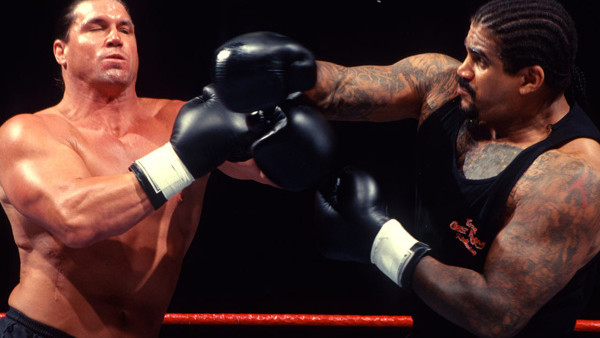
When I saw the listing of topics for this season’s Dark Side of the Ring docuseries, the one that stood out the most was “The Brawl for All”, an unusual inclusion among heavier topics like Chris Benoit, Jimmy Snuka, and Dino Bravo.
What piqued my interest is that I really haven’t revisited the BFA since I became an MMA fan and writer in 2005 when I fell in love with the sport during the first season of The Ultimate Fighter. The WWE’s answer to a Toughman competition took place seven years earlier during the meat of the Monday Night War and while I remember watching it at the time, I have wanted to revisit the circumstances and fights themselves given everything I have seen since then.
Unfortunately, this episode was better suited for a Dark Side 20-minute series similar to what ESPN does for some 30-for-30 topics as there wasn’t enough meat on the bone to sustain their usual 44 minute runtime.
They did get several of the key behind-the-scenes and in-ring participants on camera like Vince Russo, Jim Cornette, Bart Gunn, Jim Ross, Darren Drozdov, and Charles Wright, aka The Godfather. While they do a good job of telling the backstory on the concept and execution, Russo and Cornette’s participation eventually breaks down into what we have seen on past episodes: Russo wanting to just get along and Cornette nearly having an aneurysm describing how much he hates him.
The fight fan in me wanted to hear from more of the other wrestlers turned temporary fighters, especially former UFC champion Dan Severn (who forfeited after one match), Ken Shamrock (who didn’t want to participate), Steve Blackman (what happened to him?), and even Bruce Pritchard who was talked about a lot but only heard in clips from his podcast.
But any discussion about BFA really breaks down into the what if scenarios regarding “Dr. Death” Steve Williams. Gunn, Cornette, and Ross talk about this in detail with Gunn describing how everyone assumed Williams would run through him which motivated him even more to knock him out.
And, of course, if the supposed goal of the tournament was to get Williams over to the point he could have a big run with Steve Austin in a wrestling match, the obvious question is this: why not just get him over with, well, wrestling matches in order to do that? That question is never answered and may not have been asked.
Spoiler alert, but Gunn knocks out everyone on his way to winning the tourney, including the Russo-hated John Bradshaw Layfield for which he said the tourney was created to embarrass. After he won the tourney, WWE supposedly had no idea what to do with Gunn, admitted by Cornette and Ross.
So, that leads to the other big question: how could WWE not figure out what to do with a good looking, well-built guy that just knocked out three men cold on national TV? That question is not directly answered, but we are basically told that it wasn’t their original plan. Ross says, “No one got over.” That feels like more of a decision than working with something that landed in your lap. Given where UFC is now, I have to think that mindset would be different in 2020.
The documentary then strangely diverges into a Cornette promo on Russo that doesn’t have much of anything to do with the BFA and then, a retelling of how Drozdov was paralyzed by D-Lo Brown, also nothing that has anything to do with the BFA. An idea for another short doc? 100%. Here, not so much.
If you’re looking for a basic explanation of the Brawl For All and why it was regarded as a terrible idea (even though Vince McMahon reportedly wanted to bring it back as an NXT competition), you’ll get what you need here. If you’re looking for more substance, you won’t find it here, a rare miss for the Dark Side series.
You can watch Dark Side of the Ring on Vice every Tuesday night as well as on demand.
When you play the celebrity game, there is a risk. There’s the risk the media and the public won’t get interested and the deal becomes a money loser. And there’s the risk that even if they do, trying to get outsiders, even if they are great athletes, to do a cram course in pro wrestling won’t result in a good match. But there is the upside. While Hulk Hogan would have been one of the biggest stars in pro wrestling history without Cyndi Lauper and Mr. T, without question the rub off of them helped catapult Hogan to a higher level of mainstream consciousness. Antonio Inoki would have been one of the biggest stars in pro wrestling history without Muhammad Ali, but if he wasn’t a household name in Japan before their fight, he certainly has been for all of the past 22 years since their fight. And their fight, was the ultimate in the risk not paying off and what the repercussions of that are, short-term disaster and stuff that long-term legends are created from.
But as society has changed, so have the athletes. The biggest risk today isn’t so much of a bad buy rate, or lack of media attention to sell it to the general public, or even of a bad match. The risk is, will the celebrity show up, and if he does, will he feel he’s so high and mighty that what he’s doing is a joke.
Enter Dennis Rodman. Jake Roberts used to repeat the fable every time he turned heel. It went something like this. You see a wounded snake that’s about to die. You save its life, you nurse it back to health and you treat it as a friend. It becomes your best friend. And one day out of nowhere, the snake bites you. You ask the snake, after all I did for you, why did you bite me? The snake responded, the first time you picked me up, you knew I was a snake.
Rodman is Rodman. In another age, he’d be considered something entirely different. Sure, some of his actions are largely an exercise is self-promotion. And some, like blowing off practice in the middle of the playoffs are something different. But he can get away with it. Because he can play. Actually, that is probably not a lot different from what would have happened in a previous generation except the media would have covered it up as in covering for him in those days rather than making a huge issue of it and thus making him more of a celebrity for it these days. But in this generation, doing things like that also make one a hero. He’s cool. He does what he wants. So WCW invests a ton of money in him. And last year, at the height of his celebrityhood, instead of using a football player or a boxer, athletes who have the rep of being tough, they tried a basketball player. He helped the buy rates a little on two shows, although not nearly as much as revisionist history from people who know nothing about pro wrestling seem to think. He didn’t help TV ratings one bit last year, nor one bit this year, and this year they needed it. But he was a success, because by being associated with WCW, it strengthened the WCW name probably to a level very close to equal the name brand of the WWF when it comes to pro wrestling. The fact his first match was something of a miracle was well and good for wrestling fans but it wouldn’t have mattered that much either way. Overall in the giant scheme of things, it was a success and the fact the match quality was surprising had very little to do with it.