Left My Wallet returns with our annual Wrestling Observer Hall of Fame talk with Jim Valley.
Before that, we talk superheroes and what Jim is watching from both the Marvel and DC Universe, the remake of The Facts of Life and Diff’rent Strokes, 80’s sitcoms, television theme songs, and a great story from the Cauliflower Alley Club.
Then, in our main event, Jim and I discuss who he voted for in this year’s Observer HOF and other curious candidates. He breaks down the case for Don Owen and we delve into some families and factions that should get consideration to be on the ballot.
We discuss the Steiner Brothers, CM Punk, Paul Orndorff, Morris Sigel, Ole Anderson, George Kidd and why Jim voted for…Nikki Bella? He makes a compelling case for the former WWE star and why he feels she should be in.
It’s always fun to talk to Jim, so enjoy this fun, hour-long conversation with some great Hall of Fame debate.
Dave Meltzer and I are back on Wrestling Observer Radio talking all of the latest in pro wrestling.
We discuss a ton of topics including the following:
One year anniversary of the passing of Jon Huber/Brodie Lee
WON HOF ballots
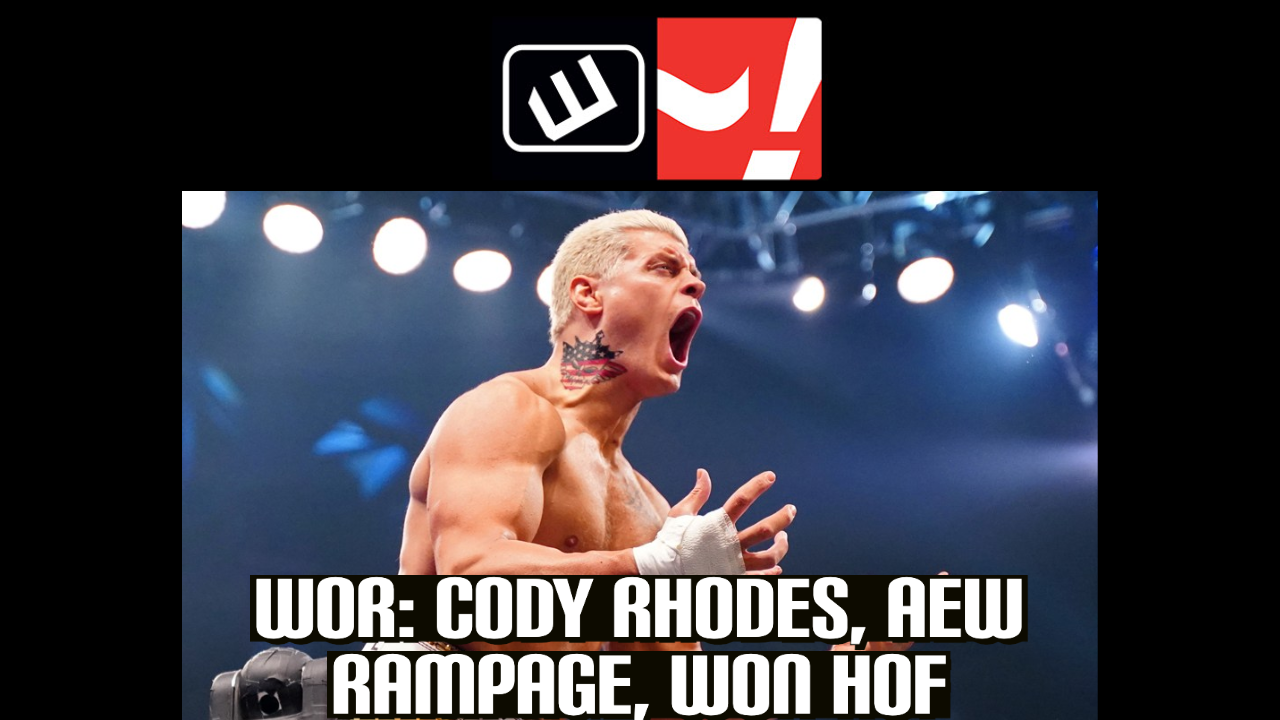
Cody Rhodes beating Sammy Guevara for the TNT title
AEW Dynamite ratings
STARDOM and NOAH
Click below to listen.
Timestamps:
Start: Christmas
1:07: One year anniversary Jon Huber’s passing
16:13: Ballots being counted for WON
26:35: Cody Rhodes wins TNT title, Jim Cornette’s comments on pro wrestling crowds
49:26: The rest of Rampage
55:58: Dynamite ratings
1:05:38: Stardom and NOAH lineups
1:10:50: Q&A
Dave Meltzer and I are back on Wrestling Observer Radio with special guest, wrestling historian Pat LaPrade.
We talk to Pat about the candidates for the 2021 WON HOF.
We talk about candidates who should be slam dunks, candidates both both Dave and Pat voted for who may not be popular on other ballots, and also some who they voted for in the past, but left off this time.
We also look at who might be on future ballots in the coming years.
You can buy Pat’s book on Andre the Giant, which is now in its paperback edition with a new cover, and Dave’s new Wrestling Observer Yearbook on 1999. (Both are referral links.)
Wrestling Observer Radio with Dave Meltzer and Garrett Gonzales is back once again with special guest Mike Tenay.
On this edition of the show, we talk about why WWE fired Zelina Vega as well as the tweets from both former U.S. presidential candidate Andrew Yang and SAG-AFTRA president Gabrielle Carteris about the issue.
We talk about the AEW and NXT ratings, the Full Gear PPV buyrate, and Seth Rollins taking a break shortly.
We then discuss the 2020 class of the Wrestling Observer Hall of Fame, who was closest to getting in, who did well in the different voting groups, and what “drawing” means in 2020 and how WWE talent will fare on future ballots.
Timestamps:
Start: Hall of Fame general thoughts
3:23: Zelina Vega released, ex-WWE guys in Impact
27:41: Seth Rollins reportedly taking time off
28:25: AEW, NXT ratings
43:09: AEW Full Gear buyrate, next AEW title match
1:00:55: Hall of Fame
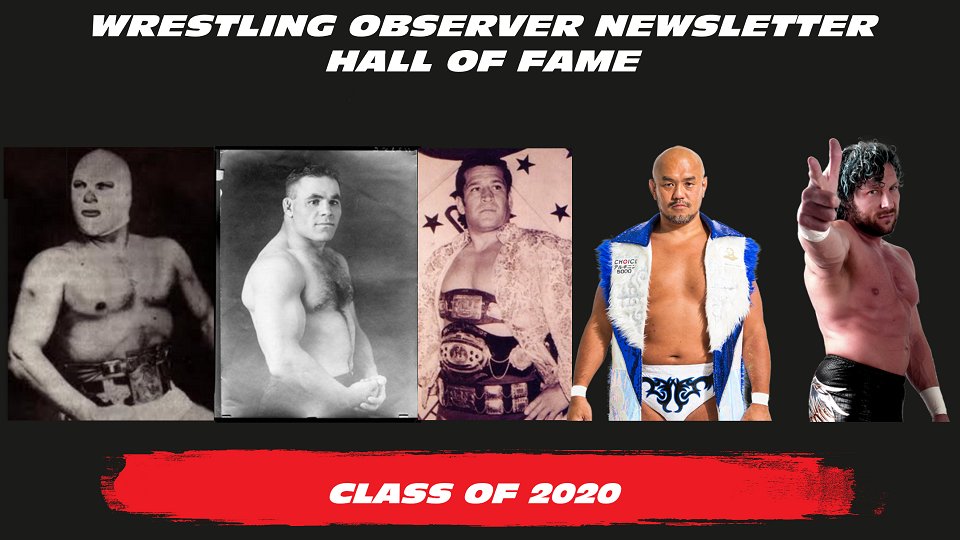
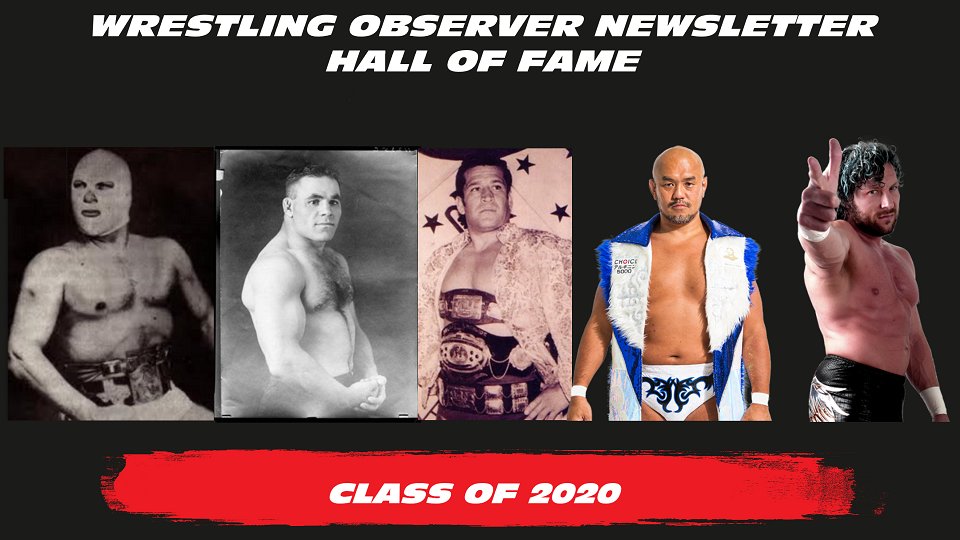
The Wrestling Observer Newsletter announced this morning that five new entrants have entered their Hall of Fame.
Four of these men were inducted by voting. In the Mexico category, Medico Asesino was voted in with 64% of the vote. Karloff Lagarde was also inducted with 61%.
In the Japan category, AJPW/NOAH mainstay Jun Akiyama was voted in with 60%. Kenny Omega, who had extensive runs with both New Japan Pro Wrestling and DDT before coming to the United States to form All Elite Wrestling, was also inducted with 61%.
A fifth entry, early 20th century wrestler Dan Koloff, was also inducted based on Dave Meltzer’s historical analysis and research.
Those that will be added to next year’s ballot include Nikki Bella, Dorrell Dixon, Bill Dundee, Seth Rollins, Kazuchika Okada, Jon Moxley, Hollywood Blonds (Buddy Roberts & Jerry Brown), Octagon, La Parka (AAA version), and Psycho Clown.
For more information on how to subscribe to the Wrestling Observer Newsletter, along with our extensive newsletter and radio show archives, check here.
‘Left My Wallet’ is back for a special Easter edition with our very own JIm Valley, host of the Portland Wrestlecast, co-host of the Pacific Rim Pro Wrestling Podcast, and fill-in co-host on Wrestling Observer Radio.
However, we start with his love of Batman and growing up with reruns of the 1966 TV series, the movies, our thoughts on Michael Keaton playing the role, and what was his favorite version of the caped crusader.
We then flip to talking about classic TV shows, Mego toys, an underappreciated museum in L.A., and under the radar shows from the past.
Then, the talk turns to wrestling as we make our cases for who could be considered the all-time greatest professional wrestler. It’s a fascinating conversation that brings up a few surprising names that we make our cases for. Then, we talk about a few potential Observer hall of fame candidates from the modern era who should be looked at a little more closely in coming years.
This was easily one of my favorite and most fun shows I have done and talking with Jim about all these different topics put a smile on my face during these trying times. Take a listen to a great show that hopefully makes you laugh and smile, too.
Editor’s Note: The following was submitted by wrestling historian Bradley Craig.
Who is the greatest professional wrestler you ever saw perform?
It is one of the ageless questions which will always be relevant while pro wrestling exists in some form. Almost everyone from every era around the industry has asked it at some point. From those who have only spectated a handful of bouts, to ardent followers, to those who have reported on wrestling or competed in a match, everyone has their own opinion, regardless of their standing within the industry or outside of it.
As the legendary commentator of the World of Sport era, Kent Walton was a credible candidate to give his own view on who the best really was. A sports broadcaster employed by ITV, and not by the cartel of promoters who actually produced what was happening within the ropes, he was as impartial a voice as you could get within the lexicon of professional wrestling.
For over thirty years, Walton would narrate the action within the most prominent national timeslot that wrestling would ever receive in the United Kingdom in a career which earned eventual recognition within the Wrestling Observer Hall of Fame. Every week, he would be on the call, methodically describing the matches of everyone who mattered on the domestic scene in his trademark calm, whispery voice that suited an understated British style of grappling and escapology.
It was a product which largely focused on hold and counterhold in which matches were fought in rounds and where two falls, two submissions or a knockout would declare a winner. There was some room for showbiz theatricality, but the solid fundamentals of matwork were key to any performer who was deemed ready for television exposure within British shores.
And, although the traditional Lord Mountevans rules of British professional wrestling have since become largely defunct, the legacy of the British style remains alive. Indeed, its influence still exists: from the fluid submission sequences that have become a mainstream staple of the WWE women’s division to the Wigan influence that permeated puroresu thanks to the teachings of Snake Pit shoot veterans Karl Gotch and Billy Robinson.
But, there was one revered master of escapology, dubbed “the Houdini of the mat”, who earned the most respect from his peers of that era known for extracting chain wrestling elements, submission holds, and weaving them into highly intricate sequences. The result was an often-emulated, breathlessly entertaining art form in which the mat wrestling element of the match became the real focus of crowd fascination.
Above all others, this innovator was the consummate professional whom Walton held in higher regard than all the rest.
Short in stature, but a genius in invention, his name was George Kidd.
Some British experts have argued that the series of matches between Mark “Rollerball” Rocco and Marty Jones fused transatlantic influences to create the foundations of the modern junior heavyweight style. Others will claim this revolution took place when the Dynamite Kid and Tiger Mask had their series of matches on both sides of the Pacific in the early 1980s. But within the shores of the United Kingdom, the age of the smaller athlete was somewhat formalised prior to the 1946 establishment of official rules of professional wrestling, which included the recognition of seven different weight divisions as part of governmental reform of the business. Wrestling championships in various weight brackets had existed since the 1800s, and exploded in prominence during the interwar era.
It was in the lightweight division where the 5’6” George Kidd established his niche, and found outstanding title glory in the aftermath of the second World War. Following his training under the tutelage of Norman Morrell, his first taste of championship success came when he ousted Tony Lawrence in the finals of a one-night tournament for the Scottish Lightweight Championship on December 16, 1947. He was rapidly elevated to the status of British Lightweight Champion in short order. On October 25th, 1949, the 24-year-old Kidd became the World Champion of the division with a win over Rudy Quarez at Caird Hall in his home town of Dundee. He would later defeat Mick Manus for the European lightweight crown before embarking on highly publicised travels to France in 1951 and a 1952 tour of Mexico (including EMLL) in a quest to unify further prominent versions of the strap from claimants such as Rene Ben Chemoul and Catarecha I.
Solidifying his standing as a credible athlete, Kidd took his role as champion seriously, and worked to elevate the sport on an equal standing to other combat sports. He was known to arrive at the arenas in punctual fashion, dressed in business attire, with a brown leather briefcase which carried his silver-plated championship belts, glittery black robe, trunks and boots. Remaining an avid follower of boxing and how it was presented to the public, there are historic similarities in the build up to his title defences to how boxing is presented in the mainstream.
One example can be studied in the lead-up to his July 17, 1956 world title defense against Bernard Murray. Set for a major show in Pittodrie Park (a soccer stadium which was home to major Scottish team Aberdeen Football Club), Kidd and Murray were engaged to a formal weigh-in at the famed Aberdeen Music Hall, which itself became a highly-publicized public event on the night before the match. Years later, the Scottish ITV franchisee Grampian would send sports reporter Frank Gilfeather (himself a local boxing great) along with a news crew to follow Kidd during his training regimes in preparation for a major title defense. His workouts, which showcased his flexibility and hatha yoga techniques, became a unique television spectacle.
When wrestling became a regular television fixture in the late 1950s, the armchair audience had acquired a greater appreciation of smaller men such as McManus, Jackie Pallo, and Kidd, who all worked to redefine the parameters of a crowd draw. By presenting a more dynamic style that could not be replicated by the heavyweights, the doors had been truly opened for the smaller athlete to enter the industry. Although Kidd was personally hesitant about the potential overexposure of weekly television coverage of professional wrestling, he adapted well and remained a top draw. His sporadic appearances were impactful enough that he remained one of the few stars to have successfully transitioned from the music hall era to the small screen one.
Beyond his skills as a television wrestling star, he made a name for himself as a presenter. As a location host of The Wednesday People, Kidd showcased his improvisational skills in live broadcasts. It earned him plaudits, and it was not long before he was given his own national talk programme, The George Kidd Show. Interviewing the likes of pop icon Lulu and other prominent celebrity personalities was effortless for Kidd. As a famous owner of two public bars, the skills of conversation came naturally to him. He would later front a third show, Ask George Kidd, and remain a favourite guest host from events as diverse as Miss Swimsuit 1964 to after-dinner speaking events such as The Policeman’s Ball. In 1965, his popularity and standing had grown to the point that he was voted the 1965 Grampian Television Personality of The Year by the station’s viewers.
In addition to his crossover success on TV, Kidd would also receive Royal acclaim for his efforts in the ring. After being requested to perform at a major card at the Royal Albert Hall in London on May 22, 1963, he was presented with a commemorative medal by Prince Philip, Duke of Edinburgh. It was later reported that the Prince was a longstanding admirer of Kidd’s technical brilliance.
Beyond his scientific skills, Kidd was a formidable draw. He was always provided prominent billing, and was responsible for sellout venues across the country. It mattered not whether he was at Nottingham Ice Rink facing a colourful star like Pallo or pitted in a human chessmatch versus Zoltan Boschik, the brand of Kidd proved reliable at the box office.
Kidd retired on March 2nd, 1976, in a match against Steve Logan at The Caird Hall. Injured from an earlier match with Mark Rocco, he taped his ribs and wore a t-shirt to conceal the injury. He was adamant that the public has paid to see him at his best and competed against the wishes of his family. It was his 49th and final defence of the World Championship, and he retired undefeated. One final time, he pleased the crowd, and the audience cheered the name ‘Geordie’ long beyond the final bell.
In the light of Kidd’s retirement, promoter Max Crabtree attempted to fill the void with a new breed of lightweights. Adopting a new style and utilising many of the tricks that Kidd employed, Johnny Saint was pushed as his successor. This elevation was further reinforced when Saint was elevated to World lightweight champion. In-ring, Saint’s homage style included spots such as rolling into a ball before arm-trapping a confused opponent (now known as the lady in the lake), the surfboard hold which Kidd popularised (some argue that La Tapatia was brought to Mexico by Kidd, not Romero), and other emulations of Kidd’s flawlessly choreographed tactics and sequences. Kent Walton noticed the similarities and would mention Kidd’s name in almost every televised Johnny Saint match that he called.
21 years after the death of Kidd on January 5th, 1998, the George Kidd style still has an imprint in pro wrestling. From small joint manipulators like Zack Sabre Jr. to Marty Scurll to Pete Dunne, a class of new practitioners in the art of chain wrestling have ensured that the legacy Kidd built continues to flourish in modern times.
When The Professional Wrestling Hall of Fame for Scotland was established in 2015, there was little debate on who should be its first inductee. On August 7th, a civic ceremony was hosted at Caird Hall, Dundee to recognise his induction, at a reception hosted by Bob Duncan, the Provost of the city. As part of the induction, a commemorative plaque was installed in the venue which summarises the life and accomplishments of Scotland’s greatest wrestler.
Across the globe, there are a small number of professional wrestlers who have solidified their legacy to be remembered as true cultural icons in their respective home countries from demigod characters such as El Santo in Mexico to Rikidozan and Antonio Inoki in Japan. In the U.S.,, this pattern can be traced to include enduring historic figures as Jim Londos and Lou Thesz right through to generational pop culture stars such as Gorgeous George, Hulk Hogan, Steve Austin, and The Rock.
In Scotland, there was one performer who transcended the industry to become a bonafide national hero and one of the most innovative contributors to the art form of matwork, and ushered in a new era for the industry. As an in-ring chain wrestler, he had no equal. His influence also created opportunities for the smaller, more talented athlete. He was an enduring draw with broad national appeal who performed at the top level of his industry for over 25 years.
People might debate the question on who the best wrestler of all time truly was. But there is no question that George Kidd belongs in the Wrestling Observer Hall of Fame.
Bradley Craig is a British wrestling historian and founder of The Professional Wrestling Hall of Fame for Scotland. He is also the co-author of Through the Shattered Glass, the autobiography of Jeanie Clarke.
After a two week break, Left My Wallet returns with the co-host of both Wrestling Observer Live and the Big Audio Nightmare, Mike Sempervive.
The man who is currently dominating the Wrestling Observer fantasy football league joined me to talk about NFL happenings, what’s wrong with his Atlanta Falcons, if there’s a standout team in the NFC, horrible quarterback play, and the Chicago Bears’ defense. We also discuss some fantasy football and who he thinks can help carry your team to the fantasy playoffs.
Finally, we delve into this years Wrestling Observer Hall of Fame ballot. Mike states his case for why Enrique Torres is a no-brainer for induction and we talk about polarizing candidates as Bill Goldberg, CM Punk, and Sgt. Slaughter. I try to make my case for the Hardy Boyz.
It’s a jam packed hour long episode to fulfill all your football and Observer Hall of Fame chatter.
Johnny Rougeau has been one of the most popular wrestlers to ever come from the Montreal territory, only behind Yvon Robert and on par with Edouard Carpentier. His peak was between 1966 and 1972, although he had started to become popular at the end of the 1950s. He holds the crowd attendance record for wrestling at the old Forum before they renovated the arena and added seats. He holds the third best wrestling attendance in the history of the Forum and the second biggest ever in Montreal. His last name is royalty in the province of Quebec with his brother and three nephews all becoming wrestlers.
As a promoter, he has three of the best 20 attendances in the history of Quebec wrestling. And when you look at the biggest draw in the history of the province, based on pretty much the same system Dave Meltzer uses at a worldwide level, he’s fifth in Quebec, behind Yvon Robert, Killer Kowalski, Hulk Hogan and Edouard Carpentier, four Hall of Famers.
Born Jean Rougeau on June 9, 1929, he started his wrestling career in 1951. Rougeau was proud of his convictions, and when he was given convincing arguments, he could get involved in multiple projects as demonstrated by the numerous careers he juggled. It’s no surprise, therefore, that he decided to help create the first trade union at Coca-Cola in the 1950s. The move ultimately cost him his job. His uncle, Eddy Auger, wrestled in the Detroit territory at that time. When someone got injured, Auger called his nephew. Rougeau had played hockey, but also trained as an amateur wrestler when he was a teenager. He had done a few matches here and there in the late 1940s, but didn’t pursuit wrestling at the time. Out of work, Johnny decided to accept his uncle’s invitation.
It was the beginning of an incredible career.
At the time, it was difficult to break into the Montreal territory as Eddie Quinn found Rougeau, like many local guys, to be too small. Nevertheless, he finally made his Montreal Forum debut on January 30, 1952. He wrestled semi-regularly in the preliminaries throughout 1952 and 1953. When not wrestling at the Forum, he would do upper mid-cards and main-events for promoter Gerry Legault at the Exchange Stadium. It was common in those days for the prelim guys at the Forum to main-event around town for other promoters.
Quinn and Yvon Robert, the biggest wrestling star Quebec has ever known and part owner of the territory at the time, were in a position to decide which French-Canadian would be part of the show. They could make you a hero or a zero. Robert, in particular, was determined to maintain his position, even late in his career. Over the past decade, only Larry Moquin had kept an enviable place in the organization. Robert was in his early forties and knew his wrestling career was nearing its end. Clearly, he would get to choose who would take his place and he had the choice between many young up-and-comers like Maurice Vachon, Guy Larose (Hans Schmidt), Sammy Berg, Tony Angelo, or even Yvon’s own brother, Maurice Robert.
Robert ultimately chose Johnny Rougeau.
The first step was the Junior Heavyweight title, held at the time by a veteran named Harry Madison, who had represented Canada in freestyle wrestling at the 1932 Los Angeles Summer Olympics. On June 8, 1953, in front of a sold-out Exchange Stadium, Rougeau won the title. The special referee for the match was none other than Yvon Robert.
Then, three months later, Rougeau wrestled in his very first main-event at the Montreal Forum. On September 9, Rougeau, 24, teamed with Yvon Robert and Larry Moquin, the three French-Canadians as they called them, against Ernie Dusek, Hans Hermann and Al Mills. The show drew 8,000 fans. Three weeks later, the rematch drew 9,000 fans. In the newspapers, he was already called the guy who would most likely replace Robert. Quinn made him wrestled in all of his core cities like Montreal, Quebec City and Ottawa. For the next few years, Rougeau would team with Robert or with Manuel Cortez, who was the office’s policeman. On February 1st, 1956, a double main event of Killer Kowalski vs. Buddy Rogers and Robert and Rougeau against the Dusek brothers drew 10,000 fans.
One knock I’ve heard about Rougeau was that aside from Detroit when he first broke in the business, he only wrestled in the province of Quebec and didn’t have an international career. That couldn’t be further from the truth.
Although he was mainly wrestling in Montreal, he also wrestled in the United States and had quite a success out there. His uncle, Eddy, who was wrestling in the United States under the name of Pierre LaSalle, was so well liked and respected in the business that he opened many doors for his nephew. In 1952, working for Al Haft in the Ohio region, Rougeau was one of the most popular wrestlers, battling Joe Scarpello and Ed Francis over the MWA Junior Heavyweight title on top, and also having a feud with Roy Shire. Haft liked him so much that he brought that feud to another territory he was promoting at the time, West Virginia, where Rougeau and Shire would do main-events or at least featured matches.
His good look and charisma allowed him to become popular quite fast. He also wrestled in Indiana until March 1953 where he had a tag team run with his uncle. Once Robert picked him to be his replacement, he brought Rougeau to Hartford, Burlington, and Boston, all New England towns where Robert was already well known. Being Robert’s heir had its advantage as Rougeau was also booked in Tampa for Cowboy Luttrell in February 1954 and from his first match, was said to have made a big hit with local fans. So much that only five days later, he main evented in Miami against TV champion Verne Gagne. The February-March Florida trip became an annual gig for Rougeau as he went back in 1955, this time working more towns, staying much longer and wrestling mainly on top. He would also wrestle in Massachusetts and in Texas that year. He was rapidly climbing his way up.
Back in Montreal, and although he was 6’ 1” and 215 pounds, he was still seen as a small guy by Quinn, who didn’t make him wrestle at the Forum that year. So, he went to work in the same New England cities he had done before, but then moved to Baltimore and in the states of Virginia and South Carolina. He was so popular that in a Baltimore newspaper, it was said that Rougeau was the wrestler with the most fan clubs throughout the United States and Canada. In a Virginia newspaper, a story was written about Rougeau getting a shot at Robert’s title back in Canada in June and putting over Rougeau as a promising prospect. That title shot never happened.
That same summer, he did the Montreal Alouettes football team training camp and actually made the team. But for various reasons, including not getting along with the coach, he decided to leave one week before the start of the season. At the beginning of 1957, he made his debut in Minneapolis for Wally Karbo and Dennis Stecher. In a very short period of time, newspapers were calling him the new sweetheart of Minneapolis, a young television star, and said that even Hard Boiled Haggerty liked him. As a matter of fact, Rougeau teamed with Haggerty during that run, feuding with the Kalmikoffs on top, also featured in the state of Wisconsin. It was working so well that at one point, it was Verne Gagne who teamed with Rougeau against the Russians. He left Minnesota in April to come back to Montreal. Since his last match at the Forum, Edouard Carpentier had made a name for himself and Quinn understood that smaller guys could draw. Rougeau came back and wrestled at the Forum for the first time in over a year. Robert was retiring and he still wanted Rougeau to be his successor, thinking the territory needed a Quebecer and not only a Frenchman.
Rougeau was now billed as a heavyweight and he drew 12,000 fans against Killer Kowalski on July 10, 1957. One of many rematches between the two was held on November 13, 1957 and drew 12,698 fans. That same feud moved to Boston where the two were immediately put in a main event program. Rougeau was hugely popular and easy to work with. That’s probably why so many people wanted to partner with him or help him out. Johnny Rougeau would say that Yvon Robert polished his style and that he improved when he was under the tutelage of the former champion. Robert taught him the tricks of the trade, even the Japanese arm lock, Robert’s famous submission hold he used to win so many matches, a sign he was passing the torch. In Quinn’s territory, he was now used in main events teaming with guys like Carpentier and Pat O’Connor or feuding in singles with Killer Joe Christie. He was also used a lot in Ottawa.
In the spring of 1959, though, Rougeau crossed the Atlantic and wrestled in France for the first time. It was Rougeau’s thinking to not overexpose himself. That’s why he would leave the territory from time to time in order to comeback stronger. Working for the great promoter Raoul Paoli, who had started his promotion in the 1930s with Henri Deglane, he main evented the Palais des Sports in Paris on April 6, 1959, against Felix Miquet. The match drew a record of 20,000 fans. Rougeau stayed in Europe for a few months after that, wrestling in France, Germany, Belgium and Sweden. Back in Montreal in August, he teamed with Carpentier and Pepper Gomez against Kowalski, Boris and Nicoli Volkoff and drew 11,200.
Business was starting to get tough in Montreal and Quinn lost his weekly wrestling TV program in the fall of 1960. Just before that, Rougeau and Buddy Rogers would draw 12,366 fans on April 13 and teaming with Bobby Managoff against Rogers and Kowalski, Rougeau drew another big crowd with 10,099. Around the same time, Robert officially became Rougeau’s manager. It was in 1961, under Robert’s management, that Rougeau won the Montreal title for the first time, defeating Hans Schmidt. After having been successful in the United States, Rougeau finally sat on top of the Montreal territory.
But being a man driven by projects, Rougeau started to open up to other businesses. In the early 1960s, he became friends with René Lévesque, a former journalist-turned-politician who ended becoming one of the most popular Quebec Prime Ministers of all-time. Rougeau held different jobs for him, working as his bodyguard, his confident and his most fervent militant. After winning the title, Rougeau bought the Mocambo, a downtown Montreal night club that wasn’t doing well. Rougeau’s perseverance eventually made it the most successful club in Montreal. Artists from all over the world came to perform, including the likes of Chubby Checker, Nat King Cole, Fats Domino and Liberace, as well as the who’s who of Montreal local performers.
With his involvement in politics and entertainment, Rougeau remained popular, one of a few with Carpentier and Buddy Rogers. When Channel 2 decided to drop wrestling, Quinn approached channel 10 and by September of that year, he was back on TV. This time, he wasn’t presenting new matches or live events. He gave the station a master tape of something like 20 to 25 hours of wrestling. However, Johnny Rougeau was one of the wrestlers most often featured on it. During that time, in 1962, Johnny also wrestled a series of shows at Madison Square Garden in New York City, but for whatever reason wasn’t really pushed. When Quinn finally retired, Yvon Robert started his own promotion, running a few shows at the Montreal Forum beginning in July 1963, but mainly using the Paul-Sauvé Arena. Rougeau wrestled on a semi-regular basis for Robert, until Robert later closed down his promotion in November 1964.
Rougeau sold his club and since he had been featured so much even in those last years, he wanted to get back into wrestling full time and the only thing making sense for him was to start his own wrestling company. On May 6, 1965, at the Paul Sauve-Center, All Star Wrestling was born. The first move after that was to get on TV. To do so, he took Quinn’s master tapes, which Robert inherited at Quinn’s death in December 1964, without either asking Robert’s permission or offering him a partnership and went to Channel 10 to pitch his new show. The show was approved and “On the Mat” started in 1966. Since Rougeau could not wrestle and have his name on a promoter’s licence at the same time as this was prohibited by the athletic commission, he made Bob Langevin his promoter, a role that Langevin had also played for Eddie Quinn a few years before.
Rougeau’s weekly arena was now the Paul-Sauve Center which could only fit 7000 fans. That said, Rougeau was the main star and he sold it out many times. This new wrestling venture allowed Johnny to bring back his brother, Jacques, into the mix. Jacques had wrestled a little in the late 50s, but didn’t think it paid good enough to keep going. Between 1965 and 1967, the promotion got more and more followers. The main stars besides the Rougeaus were Hans Schmidt, Carpentier, Rogers, Baron Von Rashke, and Maurice Vachon. Johnny won the Montreal title on two occasions during that time, once against Schmidt and once against Vachon.
Rougeau would reach new heights in 1968-69. In the span of three months, he would draw more than 50,000 fans at the Forum. It actually started when Jacques took Oreal Perras, who was wrestling under the name of Red McNulty, and transformed him into a Russian named Ivan Koloff. Johnny Rougeau saw money in him especially with the Cold War that was still strong in the 1960s. On April 22, Rougeau and Koloff drew 17,348 fans on the very last show at the Montreal Forum before some big renovations added seats. It was the biggest crowd ever recorded at the Forum until then. Upon its reopening, Rougeau and Koloff beat that number with a sellout of 20,890, the biggest crowd in North America that year. Yvon Robert was the referee for both matches.
To end the year, Johnny and Abdullah the Butcher drew 13,000. Rougeau’s success continued in 1969 as he drew more than 10,000 fans on four consecutive shows, two in Montreal and two in Quebec City. He’d face Abdullah the Butcher and Ivan Koloff in singles action and also teamed with his brother Jacques. On February 17, 1969, Rougeau and Abdullah drew 17,000. For the second year in a row, it was the largest crowd in all of wresting in North America. All in all, Rougeau’s promotion drew more than 10,000 fans in the province of Quebec on seven occasions in 1969, something the territory had not seen in a decade.
It continued in 1970 when Johnny drew more than 10,000 three times, including against Danny Lynch and Chris Tolos, who were not drawing cards in Montreal. On March 30, 15,239 came to see Johnny reclaim the title against Abdullah. It was Johnny’s first reign in two years, but his fourth since 1965. It’s also worth noting that the Forum wasn’t used every month during the 1960s and 1970s, therefore, drawing big crowds was something even rarer. That said, the weekly shows at Paul-Sauve were doing great and it was a lot because of Johnny’s popularity.
By then, the relationship between Robert and Rougeau fell into disarray, with Robert angry that Rougeau had not included him in this new venture, even though he’d helped him when he started and booked him on his shows in the past years. On the other hand, some speculate that Robert owed him money from the shows he wrestled on. Whatever the case may really be, the animosity lasted for many years. Robert didn’t want to work for Rougeau afterward; he refereed matches, occasionally, because the fans were asking for him and he didn’t want to disappoint them. But it’s clearly the main reason why he went to meet with Maurice Vachon about starting Grand Prix Wrestling.
Grand Prix started in June 1971 and two months later, on August 2, 1971, Johnny decided to call it quit. The reason wasn’t Grand Prix Wrestling though, but junior hockey. In 1969 he had bought a team and participated in the first season of the Quebec Major Junior Hockey League (QMJHL).
The decision was done at the last minute since the Montreal Forum wasn’t even booked for what was sold as Johnny’s last match. The show sold-out Paul-Sauvé, as Johnny was victorious against Mr. X. It was also the right timing since another Rougeau was getting in the business. Jacques’ eldest son Raymond had just started and was already making noise. Johnny was so happy that his nephew was following the family tradition that on Ray’s first match, he chose to be by his side, booking Jacques in another town. Same thing with Raymond’s first TV match, as Johnny was the one accompanying him to the ring. Since Johnny had two daughters, Raymond was the son he never had.
If 1971 still belonged to the Rougeaus, 1972 would be the year of Grand Prix Wrestling, except for two shows. Seeing his promotion losing ground to the competition, Johnny came back from retirement. His return on June 12, 1972 against The Sheik drew 15,000 fans, the largest crowd All Star Wrestling would do at the Forum that year. Johnny then decided to hold the biggest show ever done in the history of Quebec wrestling.
For the first time, a wrestling show would be held at Jarry Park Stadium, home of the Montreal Expos. The stadium could fit 8,000 more seats than the Delorimier Stadium that Quinn was using in his time. It was a Rougeau celebration where Johnny main-evented against Abdullah the Butcher, Jacques defeated The Sheik for the title, while Raymond beat Don Serrano for the Junior Heavyweight title. The show drew 26,237 fans, the largest crowd at the time in the history of Quebec wrestling and only 103 fans short from being the largest crowd in all of wrestling that year, finishing a close second to Dory Funk Jr against Fritz Von Erich at Texas Stadium. From a business stand point, it was Montreal’s first 100,000$ gate with 101,650$.
However, Grand Prix was too strong and the following year, it beat All Star’s number when 29,127 fans to see Mad Dog Vachon beat Killer Kowalski, the only show ever to beat Rougeau’s. Johnny kept wrestling until 1973 when he retired for a second time. He had also sold his hockey team, started doing color commentating and hosting a wrestling radio show. By January 1974 though, the Vachons had left Grand Prix and the shareholders couldn’t work well together. All Star and Grand Prix promoted a few joint shows and it was the end for Grand Prix. Johnny and All Star had won the war. Johnny came back in the ring on June 30, 1975, drawing 12,464 fans against Tarzan Tyler at the Forum, the biggest crowd for an All Star Wrestling show in over a year-and-a-half.
Two months later, he would win the Montreal title or a seventh and last time. With the 1976 Montreal Summer Olympics approaching and his eager to get back into hockey, he sold All Star in the spring of 1976. A few months before, in February, he teamed with his brother and nephew one last time and with a double main-event that also included Jean Ferre against Abullah the Butcher, the show drew 11,000 fans. Two months later, on the last All Star Wrestling show held at the Forum, Ferre and Koloff drew 10,000 spectators, the last time Rougeau would promote a large crowd at the Forum.
Soon after he sold the promotion, Channel 10 cancelled On the Mat after 10 years. It was truly the end of an era.
In hockey, as in wrestling, Rougeau commanded respect. Journalists, players and the management on other teams all appreciated his frankness and well-defined ideas. It was his initiative, for example, that sent the league’s young players back to school. In 1981 he was named president of the QMJHL, a title he would keep until his death. A trophy is now awarded in his honour to the team that finishes first in the regular season.
On May 25, 1983, Johnny Rougeau, 54, died after battling cancer. More than 7,000 attended his funeral three days later, one of the biggest in pro wrestling history. Only icons like El Santo, Giant Baba and Mitsuharu Misawa were honoured by more. He was inducted in the Quebec Wrestling Hall of Fame in 2004 and in the QMJHL Hall of Fame in 2015.
Because of Johnny, the name Rougeau has been synonymous with the Montreal territory for more than 60 years. His brother Jacques, his nephews Raymond, Jacques Jr and Armand, his niece Joanne, and three of his grandsons were all involved in wrestling at one point and to this day. Johnny Rougeau main-evented more than 20 shows that drew at least 10,000 fans in the province of Quebec only. When he retired for the first time in 1971, he was holding the assistance record in Montreal, but also in Chicoutimi with 7,900, Sherbrooke with 8,062, Trois-Rivieres with 4,300 and Quebec City with 13,000.
He was not the best technical wrestler out there, but Yvon Robert wasn’t either. He was more of a brawler who could sure also hit a dropkick right on the nose. Rougeau relied on his charisma, his talking ability and on how well he could read a crowd. He had the look, the flashy jackets, he was a crowd pleasure, and women loved him. He was very smart and was a savvy promoter who knew what to do to make a buck. The fact he could move very quickly to main-event status and could become popular so fast in territories he never worked before is very telling.
If that’s not enough to be in the Wrestling Observer Hall of Fame, I don’t know what is.
Les Thatcher and Vic Sosa look back at the last time Les did commentary with the great Gordon Solie in 1982 and the newest additions to the Wrestling Observer Hall of Fame.
The two talk about the 3/27/82 Championship Wrestling from Florida show, which was not only the last time Les worked with Gordon Solie, but was memorable for a most interesting meeting Les had with Eddie Graham and Dusty Rhodes while he was there.
The other topic of conversation is the Wrestling Observer Hall of Fame and a few of the newest inductees, including the Sharpe brothers, Mark Lewin and AJ Styles.
Induction into the Wrestling Observer Hall of Fame isn’t easy, nor should it be. This is necessary to separate “the men from the boys” and to encourage lasting and constructive discussion on wrestlers and wrestling history.
I am adding to that discussion that Pedro Morales deserves enshrinement. The man’s title history speaks volumes in and of itself. At a time when belts were an emblem of a promoter’s confidence in a wrestler’s ability to draw money, Morales’ stack of gold would sink a battleship.
By the mid 1960s, Morales was becoming a huge star on the west coast. In Cal and Aileen Eaton’s Worldwide Wrestling Associates based in Los Angeles, he became a two-time world heavyweight champion, beating the Destroyer and Luke Graham, respectively. Between March 1965 and August 1966, he held the top prize for 425 days.
His success was not stalled when he moved up the California coast to the Bay Area. Pedro (along with Pepper Gomez) was a multiple-time tag champion in the San Francisco territory, once beating the legendary duo of Pat Patterson and Ray Stevens en route to a 399 day title run from May 1967 to April 1968.
Pedro’s next venture was even farther west – Hawaii – and he thrived there too. Between June 1969 and September 1970, Morales thrice won the promotion’s top singles title, defeating Gene Kiniski, King Curtis Iaukea, and Johnny Barend along the way.
Now firmly ensconced as a major player in wrestling, Vince McMahon Sr. of the WWWF brought in Pedro to be his next ethnic babyface champion following the gigantic successes of Bruno Sammartino.
In many ways it was a perfect fit, especially in the territory’s center stage – Madison Square Garden in New York City. Not only was Morales born in Puerto Rico, of which there are (and were) heavy numbers of immigrants in New York, but he was raised in the city borough of Brooklyn, giving him even stronger ties to the locals.
And, they loved him. The only person in the history of the Garden with a higher sellout percentage is legendary Hall of Famer “Superstar” Billy Graham. The difference, however, is that Morales has the second most appearances in the Garden all-time with 111, second only to Sammartino’s 159. According to Wrestling In The Garden, Graham does not even crack the top 26 in terms of overall appearances.
Morales’ reign as WWWF Champion began on February 8, 1971, with a raucous victory over Ivan Koloff, who had recently stunned New York with his victory over Sammartino. After a double pin sequence in which both men’s shoulders were down, Morales was able to raise one shoulder before the count of three. MSG erupted.
As Jeff Bukantz recalls, “Whereas the Koloff win was met with eerie silence, the Morales win was met with a two-tiered pop. The crowd popped, but not a mega-pop, as the double pin looked like a potential screw-job and the fans weren’t quite sure the title changed hands. Then, referee Terranova raised Morales’ arm and a guttural and cathartic roar erupted. Then Bruno ran in to congratulate Morales and the roar continued. The only time I heard a roar like that in Madison Square Garden was when the Rangers won the (Stanley) Cup in 1994. Backlund’s pop (for beating Superstar Billy Graham in 1978) was huge. Hogan’s pop (for beating Iron Sheik in 1984) was unreal. But the second part of the Morales pop, the roar, had them both beat.”
Morales finally went down to defeat on December 1, 1973, in Philadelphia, after holding the WWWF title for 1,027 days. Morales stayed with McMahon until 1975, and then bounced around for a few years with stops in San Francisco, the AWA, and Florida. Wrestling for Eddie Graham, Morales found himself as the Florida promotion’s top champion in 1977.
Morales rounded out his Hall of Fame career with a resurgence in the renamed WWF. Within a couple years Pedro, already a United States champion in his first run with the WWWF, won the tag team championship and the Intercontinental championship, not only becoming the first triple-crown champion but the first quadruple-crown champion in WWE history.
Morales’ combined 619 days as IC champion remains a record to this very day.
When looking at the top draws of the 1970s, it is impossible to ignore Pedro Morales’ place. Between 1971 and 1973, only the Sheik drew more gates of 10,000 of more. Looking at the decade as a whole, Morales ranks 5th. The top four (Sammartino, the Sheik, Graham, Andre the Giant) and six through ten (Harley Race, the Crusher, Dory Funk Jr./ Ernie Ladd, and Dick the Bruiser) are all in the Observer Hall of Fame. Morales is not.
Several years ago, Dave Meltzer did a study to try and determine the top contenders for a “real” WWE Hall of Fame based on merit. Several metrics were used to determine who, in general, were on top for the longest and drew in that position. Morales finished in the top ten. The other nine wrestlers (Sammartino, Hulk Hogan, Bob Backlund, Argentina Rocca, Triple H, Undertaker, The Rock, Steve Austin, and Shawn Michaels) are all in the Observer Hall of Fame.
Morales is not and it’s about time that changed.
He is a top five draw of the 1970s, a top ten performer in the history of WWE, a heavyweight champion in Los Angeles, Hawaii, Florida, New York, and Puerto Rico, and a major tag team champion in the Stevens/Patterson dominated San Francisco territory. He was an above average worker in his day by most accounts, and even something of a renowned high flyer in the 1960s. He is one of the biggest draws in the history of Madison Square Garden and has the highest sellout percentage of any babyface champion in company history.
Wrestling Weekly back with a fun and fast-paced show this week! It like the hour flew by as we discussed the late John Cozman (2:40), the American Alpha vs. Randy Orton & Bray Wyatt (5:59) match from SmackDown this week, and Sasha Banks regaining the Raw Women’s Championship from Charlotte on Monday night (8:10).
We also shared a few thoughts on the debut of WWE’s 205 Live (12:32), as well as three of the new inductees into the Wrestling Observer Hall of Fame (17:58). After that, a few thoughts on someone who didn’t get in (25:40) and some of those who will be appearing on the ballot next year (28:00), and then it’s onto the mailbag.
We answer your questions on the Von Erichs (33:15), the differences between HWA and OVW (36:46), Pedro Godoy and the Amazing Zuma (39:07), longtime Memphis Wrestling announcer Dave Brown (46:48), and just how do you keep a wrestling canvas clean (50:23)?
The following is a column by Australian pro wrestling historian Kirk Beattie on making a Wrestling Observer Hall of Fame case for Bearcat Wright.
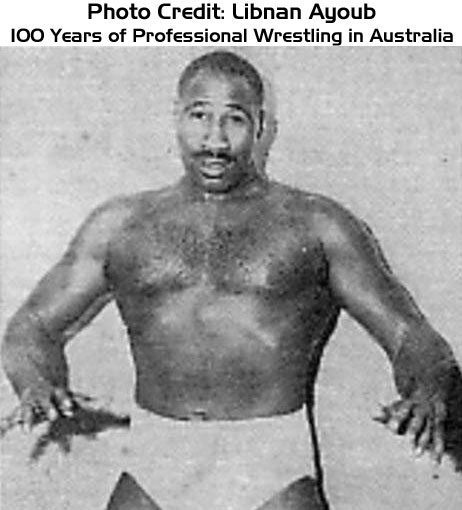
Bearcat Wright was born on 13 January 1932, making him just 21 years old in his first tour of Australia in 1953. Steve Yohe has compiled a great ring record for Bearcat showing his earliest match as 17 December 1951 whilst Bearcat was still competing as a professional boxer. Thus, Wright had just barely 18 months of experience when he made his Australian wrestling debut on 21 May 1953 and toured until the end of July that year. His name was acknowledged as Eddie Wright but he was generally billed as Bobo “Bearcat” Wright.
Size
His professional boxing statistics credited him as being 6’5″ inches tall, and 18 stone 6 pounds (258 pounds). In Australia, he was billed as 6’7″ tall and 19 stone (266 pounds) in weight.
Australian newspaper articles in 1953 acknowledged Wright as “the biggest wrestler to visit Australia”, possessing an “abnormal reach of 87 inches”, being “remarkably fast for a big man” and “in perfect condition and strong in proportion to his great weight”. It was noted that Bearcat would turn heads as he walked down main streets as he “dwarfed” the average Australian of the time.
Other newspaper reports were that Wright had “a chest measurement of 50 inches”, wore “size 13 shoes and “6 ½ yards of cloth are required to make him a suit”.
Boxing
It was published that Bearcat was formerly a professional heavyweight boxer who “in August 1951 was named in The Ring (magazine) as prospect of the month”. Wright’s pro boxing record was embellished from actually winning all of his eight professional boxing contests – 5 by knockout – to having “had 37 fights for 35 wins”. Bearcat was quoted as saying he “would like to fight Kevin Brady, heavyweight (boxing) champion of Australia.”
A gimmick at some of his matches was that “all ladies attending the wrestling will receive a free picture” of him.
The Debut Tour
Technically, all of Bearcat’s 1953 Australian matches were main events as back then, shows were headlined by a wrestling match featuring overseas stars supported by preliminary matches with local wrestlers and/or boxing bouts. At Sydney Stadium, the undercard contained two matches featuring local wrestlers plus boxing bouts. At Leichhardt Stadium (in suburban Sydney), the undercard contained three matches featuring local wrestlers plus boxing bouts, whilst the undercards at West Melbourne Stadium, Brisbane Stadium and Newcastle Stadium contained only boxing bouts.
On rare occasions, there would be two matches featuring overseas wrestlers. Of course, by these standards, all overseas wrestlers wrestled only main event matches.
Overseas wrestlers working in Australia during Wright’s campaign were Chief Little Wolf, Pat McGill, Johnny Moochy, Pierre La Salle (Eddie Auger – uncle of Johnny and Jacques Rougeau), Mario De Souza, and Nick Kapitan.
Wright’s second tour of Australia was in July to September 1966 for the World Championship Wrestling promotion of Jim Barnett and Johnny Doyle. In typical pro wrestling manner, Bearcat was then billed as 6’9″ and 20 stone (280 pounds).
He was nicknamed “the world’s most spectacular wrestler” due largely for his ability to deliver dropkicks, flying head scissors and somersault splashes despite being as such a huge man, and “the Houdini of the mat” for his smooth escapes from opponents’ holds.
Australian newspaper articles of the day proclaimed Bearcat as “a giant” who “dwarfs his opponents not only in physique but also in skill, speed and showmanship.”
Wright debuted in 1966 with great fanfare, wrestling in special event matches directly before the main events in capital cities and major towns throughout Australia. After a week Down Under, Bearcat was headlining World Championship Wrestling events. After two weeks, he teamed with Mark Lewin to win the International Wrestling Alliance (IWA) World Tag Team Titles from Skull Murphy & Brute Bernard. After five weeks, Bearcat defeated Skull Murphy to become the IWA World Champion.
At one stage, Wright held both the IWA World Championship and the IWA World Tag Team Title simultaneously.
On this tour, Bearcat had great matches against Professor Tanaka, Skull Murphy, Brute Bernard, Bob “the Bruiser” Baker (Larry Hulin aka Bobby “Hercules” Graham), Mitsu Arakawa, Mark Lewin, Dan Miller and the masked Destroyer (John Hill aka Guy Mitchell).