More matches have been announced for both Wrestle Kingdom cards, including the double championship match.
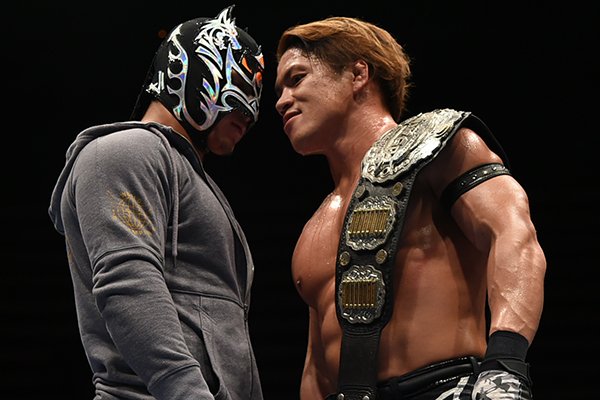
It was confirmed during tonight’s NJPW press conference that both titles will be on the line on the second night of Wrestle Kingdom 14 on January 5. This double champions match will be between the winners of two matches that take place on January 4: Jay White vs. Tetsuya Natio for the Intercontinental title and Kazuchika Okada vs. Kota Ibushi for the IWGP Heavyweight title.
The two non-champions after January 4 will compete the following day in a special singles match.
The press conference also confirmed several matches that were made during Power Struggle this past Sunday. January 4 will now have Will Ospreay defending the Jr. title against Hiromu Takahashi as well as the new Intercontinental title match. January 5 will have a special singles match between Chris Jericho and Hiroshi Tanahashi. The Jr. Tag Team title match, which will have champions Taiji Ishimori & El Phantasmo take on Roppongi 3K, will also take place on January 5.
As usual, the January 6 New Year Dash card will not have a card announced until bell time. It will host Jushin Thunder Liger’s retirement ceremony.
Here are the current cards for Wrestle Kingdom 14:
January 4 –
Kazuchika Okada vs. Kota Ibushi for the IWGP Heavyweight title
Jay White vs. Tetsuya Naito for the IWGP Intercontinental title
Will Ospreay vs. Hiromu Takahashi for the IWGP Jr. title
Jushin Thunder Liger, Tatsumi Fujinami, The Great Sasuke & Tiger Mask (with El Samurai) vs. Naoki Sano, Shinjiro Ohtani, Tatsuhito Takaiwa & Ryusuke Taguchi (with Kuniaki Kobayashi)
January 5 –
IWGP Heavyweight champion vs. IWGP Intercontinental champion for both titles
The two non champions following the IWGP Heavyweight and Intercontinental title matches on January 4 will have a singles match
Hiroshi Tanahashi vs. Chris Jericho
Taiji Ishimori & El Phantasmo vs. SHO & YOH for the IWGP Jr. Tag Team titles
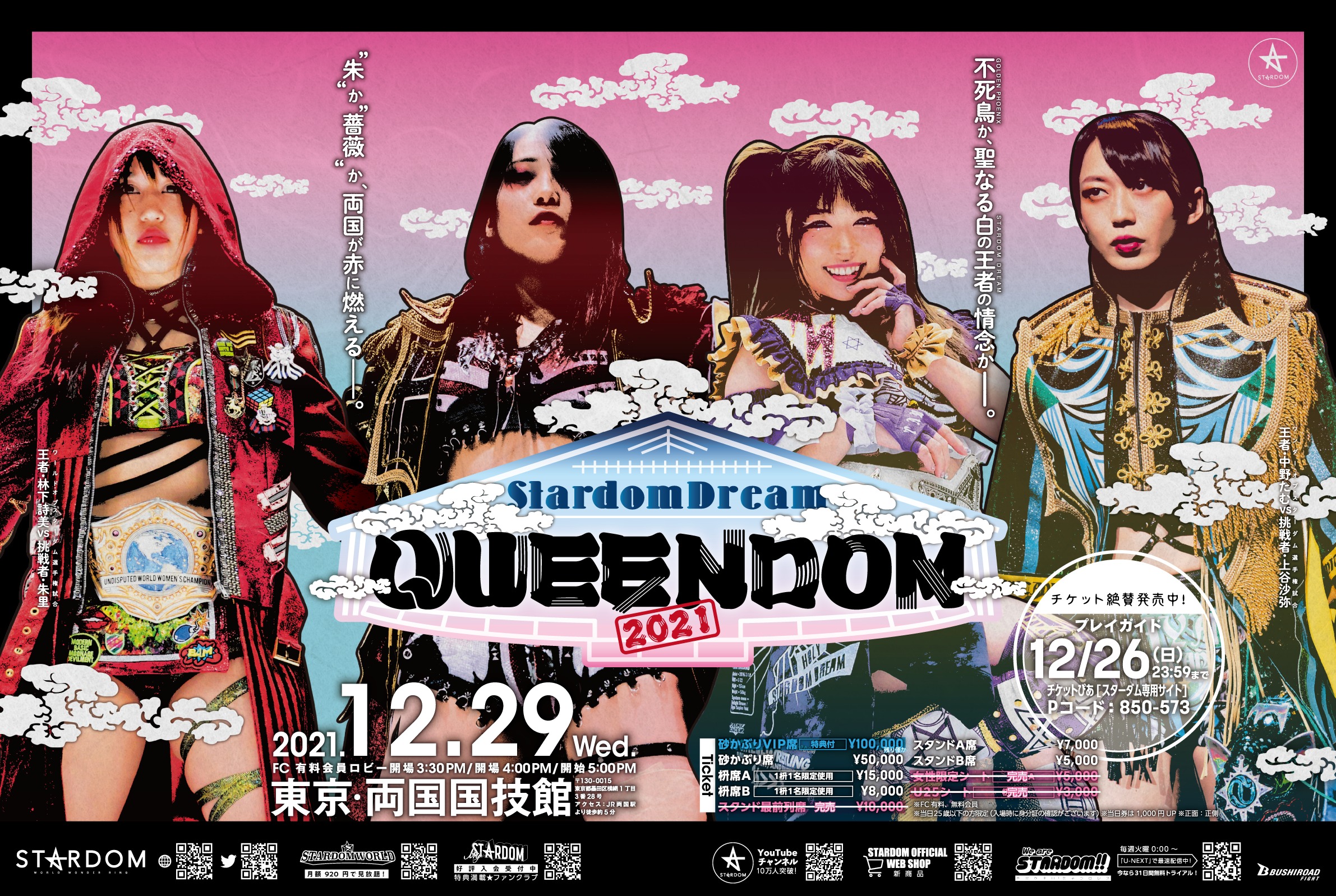
World Wonder Ring Stardom, the Japanese women’s pro wrestling company best known as Stardom, has been sold to Kix Road, a subsidiary of Bushiroad, in a deal announced Thursday afternoon in Japan.
The story is likely to be misinterpreted as either New Japan buying Stardom, a merger between the two groups, or that New Japan will start using women wrestlers on their shows. None of this would be accurate.
But what is accurate is New Japan and Stardom would both be owned by the same parent company, but they are being run and kept completely separate. Stardom will be under the umbrella of Kix Road, which is the parent company of Knock Out, the Bushiroad kickboxing company.
As part of the deal, Kix Road, on December 1, Kix Road Co,. Ltd will have its name changed to Bushiroad Fight Co, Ltd. There are no plans for any interaction between Knock out and Stardom.
Hiroshi “Rossy” Ogawa will remain CEO of the women’s wrestling promotion, which will main using the name Stardom, but World Wonder Ring Stardom will no longer exist as a company.
There will be people at Bushiroad joining Stardom to work in the front office but the Stardom staff will stay in place.
Bushiroad’s role will be attempting through advertising and television to build the popularity of the brand, similar to how the resurgence of New Japan Pro Wrestling was built.
As part of the deal, a TV show will air on BS NTV and Tokyo MX starting in January, with the BS NTV show being a 30 minute show on Thursdays.
The streaming service Stardom World will remain the exclusive for Stardom events. New Japan World will not be streaming Stardom, and with New Japan World part-owned by TV-Asahi and the Stardom TV deal with rival NTV, politically that would be almost impossible to work out.
There are no plans at present for Stardom talent to appear on New Japan shows, or vice versa. However, if New Japan does see a demand for women’s matches on foreign shows, where there is no sign of any at this point, this will give them easier access to broker a deal for such talent.
Bushiroad will begin marketing Stardom in January with more advertising in wrestling magazines, on billboards and on television, and will be marketed as part of the Bushiroad family.
As an example, on December 7 and December 8, Stardom talent will participate in CharaExpo 2019 at the Anaheim Convention Center, with a main event of Mayu Iwatani & Tam Nakano vs.Samie Sakai & Nicole Savoy.
The Stardom talent will also be signed to full-time contracts.
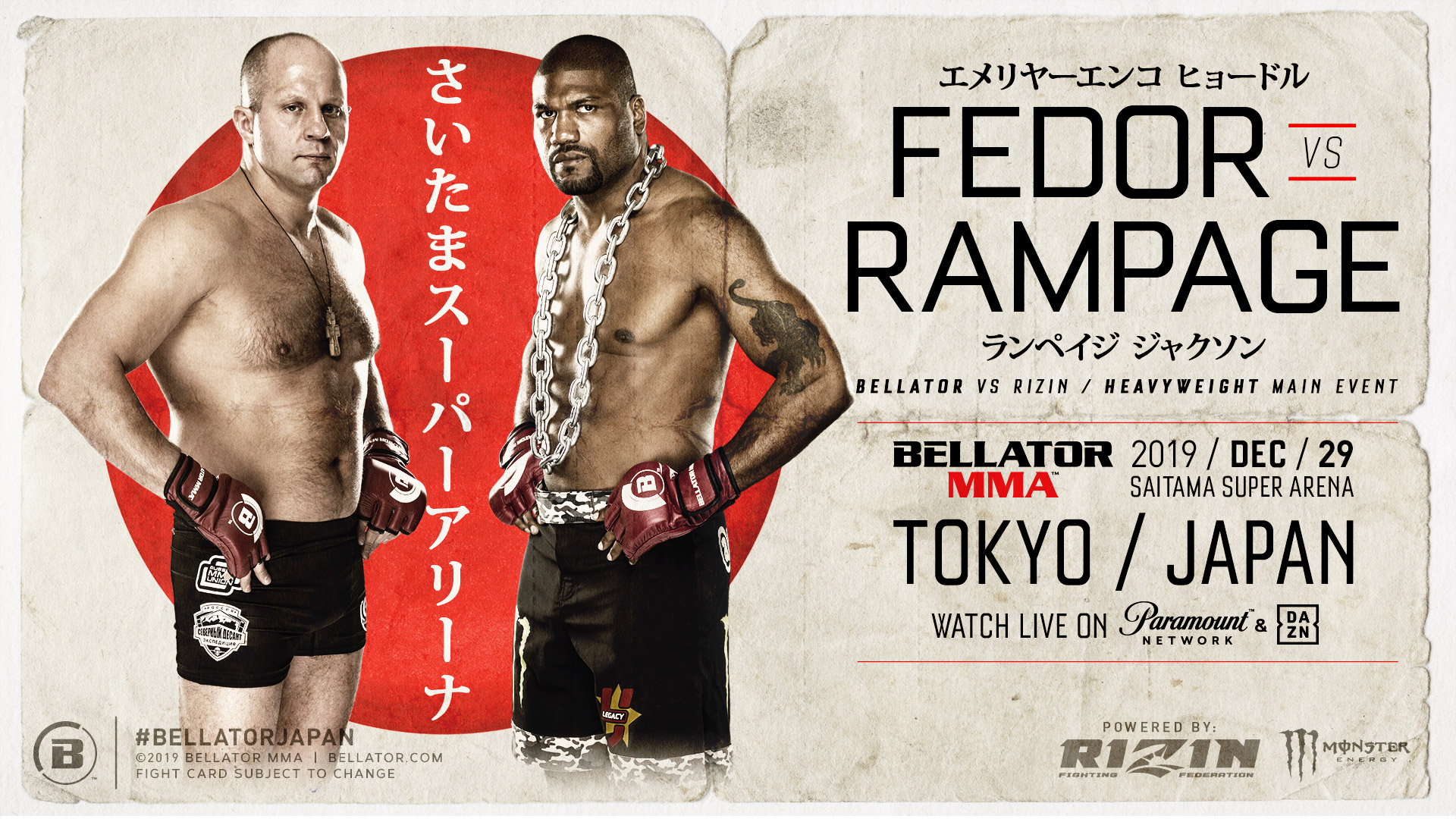
Bellator MMA announced Wednesday that former PRIDE heavyweight champion and all-time great Fedor Emelianenko will face former UFC light heavyweight champion and former PRIDE star Rampage Jackson on Sunday, December 29th.
The heavyweight fight will main event Bellator’s Japanese debut, taking place at Tokyo, Japan’s famed Saitama Super Arena. The event is being billed as Bellator vs. RIZIN with the expectation the two sides will continue their past of interpromotional fights.
It will be simulcast on DAZN and Paramount Network.
Emelianenko, 43, re-signed with Bellator this summer for what’s expected to be the final time as he once again prepares for retirement. He’s 2-2 in his run with the company and is coming off a 35-second January loss to Ryan Bader in the finals of the Heavyweight Grand Prix.
Jackson, 41, won his first four Bellator fights, but has lost two of his last three. He last was seen defeating Wanderlei Silva by second round TKO in September 2018.
Back from forming like Voltron, the original alternate returns and is (not even close to) well-rested after the insanity of WrestleMania weekend.
Co-host Adam Summers and I give our live perspective on the G1 Supercard at Madison Square Garden as well as look ahead at the upcoming Wrestling Dontaku tour.
There’s lots of rambling, but the buzz is just wearing off now so cut us a break!
Plus, get Adam’s thoughts on Pro Wrestling Revolver, NXT, and RevPro (aka New Japan’s hot exotic foreign cousin on holiday you want to hook up with), too much ROH talk, Champion’s Carnival love, and much more!
NJPW has confirmed that they have visas for their Japanese wrestlers to wrestle in the United States as they prepare for the G1 Climax 29 Opening Day this summer.
In a simple statement on New Japan’s site, the company wrote “New Japan Pro-Wrestling’s Japanese wrestlers have obtained their visas for the United States. We truly appreciate the understanding and support of our fans.”
The company also confirmed that tickets will go on sale for their G1 Climax 29 Opening Day event in Dallas, Texas on March 13 starting at 12 p.m. Central time. Prices will start at $50 and will go as high as $300.
Due to the United States government shutdown that started in December and ended a month later, New Japan was unable to get visas in time for shows that took place during the New Beginning tour earlier this month. As a result, a number of planned matches featuring the likes of Tomohiro Ishii, Yuji Nagata and Hirooki Goto had to be scrapped. ROH and other local talent were brought in instead for the shows.
Editor’s Note: In this monthly series written exclusively for our website, combat sports television commentator and regulator Sean Wheelock takes an in-depth and analytical look at infamous matches from MMA, boxing, pro wrestling, kickboxing, and the long and confused history of mixed match fighting to determine whether the controversial and contentious bouts were shoots (real competition) or works (predetermined result).
If there a bout that you’d like Sean to give the “Shoot or Work?” treatment to, send him a tweet.
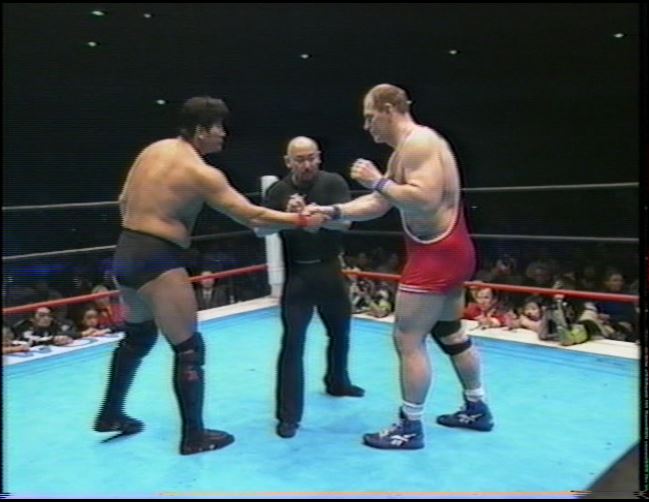
Aleksandr Karelin vs. Akira Maeda | Yokohama Arena, Yokohama, Japan | February 21, 1999 | RINGS
Overview
Aleksandr Karelin vs. Akira Maeda was the main event of the 27th MMA card held by the Japanese promotion Fighting Network Rings, which had pivoted from pro wrestling to mixed martial arts four years prior. Dubbed “RINGS: Final Capture”, the nationally televised show in Japan was comprised of seven total bouts, and included future PRIDE fighters Ricardo Morais, Yoshihisa Yamamoto, and Valentijn Overeem (Alistair’s older brother); Sean Alvarez, who went on to fight at UFC 42; and Nikolai Zouev, who became Sergei Kharitonov’s main grappling coach.
A sellout crowd of 17,048 produced a live gate of almost $2.5 million USD, widely reported as the largest monetary sum to that point for a fight card of any kind held at an indoor arena in Japan.
The bout, scheduled for two five-minute rounds, featured the MMA debut of Karelin, known as “The Experiment”, and (then and now) widely considered the greatest ever Greco-Roman wrestler, vs. Japanese puroresu superstar and promotion co-founder Maeda.
Competing in the 130 kg (286 lb) weight class, Karelin ultimately amassed a record of 887-2 in his truly remarkable wrestling career in which he won three straight Olympic gold medals as well as gold at nine World Championships and at 12 European Championships.
At the time of the Maeda match, Karelin was the reigning Olympic Gold Medalist from the 1996 Atlanta Games where he didn’t concede a single point in the entire competition, and where he was given the honor of carrying the flag for his native Russia at the Opening Ceremonies.
At 31, Karelin didn’t just seem unbeatable–he actually was unbeatable, having not lost a Greco-Roman wrestling match in 12 years, nor dropped a point in five years.
His opponent for this “Fight of the Decade” was truly a legend in Japanese pro wrestling. Although unable to achieve the popularity of Antonio Inoki at home and abroad, Maeda was still an outright star in his native Japan, and one who transcended sports into popular culture.
Having just turned 40 the month prior, and having retired from both pro wrestling and MMA the year before, Maeda was still viewed as the man who possessed both the fighting ability and the requisite fame to serve as a worthy opponent for the mighty Karelin. And with seven career MMA victories, coupled with a well earned reputation as a pro wrestler who could and would shoot on uncooperative and/or disliked opponents in worked matches, he was even seen by some in the Japanese public as the fighter who just might be able to actually defeat Karelin in this still new and rapidly evolving combat sport.
Maeda had begun his career 21 years earlier in New Japan Pro Wrestling, did a brief stint in the WWF in 1984, helped launch Newborn UWF in 1988, and then co-founded Fighting Network Rings in 1991. The Wrestling Observer Newsletter named Maeda Wrestler of the Year in 1988, and Promoter of the Year just a year later. In MMA, Maeda had fought 11 times entering the Karelin bout – all in RINGS – with his most notable win coming over future UFC heavyweight champion Maurice Smith on New Year’s Day 1997.
Like the other six fights on the card that night, Karelin vs. Maeda used the RINGS rule set which made closed fist punches and elbow strikes to the head illegal from all positions; closed fist punches to the body and knees to the head illegal on the ground; and which allowed for rope escapes to break submission holds. Ryogaku Wada, RINGS’ top referee, was assigned to the bout. Like virtually all Japanese mixed martial arts refs at that time (including Yuji Shimada), Wada had come from pro wrestling, in this case UWF International. He’d reffed alongside Shimada at the inaugural PRIDE event two years prior, and had helped write the RINGS MMA rule book.
Although the line was continually blurred between MMA and pro wrestling during this era across all Japanese promotions (PRIDE and Pancrase most definitely included), and although the bout was taking place in Fighting Network Rings, which had begun life as a unabashed puroresu promotion, Karelin vs. Maeda was sold as a completely legitimate MMA bout to be honestly contested by two hugely accomplished stars from very different disciplines.
The Match
Immediately after the opening bell, Maeda, attired in pro wrestling trunks and boots, comes forward and throws two solid low kicks with his right leg. Karelin, wearing a wrestling singlet and wrestling shoes, takes the strikes flush on the outside of his lead left leg, which causes him to circle out towards the ring ropes. Maeda then closes the distance, throws another right low kick which lands, re-sets and just misses with a right head kick, then turns over another right outside kick into Karelin’s left leg.
Maeda then shoots a double leg, on which Karelin sprawls, gains double underhooks, and takes Maeda to the ring mat. Karelin then quickly sits through from side control to take Maeda’s back. But instead of looking for a choke, Karelin goes for a wrist ride. Maeda then turns onto his own back, and drapes his right leg over the bottom rope, forcing the stand up. The absence of submission attempts and utter submission awareness by Karelin would quickly become the recurring theme of this bout.
From the center ring restart, Maeda throws another right low kick, followed by a fingers out slap to Karelin’s face with his lead left hand, and then two more right low kicks, which flows to a completely whiffed upon arm drag takedown. This miss allows Karelin to take Maeda’s back again, from where he goes to work with a chest hold, a head chancery, and a modified half nelson. Maeda is able to get open guard, which Karelin quickly turns into what seems like a perfect Boston crab set up.
But the lack of sub attempts continue as Maeda moves to the edge of the ring on all fours in a stalling position. Karelin locks an S-grip under Maeda’s chest, and starts to set up a reverse body lift (renamed the Karelin Lift as this was his signature and fearsome move in Greco-Roman). But Maeda’s position on the ring apron causes referee Ryogaku Wada to order the bout’s second stand up.
After the re-start, Maeda lands yet another hard right low kick. Karelin attempts to counter with a an illegal closed fist lead left jab, which misses Maeda’s head. Perhaps remembering the RINGS rules, Karelin then puts an open left palm in Maeda’s face, but with almost no force. After the trading of open hand slaps to the head, Karelin is able to then gain inside position. From there, he snatches what could have been a standing guillotine, but Karelin instead uses as a head chancery to hit a clean front head lock throw. This lands Karelin in side control, but Maeda is able to scramble out and then take down Karelin with a single leg.
Karelin quickly turns onto his stomach and starts to crawl towards the ropes as Maeda holds his opponent’s right leg, contemplating perhaps a reverse knee bar from a really odd angle, or a modified rolling ankle lock. But before Maeda can attempt any true leg lock submission, Karelin gains the automatic escape by clutching the bottom rope with his right hand.
Back in the stand up, Karelin actually checks his first kick of the match (and perhaps of his life), and takes Maeda down with a throw from a single underhook to again do nothing more than hold top position and awkwardly squeeze Maeda from various angles.
Maeda is able to get back to his feet only to be taken down once more, this time by a solid head and arm throw. Karelin elects to pop back up, rather than stay tight to his opponent on the ground, and methodically moves into the Karelin lift as Maeda is on all fours. Karelin then brings Maeda off the mat, and holds him almost completely vertical and upside down. Maeda takes the brunt of the impact on his left shoulder as he’s slammed to the mat. Karelin lands in side control, but Maeda is able to work back to his feet, where he connects with a series of punches and knees to Karelin’s body. Karelin answers with another takedown, where he applies a somewhat arm-in side headlock while using an S-grip. Maeda postures on to his left hip to alleviate the pressure, just before the bell sounds to end Round 1.
Lax officiating by Ryogaku Wada causes the one-minute break between rounds to run 75 seconds as he’s slow to hustle Karelin’s four cornermen out of the ring.
Upon the start of Round 2, Maeda comes out quickly with a barrage of low kicks, head slaps, and a knee to the body as he closes the distance. Karelin attempts an arm drag takedown, and just as Maeda did in the opening round, fails to execute. This error lands Maeda in top position, which he quickly uses to take Karelin’s back, and look for a rear naked choke. But with no hooks in, Maeda gets very high in the ride and goes over the top as he loses the submission attempt. Karelin seizes the opportunity to sit through and grabs a side headlock. Rather than attempting to defend, Maeda instead shoots his right foot over the bottom rope, forcing the automatic break.
With both fighters back on their feet center ring following the re-start, Maeda lands two more low kicks with his right leg to Karelin’s left leg, making Karelin look extremely awkward in the process. Karelin is able to work to the inside and tie up Maeda, who elects to take himself to the mat, roll to his back, and into open guard. Karelin bases up, gains full mount, and then mystifyingly proceeds to bend Maeda’s left arm in the anatomically correct direction. As an aside, arm and leg locks work on the basis of moving the limbs in the direction in which they are not anatomically designed to move. Karelin, however, bends Maeda’s left arm downward towards Maeda’s own chest, creating absolutely no pressure on the elbow joint; the reverse actually.
Hand fighting followers with Karelin still in top position until Maeda shrimps under the bottom rope whereupon Wada elects to stand up the two fighters. Back on their feet, Karelin absorbs more leg kicks until he clinches and hits another head and arm throw. From side control, Karelin turns a side head lock into an almost accidental neck crank. Maeda immediately drapes his right foot over the bottom rope for yet another rope escape.
This time from the center ring re-start, a suddenly weary looking Maeda fails to throw any of his outside kicks that have been so effective to this point, and allows Karelin to come back inside unabated. From the clinch, Maeda throws a left knee, which Karelin catches, and then transitions into a slick scoop body slam. Maeda turtles, Karelin locks on a chest hold, and then Maeda rolls to his back. Karelin goes back to the side head lock, which Maeda is able to escape, and then regains his feet.
From the ensuing tie-up, Maeda takes himself back down to the canvas, is lifted up by Karelin, and then drops down again while feebly and unsuccessfully trying to cradle Karelin’s left leg. From top position, Karelin again goes for the Karelin Lift, but this time is only able to elevate Maeda about 10 inches off of the ground, and horizontally rather than vertically. Karelin does however hit the throw, perhaps the least impressive Lift of his life, and then grabs a half nelson. Maeda turtles once more, then rolls to his back. Karelin breaks contact completely, and Wada orders both men to get up. Karelin now looks utterly exhausted, but not quite as exhausted as Maeda.
Back on their feet, Maeda shoots a fingers-fully-extended open hand jab towards Karelin’s face, but misses. Karelin comes inside, and maneuvers into prime belly to back suplex position. But Maeda grabs Karelin’s wrists as an effective counter, causing Karelin to instead force his opponent forward and down onto the mat. In the closing seconds of the bout, Karelin bypasses a guillotine to instead grab another head chancery as his left arm overhooks Maeda’s head. Before it can be fully applied, the bell rings, thus ending the second and final round.
Karelin immediately stands up while Maeda stays on the canvass, flat on his back. Exactly 13 seconds after the final bell, Karelin is announced as the winner, getting the decision victory.
The Case for a Shoot
In the book that I co-wrote with UFC founder and Hall of Famer Art Davie about his launching the UFC, we recounted Art’s unsuccessful attempt to recruit Karelin for UFC 1 due to the byzantine politics of post-Soviet Russia at that time. Art could never even get a contact of a contact of a representative of an associate of Karelin, let alone reach the great man himself. But even after the first UFC, Art persisted in his quest, which caused his business partner and fellow UFC co-owner of the time Rorion Gracie, genuine concern.
What is not in our book, but what Art has told me, is that Rorion confided in him that if Karelin did sign with the UFC, Rorion would replace Royce with the real family champion, Rickson. The respect was that great for Karelin within the Gracie Family.
Yet, for all of the talk before and after this match that Karelin was the real-life Ivan Drago of Rocky IV fame, it’s painfully clear that Karelin has absolutely no idea how to strike and doesn’t know a single submission. Being the greatest Greco-Roman wrestler of all time doesn’t automatically make him a great, or even a good, mixed martial artist. In the Maeda match, Karelin appears not like the most ferocious and unbeatable fighter on the planet, but instead looks like a lot of international level wrestlers who crossed over to MMA in the 1990s and early 2000s: quality takedowns, solid top control, positional dominance, and absolutely nothing else.
For their bout, both men were listed at 6’3″ (although numerous sources note Karelin was actually 6’4″), but Karelin had 38 pounds on Maeda, being announced at 295 to his opponent’s 257 on that night. Other than the takedowns and throws, Karelin did virtually nothing with his sizeable weight advantage.
Maeda, meanwhile, had an extensive and high level karate background from his youth, understood catch wrestling and elementary submissions from his long run in puroresu, and entered the Karelin match as a four-year veteran of MMA. He also had a well earned tough guy reputation from two decades of incidents in and out of the pro wrestling ring.
This all brings us to the main (and earliest) argument for Karelin vs. Maeda being a work. If it were a legit MMA match, Karelin would have absolutely trucked by Maeda. Yet, this is really based on the evidence of Karelin’s unparalleled Greco-Roman wrestling career, coupled with his massive athletic frame. Pawel Nastula won 312 straight matches, 2 World Championships, and an Olympic Gold Medal in judo, yet was TKO’d in the first round by Antonio Rodrigo Nogueira (Big Nog) when Nastula made his MMA debut in PRIDE in 2005.
Karam Gaber and Istvan Majoros both won Gold in Greco-Roman wrestling at the 2004 Summer Olympics and both were finished inside of one round in their lone MMA bouts. All three men were superstars in their respective sports but were unable to make an impact in MMA. Perhaps Karelin could have replicated his Greco-Roman dominance in mixed martial arts, but based on the Maeda fight, he had a very, very long way to go.
In the match itself, Maeda landed numerous hard outside kicks to Karelin’s lead leg, which visibly caused Karelin to move off of his striking line, and in some cases, even retreat. For his part, Karelin hit both throws and takedowns, including the Karelin Lift. To view this match properly, it’s important to be reminded of the RINGS MMA rule set, which greatly limited striking from what we see in the sport today. Karelin simply wasn’t allowed to legally throw punches and elbows to Maeda’s head from the top position that he continually gained throughout the 10 minute match. And Maeda wasn’t permitted to punch Karelin’s head in the stand up. Had the rules been more liberal, things could possibly have looked, and gone, much different.
And then there is, to a lesser extent, the reaction of the media towards this match. As I wrote in my column last month on Andre the Giant vs. Chuck Wepner, how the press views a bout (at the time and with historical perspective) doesn’t really mean anything, but it’s still worth noting.
In 1999 Japan, this match was covered as a straight up fight and the biggest in the country since Muhammad Ali vs, Antonio Inoki 23 years earlier. The Russian media treated it as legit, as did the mainstream US press, including The New York Times and Sports illustrated. A 2008 profile of Karelin, written by Jeff Wackerly for Bleacher Report stated, “Karelin threw him (Maeda) around for the duration of the match…imagine the potential.” Even now, Sherdog lists Karelin vs. Maeda in their MMA records database (although incorrectly as a three-round bout).
The Case for a Work
For starters, you have Karelin facing one of Japan’s most famous pro wrestlers in his own organization which started by promoting pro wrestling before it turned to mixed martial arts, and which is now widely accepted to have featured numerous worked MMA matches. Maeda wasn’t just a legendary figure in puroresu, he was one of the founding fathers of shoot style. And make no mistake, this match contains numerous markings of a shoot style pro wrestling bout.
Strikes are definitely landed, including those numerous Maeda right outside kicks to Karelin’s left leg, which Maeda really turns over. But the knees that Maeda lands to Karelin’s body clearly lack forceful impact. And while Karelin hits numerous throws and takedowns, including a really solid front headlock throw in the opening round, none of them are beyond what you would see daily between teammates in a quality wrestling room. In fact, they seem a bit more gentle.
Those who cling to the legitimacy of this fight often cite the fact that 18 months later at the 2000 Summer Olympics in Sydney, Australia, Karelin lost the Gold medal match to Rulon Gardner and then promptly retired. The implication is that Karelin was pretty much shot by the time that he faced Maeda, thus the reason for his lackluster (albeit victorious) performance in Yokohama vs. Maeda. What is omitted from this narrative is that Karelin won his other four matches of the 2000 Olympic competition by a combined score of 13-0 and fell to Gardner in the final 1-0 with the lone point being scored through Karelin’s loss of a grip.
Karelin may have been in his fourth Olympiad but was only 33, having had his birthday the week before the Gardner match. He was hardly old, and far from past his prime.
There are actually two smoking guns in this bout which expose this as an outright work: one big and one massive. The big one is the single leg takedown that Maeda hits on Karelin in round 1. Really? A single leg takedown on Karelin? Of course, in Greco-Roman wrestling, it is illegal to grab an opponent’s legs. But still, the guy who entered this fight without having conceded a single point in wrestling in five years, is taken down by a 40 year old who had never had a match in Greco-Roman, freestyle, or folkstyle wrestling in his life. And, this takedown occurs right after Maeda had been on the receiving end of a front head lock throw that dumped him on his back.
But the massive smoking gun comes in the form of a move that Karelin actually did hit: the Karelin Lift in round 1. Now, the round 2 Karelin lift was awful, but the poor form could be explained away by his presumed exhaustion. But in the opening round, Karelin looked completely fresh as he held Maeda, with his legs straight up, head straight down, above the mat. Karelin had done this with numerous world class Greco-Roman opponents before, many of whom weighed considerably more than Maeda’s 257.
To be clear, Karelin didn’t invent the reverse body lift. Rather, he became the only big weight category Greco-Roman wrestler to be able to accomplish it at the international level. And, of course, Karelin accomplished it so frequently and with such ferocity and perfection, that it now bares his name. During his wrestling career, Karelin would regularly and legally spike his opponent’s head into the mat from the Karelin Lift, viciously compressing their neck, spine, and shoulders.
The move was so feared that in the final round match of Pool A at the 1992 Summer Olympics, Ioan Grigoras elected to roll on to his back and concede the pin to Karelin in just 14 seconds, rather than risk severe injury via the Lift. Grigoras rationalized that he had a zero percent chance of defeating Karelin, but by losing quickly and relatively violence free, he could come back and capture the Bronze medal (which he did).
But against Maeda, Karelin dumped his opponent onto his left shoulder from the first round Karelin Lift rather than onto his head. The impact is so slight, and the sell is so minimal, that Maeda is actually back on his feet 15 seconds later. This moves from the realm of unthinkable to actually laughable. All that was missing was a Hulk Hogan style finger wag by Maeda after surviving the Lift to move into full blown kayfabe territory.
The result of the match is extremely telling as well. Karelin got his win, but Maeda went the distance against the unbeatable champion. Maeda was allowed to have his moments along the way: landing strikes, taking Karelin’s back, attempting subs, and even hitting that single leg takedown.
That Karelin had never had either a pro wrestling or MMA match when he faced Karelin speaks fairly well of his performance. Still, he’s far from fluid, and, at times, looks as though he’s moving at half speed compared to his Greco-Roman matches of the era.
For his part, Maeda did just enough to lose and put Karelin over while making the bout appear competitive. He did, however, seem unrealistically exhausted and/or injured at the conclusion of the match, and then carried the act out of the ring as the live broadcast cameras followed him backstage. Even had this been a shoot, it was only a ten minute match, and one in which Maeda never got hit. Oh well.
And what’s with the decision being announced just 13 seconds after the end of the match? How could it possibly have been legitimately determined so quickly that Karelin was the winner when Maeda was never in any serious jeopardy during the two rounds?
The Verdict
This is a work without question. It’s just not overly obvious due to the lack of theatrics and histrionics that no doubt would have been present had Karelin instead faced someone from Vince McMahon’s stable in a purported real fight under the WWF banner. Watch any high level shoot style wrestling match from Japan during this era and Karelin vs. Maeda suddenly doesn’t look that unique. This is just one of numerous matches from 1990s Japanese MMA that settles firmly into that gray area between real and imagined.
In the United States, MMA was partially inspired by the backroom Gracie Challenges that UFC creator Art Davie witnessed during his time as a student at the Gracie Academy in Torrance, California; real fights emanating from a Brazilian Jiu-jitsu base. Japanese MMA, meanwhile, evolved directly from pro wrestling, namely strong style and shoot style pro wrestling with puroresu icons such as Nobuhiko Takada, Masakatsu Funaki, Satoru Sayama, and of course Maeda, leading the way.
Aleksandr Karelin vs Akira Maeda serves as the prototypical example of a match from the time when professional wrestling and mixed martial arts in Japan were rapidly heading towards a clean split, yet were still intrinsically linked together. That it features two absolute legends meeting in the same ring, regardless of the circumstances, makes it something truly special.
Next month: Ken Shamrock vs. Kimbo Slice.
*********
Sean Wheelock is an MMA, boxing, and combat sports television commentator, having broadcast over 3,00 bouts across 21 countries. He’s also the Chairman of the ABC’s MMA Rules and Regulations Committee, a Commission Member of the Kansas Athletic Commission, and a former licensed professional boxing referee. And despite his best efforts and years of diligent training, Wheelock remains a very mediocre grappler, and a less than mediocre striker.
Buy the book that Sean wrote with UFC creator and Hall of Famer Art Davie about the birth of the Ultimate Fighting Championship, enttiled Is This Legal? It’s also available in hard copy or Kindle ready at Amazon.
The original alternate returns with a bit of banter ‘bout Japan…just sliding in before the end of the month.
After a short reintroduction, yours truly and Adam Summers talk about the state of the current team leagues: New Japan’s World Tag, and All Japan’s original recipe Real World Tag.
Also, as WWE continues to sink their tentacles into everything globally, there’s something to consider about future WrestleMania weekends.
Plus, Being The Change you wish to see in the World, Katsuhiko Nakajima is a glorious bastard, some thoughts on random matches, and more.
It’s the other two guys who talk about Japan on this site: The Adam and Mike BIG AUDIO NIGHTMARE~!
Will Ospreay is off Power Struggle after suffering an injury earlier this month.
New Japan’s English website made the announcement tonight that Ospreay will not make his scheduled match against Taichi for the NEVER Openweight championship at next weekend’s event, saying that he needs more time to recover from the injury. There will not be a replacement match and instead the bout will be cancelled.
Ospreay suffered an injury to his ribs back on October 14 in a match against Chris Ridgeway on a RevPro/New Japan Global Wars UK event in Brixton, England. He landed wrong after a kick and was taken to a hospital for evaluation after the match.
A few days later, New Japan announced that Ospreay would be taken off the Road to Power Struggle tour and instead would focus entirely on the NEVER title match at Power Struggle. Obviously, things have changed.
Power Struggle is set to take place on November 3 at the Osaka Prefectural Gymnasium.
Ayako Hamada has been placed under probation following her arrest for possession of methamphetamines.
Initially, outlets in Japan and the US reported that Hamada had been sentenced to eighteen months in prison. Sister Xochitl Hamada, however, told Mediotiempo in Mexico that Hamada had been sentenced to three years probation, and that if she were to violate her probation she could face eighteen months in prison.
In a statement to media in Japan, Hamada announced that she is retiring from pro wrestling due to the situation. She stated that she hopes to find work as a interpreter since she is fluent in both Japanese and Spanish.
Hamada, 37, was arrested back on May 13 for possession of a banned stimulant, in this case meth. Pro Wrestling Wave, who she was working for at the time, immediately terminated her contract. Sendai Girls also stripped her of their world title, which she had just won a few weeks before her arrest.
The daughter of Gran Hamada, Ayako Hamada started her career in 1998, initially working for the Arison promiton. She would later go on to wrestle mainly in Japan and Mexico, though she did have a run in Impact Wrestling and has also wrestled for SHIMMER. Before her arrest, she had been mainly working for Seadlinnng and Sendai Girls, along with Pro Wrestling Wave.
In a surprise move, longtime junior heavyweight Taiji Ishimori announced today that he is leaving Pro Wrestling NOAH effective immediately.
Ishimori, 35, announced that starting today he would become a freelance wrestler after being a part of Pro Wrestling NOAH for over 12 years, starting with the promotion back in 2006. Ishimori said in a press conference at NOAH’s Tokyo office Monday that people like Hideo Itami and Shinsuke Nakamura inspired him to make the move.
“While I personally do like to fight on the front line of things, I have experienced [a] overseas expedition and [am] more interested in the outside world now,” he is quoted as saying in a translation from a Yahoo Sports article. “I have been at NOAH for twelve years and a wrestler for sixteen. If I do not make this decision, I will regret it unless I take the first step.”
“WWE is the goal and I want to keep trying to end up there” he mentioned.
Ishimori had been a big staple of the junior heavyweight division in the promotion, winning the GHC Junior Heavyweight championship three times. He most recently appeared for Impact Wrestling where he held the X Division title until this past January when Matt Sydal defeated him for the title.
Haruka Eigen, an Executive Director of Pro Wrestling NOAH that was also as a full-time wrestler for 40 years, passed away at 8 p.m. Japanese team at his home. He was 70.
Little information is out on the death at this point other than the promotion reporting it and Great Kojika, a contemporary, also releasing the information.
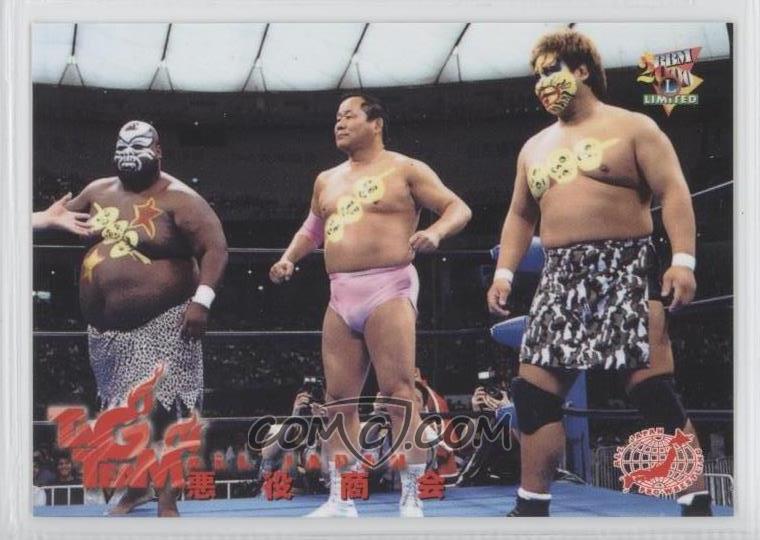
Eigen (pictured in the center above) was a preliminary wrestler best known in the glory days of All Japan Pro Wrestling for the “spit spot” where he’d be chopped hard in the chest and would spit in the crowd.
As part of the comedy match on those shows (a six-man tag that usually involved a past-his-prime Giant Baba and Rusher Kimura), fans seated at ringside knew to bring the newspaper you’d pick up at the train station (usually Tokyo Sports) to the matches. In those six-man tags, people would then shield themselves using the newspaper like an umbrella as they did the carefully set up spot.
Eigen wrestled from 1966 until a retirement series in Pro Wrestling NOAH in 2006. He started with the old Tokyo Pro Wrestling promotion under Antonio Inoki, and then moved to the JWA upon the folding of Tokyo Pro in 1967. He was wrestling in the United States as part of a heel Japanese tag team when the JWA folded, and signed with New Japan in 1974.
He made the switch to All Japan in late 1984 as part of Choshu’s Army where he became a mid-card fixture.
WWE announced on Sunday night that Osaka’s Edion Arena will host NXT’s first live event in the country on Saturday, December 3rd.
If he manages to hold the title until December, the show will be Shinsuke Nakamura’s homecoming as NXT Champion. NXT Women’s Champion Asuka is also scheduled to return to her home country for the show. She previously defended her title in Japan twice during WWE’s tour of the country in July.
Not to be forgotten after recently returning from a lengthy absence due to a shoulder injury, Hideo Itami tweeted that he will appear on the show. Itami hasn’t wrestled in Japan since joining WWE in 2014.
Though NXT has never held a standalone show in Japan, the NXT Championship previously changed hands at Tokyo’s Sumo Hall when Finn Balor defeated Kevin Owens for the title at WWE Network’s Beast in the East special in July of 2015.
The event in Osaka comes ahead of NXT’s eight-show tour of New Zealand and Australia in December. The dates and locations for those shows are:
December 5th — Auckland, NZ | The Trusts Arena
December 6th — Wellington, NZ | TBS Bank Arena
December 8th — Melbourne, Australia | Margaret Court Arena
December 10th — Newcastle, Australia | Newcastle Entertainment Centre
December 11th — Gold Coast, Australia | Gold Coast Convention & Exhibition Center
December 13th — Sydney, Australia | Qudos Bank Arena
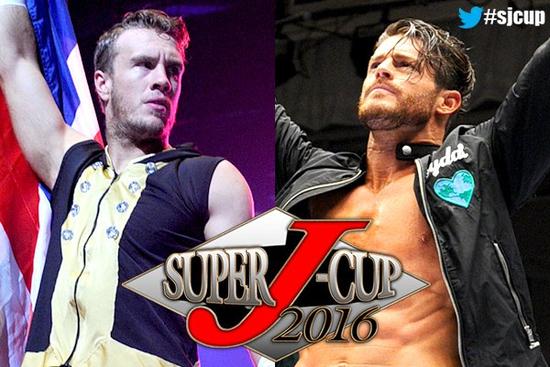
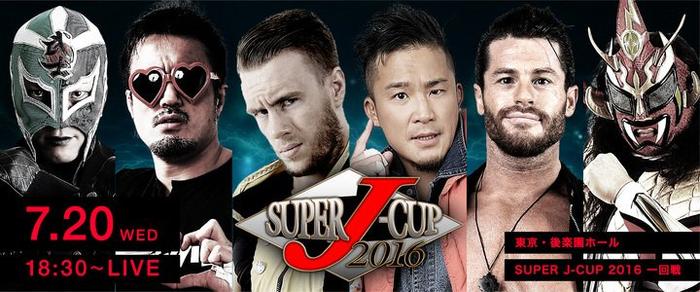
The 2016 Super J-Cup crowns its winner on Sunday morning with the tournament finals airing live on NJPW World from Tokyo, Japan.
We’re looking for your thoughts on this show, the UFC show, the NXT show and the ROH show with thumbs up, thumbs down, thumbs in the middle along with a best and worst match to [email protected]
Going into the show, Jushin Thunder Liger, Taichi, KUSHIDA, Kenoh, Ryusuke Taguchi, Yoshinobu Kanemaru, Matt Sydal, and Will Ospreay are all still alive in the tournament. The card will feature second round matches, semifinal matches, and the tournament final.
And the show will also feature notable appearances from competitors outside of the tournament, as The Young Bucks defend their IWGP Junior Heavyweight Tag Team Championship against familiar rivals in the Motor City Machine Guns.
The GHC Junior Heavyweight Tag Team Championship will be on the line as well, with Atsushi Kotoge and Daisuke Harada defending against ACH and Taiji Ishimori. And the show will feature CMLL stars as Volador Jr., Titan, and Caristico take on Ultimo Guerrero, Gran Guerrero, and Euforia in a six-man tag.
Our coverage starts at 2 a.m. ET/11 p.m. PT. The full card is:
Super J-Cup tournament finals match
IWGP Junior Tag Team Champions The Young Bucks (Matt & Nick Jackson) vs. The Motor City Machine Guns (Alex Shelley & Chris Sabin) for the titles
GHC Junior Tag Team Champions Atsushi Kotoge & Daisuke Harada vs. ACH & Taiji Ishimori
Super J-Cup tournament semifinals match
Super J-Cup tournament semifinals match
Volador Jr., Titan, & Caristico vs. Ultimo Guerrero, Gran Guerrero, & Euforia
Matt Sydal vs. Will Ospreay in a second round tournament match
Ryusuke Taguchi vs. Yoshinobu Kanemaru in a second round tournament match
KUSHIDA vs. Kenoh in a second round tournament match
Jushin Thunder Liger vs. Taichi in a second round tournament match
David Finlay, Eita, & Yuma Aoyagi vs. BUSHI, Kaji Tomato, & Gurukun Mask
EITA & DAVID FINLAY & YUMA AOYAGI VS. BUSHI & KAJI TOMATO & GURUKUN MASK
Okay match. Eita, Gurukun Mask and Aoyagi did some cool dives at the end. Bushi pinned Finlay coming off the top rope with a codebeaker. After the match, Bushi turned on his teammates, blowing mist in Tomato’s eyes after Tomato offered him a tomato, and then Bushi started tearing up Gurukun’s mask.
JUSHIN LIGER VS. TAICHI IN THE QUARTERFINALS
Nothing to this match. Desperado kept interfering. It ended up on the floor in the aisle with Liger fighting with Desperado and Taichi. Taichi kicked Liger and Desperado just held Liger on the ground while Taichi ran in to beat the count and win via count out quickly. Taichi had his girl with him who was hitting on Liger before then making out with Taichi. After the match Liger hurled a chair at them and hit Desperado right in the from far away and he went down selling the knee and limped to the back.
KENOH VS. KUSHIDA IN THE QUARTERFINALS
This was an excellent technical match. If you’re into top level matwork this was it. But a big issue today is that the crowd is small and because of that it doesn’t have the big event feel. They exchanged moved and submissions on the mat with Kushida constantly going for the hoverboard lock until getting the armbar in the middle for the submission. This sets up Kushida vs. Taichi next.
RYUSUKE TAGUCHI VS. YOSHINOBU KANEMARU IN QUARTERFINALS
This was good, but lacked heat which is looking like the theme of the show. Kanemaru kicked out of the Dodon and Taguchi kicked out of a DDT off the top rope but Kanemaru followed that up with his touch out, which is a brainbuster for the clean pin. Kanemaru is the GHC jr. champion so he figured to not get eliminated here.
WILL OSPREAY VS. MATT SYDAL IN QUARTERFINALS
In an upset, Sydal pinning him clean with a shooting star press after a reverse Frankensteiner off the middle rope. Athletically, this blew away anything this week but this is just not a crowd where you can be in the match of the year because they were so quiet, although in the end you could see they really liked it. There was an awesome high spot early. Ospreay did the Space Flying Tiger drop and a lot of things that were blow away like Sydal giving Ospreay a lariat and Ospreay doing a spin bump and landing on his feet. It wouldn’t be my call to beat Ospreay here.
TITAN & CARISTICO & VOLADOR JR. VS. ULTIMO GUERRERO & GRAN GUERRERO & EUFORIA
Very good match and the crowd appreciated it but didn’t go wild for it. It was almost exactly what you’d think. The first several minutes of heel heat saw nobody care because there was no interest in personalities or storyline. Once they did the first sequence of dives the crowd was into it. Caristico is nowhere near 100% due to a broken pelvis and he was the big star from his days as Mistico. Titan and Volador were great and the heels did their jobs. The biggest reaction was Volador doing a big plancha into a hurricanrana. Caristico kicked out of the Guerrero special. Volador pinned Gran Guerrero after a top rope Spanish fly. This was pretty much their Friday night Arena Mexico match but without the intense fan reaction.
KUSHIDA VS. TAICHI IN THE SEMIFINALS
Taichi attacked him before the match with the mic stand. At one point Kushida made a comeback and was on the top rope for a dive to the floor, Taichi’s girl got in front of Taichi so he wouldn’t dive. Taichi used the ring bell and played heel and got good heat. Kushida came back with the hoverboard lock but Desperado distracted the ref who missed Taichi furiously tapping. Taichi hit Kushida in the head with a chair and used the Gedo clutch for a strong near fall. Kushida also kicked out of a last ride power bomb and scored the pin with a spinning move into a cradle. After the match Taichi and Desperado attacked him again.
Editor’s note: The remainder of the show was covered by Bryan Rose
MATT SYDAL VS. YOSHINOBU KANEMARU
Good back and forth match. You can tell they were going forward with a champion vs. champion finals results since Kanemaru is the current GHC junior champion. Sydal tried for the shooting star press but Kanemaru got the knees up, smashed him with a lariat and picked up the win to go to the finals.
GHC TAG TEAM CHAMPIONS ATSUSHI KOTOGE & DAISUKE HARADA VS. ACH & TAIJI ISHIMORI
Pretty good match. ACH in particular looked strong here and should be a regular in NOAH going forward as he could definitely be a new bright spot in that division. Cool spot at one point was ACH and Ishimori hitting stereo 450 splashes, but both Kotoge and Harada got the knees up and cradled them for a double near fall. Kotoge and Harada isolated Ishimori and pinned him after a bridging German suplex by Harada.
After the match, the champions called out Gedo & Jado. Jado came down to the ring, and Gedo left commentary to accept their challenge. Guess them getting a win on the G1 finals card made sense in the end.
IWGP JUNIOR TAG TEAM CHAMPIONS THE YOUNG BUCKS VS. THE MOTOR CITY MACHINE GUNS
This was really good, one of the better matches of the night but the crowd, which was cold for a lot of the show, was just there. Bucks were wearing gear with Dave Meltzer’s face plastered all over. MCMG looked good, as did the Bucks. Lots of great back and forth sequences towards the end. The Bucks laid out Shelley on the outside with an Indytaker, then pinned Sabin after hitting the Meltzer Driver.
Bucks got on the mic after the match and said they have won the IWGP Jr. tag team championships, but they want to do something that has never done before – they challenged the Briscoes, who hold the heavyweight tag team titles. If this is the next step toward unifying these two divisions, I’m all for it.
KUSHIDA VS. YOSHINOBU KANEMARU FOR THE SUPER J-CUP
Pretty good match, but again the crowd was just there and didn’t feel like a big tournament was concluding, or that two junior world champions were going at it. Taka Michinoku got involved, pulling the ref out of the ring at one point. KUSHIDA fought off the brainbuster attempts by Kanemaru. Taichi also got involved but Taguchi thwarted him. KUSHIDA got in the hoverboard lock and Kanemaru tapped.
KUSHIDA was awarded the golden jacket as Alex Shelley, his former tag team partner (I guess it’s former for right now) helped him put it on. They shared a nice moment as everyone came out and posed for a group picture to close out the show.
What has been a tremendous G1 Climax was slightly marred this past weekend by some very disappointing booking in the A Block.
Coming into the tournament, it seemed pretty likely that the Kazuchika Okada vs. Hiroshi Tanahashi match on the final night of the block would be the match to decide who would get to the final. But, it would have been nice for some other scenarios to still be viable past July 31st.
But on the show in Gifu this past Sunday – the midway point of the tour – they completely killed everything else that could be intriguing in the Block, and all it took was three results to do it.
Tomohiro Ishii lost to Tama Tonga, stalling at four points and making him a non-player at this juncture. He had a huge match in Osaka today with Okada that was made a lot less interesting going into it. SANADA started the G1 with a huge career boosting win over Tanahashi, and everyone was ready for him to soar and be a key guy in the block. Since then, he’s gone 1-4, taking him out of play two weeks before we get to Sumo Hall.
The biggest disappointment of all is that his Sumo Hall opponent is also out of contention. Hiroyoshi Tenzan’s miracle run in his final G1 Climax was looking like the most exciting thing in the tournament after his 2-0 start and great performances. He’s lost four in a row since then and his loss to Kazuchika Okada in Gifu ended his chances, also taking away what many hoped would be one of the biggest moments of the tour with the legend veteran beating the champ.
The story is clear now. Tanahashi, who got off to a very slow start, is going to win out until we get to Sumo Hall. Okada is going to drop points in one of his matches and then it will all come down to their match. There is nothing at all wrong with that story, but it would have been nice if other matches in the last two weeks had meaning.
Thankfully, the B Block still has a lot of viable scenarios and there are many guys who could be players on finals night.
That Block also produced the show of the tournament at the weekend in Nagoya. The final four bouts of the show were all great with the main event being arguably the best match of the tour. Tetsuya Naito and Katsuyori Shibata had an easy story for their match. Shibata was mummified with his shoulder, collarbone and leg all taped up after several gruelling matches. Naito had attacked his leg on the prior show throughout their tag bout and put him in a leglock after the bell which he refused to break.
Shibata was coming for blood, but there was not a whole lot he could do due to the injuries. Naito taunted him throughout the match, slapped him around and toyed with him. It came back to bite him though as Shibata finally got his opportunity and took out Naito’s wheel in return. The last few minutes were classic as the two wrestlers scratched and clawed to get the win.
Shibata finally hit his PK but he didn’t go for the pin as normal. He wanted retribution and he grabbed Naito by the neck, sunk in a choke, and held it until the former IWGP champ passed out. Then, in a fitting touch, he kept it locked in after the bell right up until the point where he would have been DQ’d.
Here’s a rundown of this morning’s Super J-Cup, held live at Korakuen Hall:
Matt Sydal (ROH) defeated Kaji Tomato (Kaientai Dojo)
Tomato’s gimmick is, in fact, coming to the ring with tomato pom-poms that turn into plush tomatoes.
He showed some nice offense early. Sydal took control but Tomato came back with some good offense, including a really great cradle near fall. Sydal laid him out with a Meteora (that Tomato kicked out of in another good near fall) and pinned him with the shooting star press to advance.
Sydal wanted to shake hands after but Tomato refused, instead giving him his tomato plush. Sydal appreciated it, but gave it back.
Kenoh (Pro Wrestling NOAH) defeated Gurukun Mask (Ryukyu Dragon Pro Wrestling)
Crisp offense to start. Kenoh was the heel and took control of the match. He stands out and has good presence. Gurukun Mask came back with a crossbody to the floor but Kenoh came back with some on point offense.
Gurukun Mask escaped early from an ankle lock attempt but withstood punishment for a good while after a second one was applied. Kenoh’s kicks came off as particularly vicious. In fact, it looked pretty silly when Gurukun Mask tried to counteract them with his own and didn’t even come close to sounding effective.
Gurukun Mask hit Kenoh with a Celtic Cross and a top rope moonsault for a good near fall. Kenoh was able to hit a snap dragon suplex and a penalty kick for a great near fall. Kenoh finished it off with the Ragou (dominator position into a powerbomb) for the win. Turned into a really good match towards the end.
Taichi had an elaborate entrance where a woman in a mask similar to his danced around the crowd until he emerged. Milano Collection AT, doing commentary, was very interested in this couple and took photos.
Taichi stalled forever, refusing to take his outfit off, Desperado came in to cause mischief, etc. Aoyagi was distracted by Desperado and Taichi smashed a chair into his back.
As a gimmick/sidekick Taichi is good, but as a wrestler he’s just there, and they had a match with tons of interference and stalling for the first half. Not good.
Aoyagi took both out with a crossbody to the floor. It picked up towards the end as Aoyagi was good in his underdog babyface role. Taichi pinned him with a superkick. First half was really lame, but got better as the match progressed. Taichi got the win with a second superkick and a Last Ride powerbomb.
Jushin Thunder Liger (New Japan) defeated Eita (Dragon Gate)
Eita picked this show right out of the doldrums by laying out Liger with a huge senton to the floor. I think he busted his eye in the process.
Liger made a comeback and hit a powerbomb, then got him in the surfboard. Eita escaped with quick, agile offense. He stretched Liger with a double underhook submission for a while before Liger got his feet on the ropes.
Liger came back with a Shotei then pinned him with the brainbuster. Didn’t seem like the right finish at all as I’m not sure why Liger needs a win over Eita, but then remember who is hosting this. Still a very good sprint of a match.
Will Ospreay (Chaos) defeated Titan (CMLL)
This started off really great. Ospreay is trained in lucha so he fit in really well with Titan’s style and they had some great back and forth before Ospreay hit a shooting star press to the floor.
Titan came back with a huge springboard moonsault, laying out Ospreay. Ospreay went for an atomic drop, but Titan countered with a dragon screw in a cool spot. Ospreay came back with a flurry of great offense including a forearm, standing shooting star press, and a Phoenix splash from the middle rope for a near fall.
Ospreay hit a kick and a springboard cutter for the win. Very good.
Yoshinobu Kanemaru (Suzuki-Gun) defeated Bushi (Los Ingobernables de Japon)
This got wild as Bushi jumped Kanemaru and they brawled around the arena, going into the crowd. Bushi laid him out with a DDT and hit an amazing crossbody off a stairwell to the floor.
It’s funny because both are heels, and even though Bushi took a lot of this match, Kanemaru was the total heel and spent most of the match being worked on, though he did come back one or two times.
Bushi went to distract the referee, then went to mist Kanemaru, but he low blowed him and finished him with a brainbuster. It was kind of a weird match given the layout but Bushi looked great.
Ryusuke Taguchi (New Japan) defeated Daisuke Harada (Pro Wrestling NOAH)
Taguchi was in control, doing his comedy routine and working on Harada’s ankle. They had a pretty good match, full of good back and forth action. Harada laid out Taguchi at one point with a crazy looking Death Valley Driver.
They rolled around and traded ankle locks with one another in some great submission spots. Harada kicked out a Dodon, but didn’t kick out of a second.
Kushida (New Japan) defeated Taiji Ishimori (Pro Wrestling NOAH)
This started out slow but started to build up as time went on. They really laid it in, which got the crowd into the match big time behind Kushida. Ishimori went to the top rope but Kushida grabbed his arm. Ishimori fought back and hit what can be best described as a reverse Green Bay plunge then missed a 450 splash.
Kushida tried going for the Hoverboard Lock but Ishimori kept blocking. Kushida finally got it in, and after fighting it for a while, Ishimori tapped. Another good match.
The 8/21 tournament matches therefore are:
Jushin Thunder Liger vs. Taichi
Kushida vs. Kenoh
Ryusuke Taguchi vs. Yoshinobu Kanemaru
Will Ospreay vs. Matt Sydal
Final Thoughts: This was a weird show. There were no outright terrible matches on this card, and actually top to bottom, if you just look at workrate, this was a really solid show. But the booking just came off as super flat.
You’re looking at a second round where five out of eight guys are wrestling regularly for New Japan, and beyond that Taichi was a regular for years and has had plenty of matches with Liger, who I am already surprised enough beat Eita pretty clean in the middle.
You can also mention the other two outsiders are NOAH guys, but at least that kind of creates a fresh dynamic in some ways for the second round.
I expected a far more interesting, diverse second round is what I guess it boils down to. Not exactly the reaction I expected myself having upon the return of the Super J-Cup, but I guess in the end it’s New Japan’s tournament in more ways than one, isn’t it?