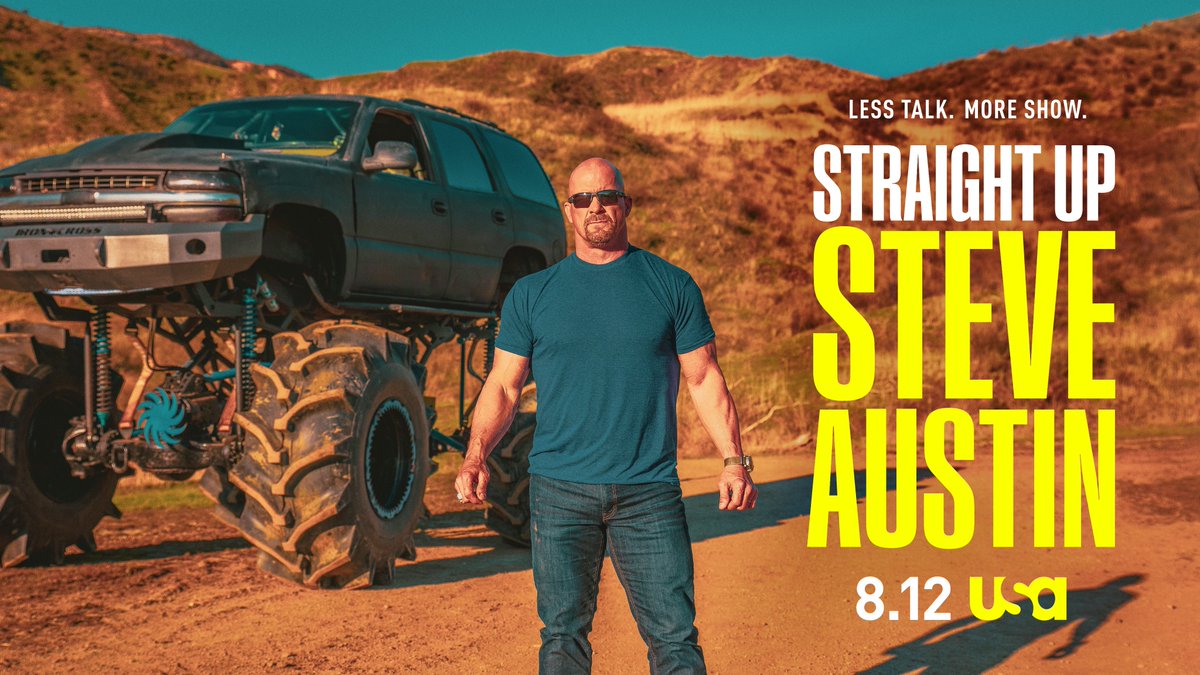
A new interview-based series starring Steve Austin is coming to the USA Network this summer.
It was announced today that USA Network has picked up “Straight Up Steve Austin” for seven half-hour episodes. The series premieres on August 12 and will air after Raw on Mondays at 11 p.m. Eastern time.
USA Network described the show in a press release: “In each episode, Austin and a celebrity guest swap stories about their lives and careers during one-of-a-kind custom-tailored adventures in different cities across America. In this unique interview format, there’s no studio, no couch and no cue cards — just a straight-up good time and some good old-fashioned American fun.”
Raw Women’s Champion Becky Lynch will be a guest on one of the episodes. Country music singer Trace Adkins, former NASCAR star Dale Earnhardt Jr., comedian Gabriel Iglesias, Cleveland Browns quarterback Baker Mayfield, actor Rob Riggle, and Sal Vulcano of “Impractical Jokers” are also listed as guests for the show.
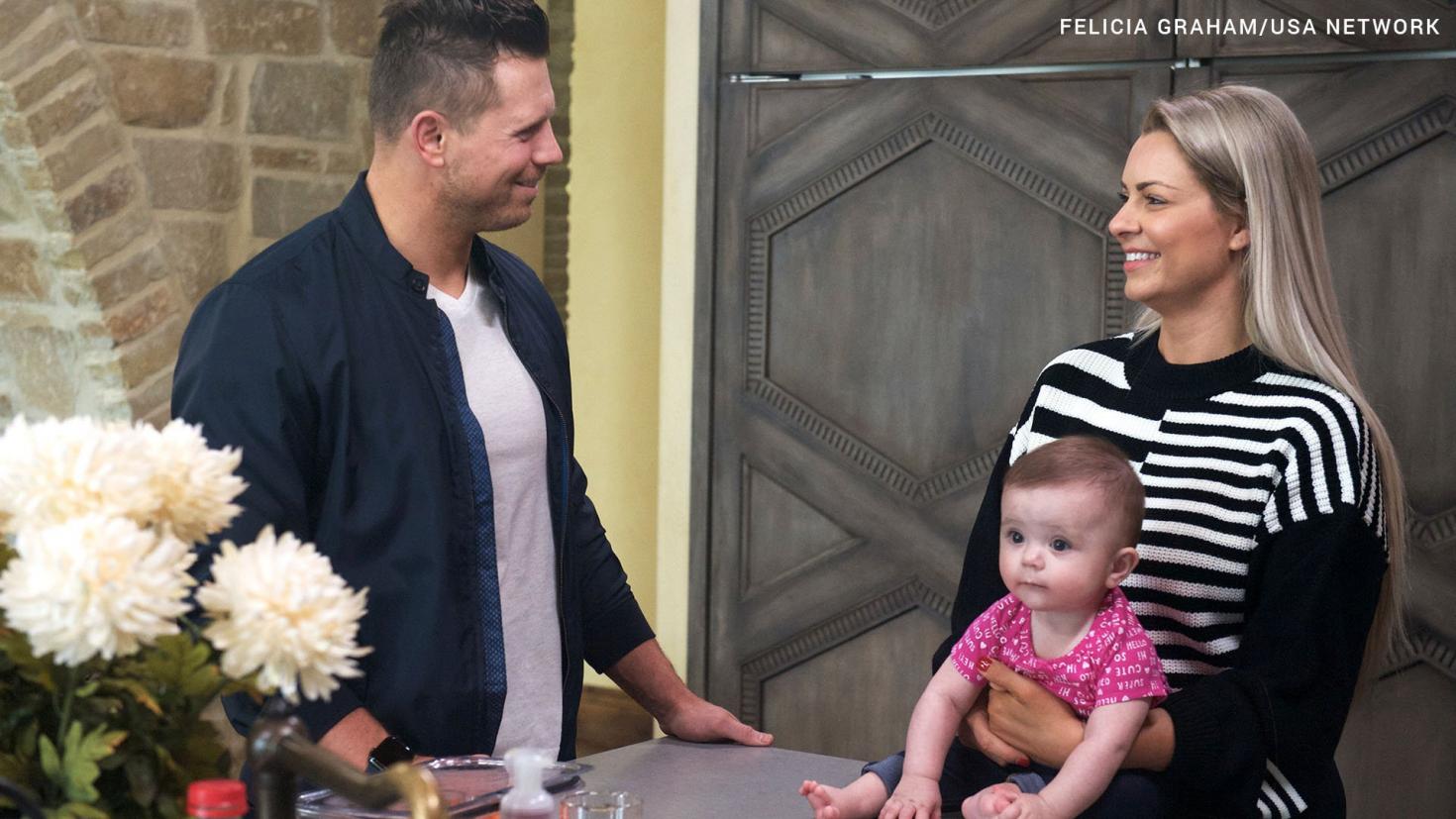
Ahead of season one continuing on the USA Network tonight, The Miz & Maryse’s reality show has been renewed for a second season.
USA Network announced today that “Miz & Mrs.” has been renewed for a 20-episode second season. The season is expected to air in 2020.
“Miz & Mrs.” is produced by WWE and Bunim/Murray Productions.
Twenty episodes is also the length of “Miz & Mrs.” season one. Six episodes aired during its original run, with 14 more set to air as part of the continuation. The episodes are 30 minutes long.
“Miz & Mrs.” airs in the post-SmackDown time slot on the USA Network at 10 p.m. Eastern on Tuesday nights.
Maryse appeared at February’s Elimination Chamber pay-per-view and announced that she and Miz are expecting their second child.
Miz is facing Shane McMahon in a falls count anywhere match at WrestleMania 35 on Sunday. They’ve been feuding since Shane turned heel and attacked Miz after they lost to The Usos at Fastlane last month.
The Miz and Maryse’s reality show officially has its return date.
WWE announced today that new episodes of “Miz & Mrs.” will return to the USA Network on Tuesday, April 2. The show will again be airing in the post-SmackDown time slot at 10 p.m. Eastern time.
The new episodes are being billed as a continuation of the first season. Six episodes have already aired, and 14 more will air during the second run. The episodes are 30 minutes long.
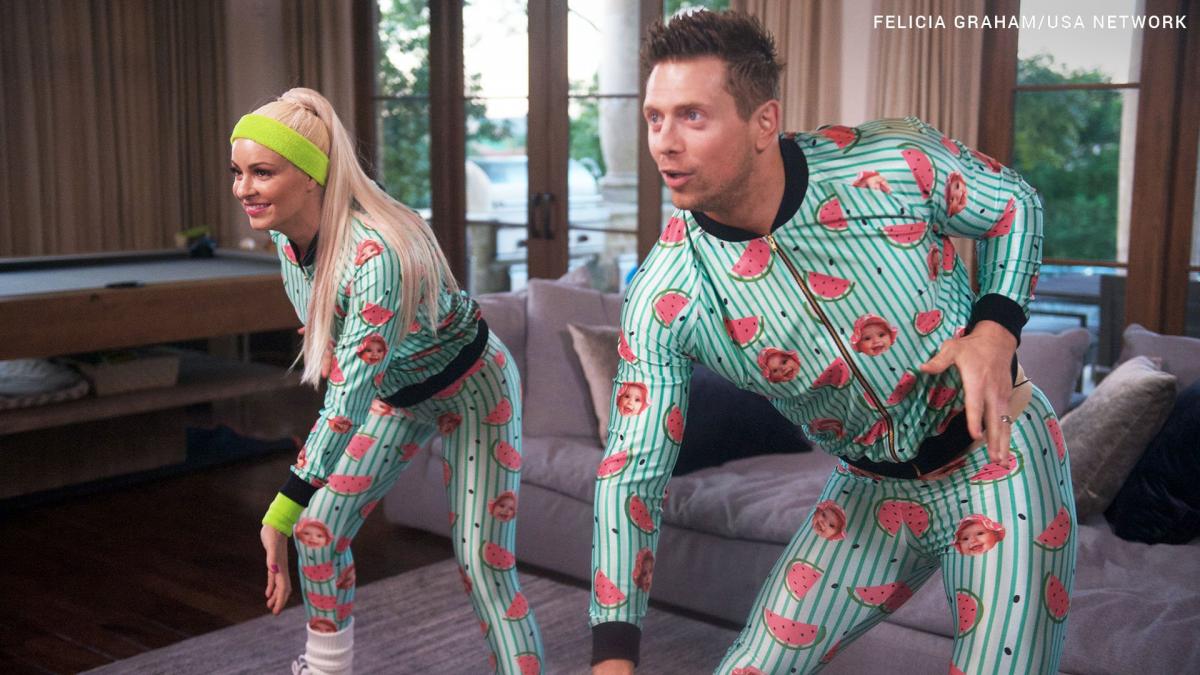
At Sunday’s Elimination Chamber pay-per-view, Maryse and Miz announced that they’re expecting their second child. Maryse gave birth to their daughter, Monroe Sky Mizanin, in March 2018.
It was announced on Tuesday’s SmackDown that Miz & Shane McMahon are getting their Tag Team title rematch against The Usos at Fastlane, which is taking place in Miz’s hometown of Cleveland, Ohio on March 10. WWE has set up that Miz’s dad will be ringside for the match.
The trailer for the return of “Miz & Mrs.” is available to watch below:
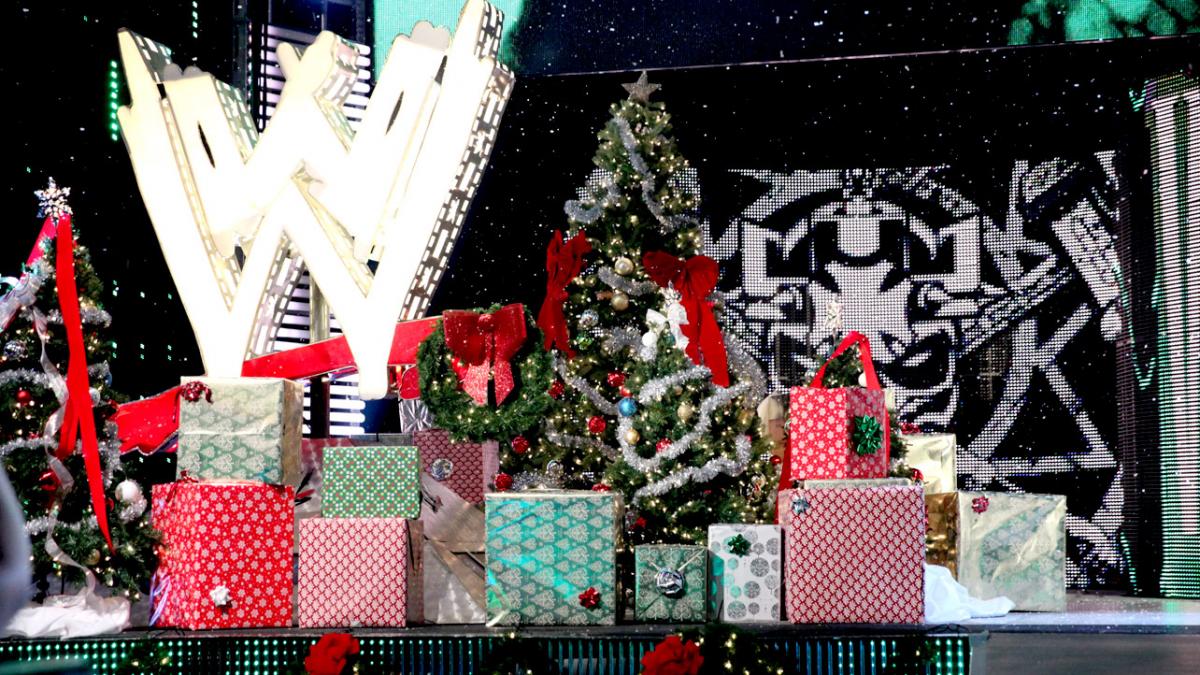
WWE Holiday Week 2018 includes the Monday, December 17 episode of Raw and Tuesday, December 18 episode of SmackDown, along with additional WWE-themed programming.
“New Day’s WWE 2018 Pancake Powered New Year Super Spectacular” will air on USA at 10 p.m. Eastern time on Wednesday, December 19. Here’s the description for the hour-long special: “The New Day host a fun look back at all the historic, outrageous and unforgettable moments that made 2018 so super spectacular at WWE. Featuring Ronda Rousey, Roman Reigns, Braun Strowman, AJ Styles, John Cena and Becky Lynch, along with some surprise Superstar sightings.”
An episode of NXT aired on the Wednesday of 2017’s Holiday Week, but NXT isn’t part of the schedule for this year.
Tribute to the Troops 2018 will air on USA from 9 p.m. to 11 p.m. Eastern on Thursday, December 20. It will be followed by a marathon of Miz & Mrs. season one.
The movie “San Andreas,” which stars Dwayne “The Rock” Johnson, will air on USA at 6 p.m. Eastern on Friday, December 21.
USA’s “Talk Stoop” will also be “featuring interviews throughout the week with WWE Superstars The Miz and Maryse, Ronda Rousey, the Bella Twins, Natalya, Nia Jax and Lana.”
As part of USA Network’s week of limited commercials, both Raw and SmackDown this coming week will be commercial-free for the first hour of each show.
WWE made the announcement earlier today, also noting that Monday’s show will be the first time Raw has ever aired live on Christmas. In previous years, when Christmas fell on a Monday, the show was taped ahead of time.
John Cena will return on Monday’s Raw from the All-State Arena in Chicago. SmackDown will also be from the same venue.
When it comes to live attendance, historically, Christmas was one of the best days to draw a crowd, but WWE has not booked live shows on Christmas in recent memory. The week after Christmas house show tour is also traditionally WWE’s strongest week of the year, drawing well above usual crowds and playing mostly major arenas.
A week after the Christmas episode, Raw will also air live on New Year’s Day.
While airing on the USA Network as part of WWE Week, NXT averaged 841,000 viewers for last night’s episode.
When it comes to first-run cable programming, some head-to-head comparisons were:
NBA on ESPN did 1,530,000 viewers
Erin Burnett on CNN did 1,081,000 viewers
Hardball with Chris Matthews on MSNBC did 2,053,000 viewers
The Story on Fox News did 2,087,000 viewers
Vice News on HBO did 420,000 viewers
E! News on E! did 332,000 viewers
College basketball on ESPN 2 did 292,000 viewers
NFL Total Access on NFL Network did 196,000 viewers
Given the value of wrestling programming, that’s not a number that would seem to make USA try to add it to the package regularly since Tough Enough did better numbers and wasn’t renewed, though the 55-minute episode of NXT did air at 7 p.m. Eastern time instead of what is traditionally considered prime time for television.
NXT did a 0.27 rating in the 18-49 demo for the episode, which was 22nd for the night on cable in terms of original programming. The only other USA show to rank was the season three finale of Mr. Robot, with that averaging 454,000 viewers and doing a 0.19 rating in the demo.
For a comparison, Raw averaged 2.68 million viewers this week and SmackDown averaged 2.481 million. On Pop TV, which is less prominent than USA and is in fewer homes, Impact Wrestling averaged 226,000 viewers last Thursday.
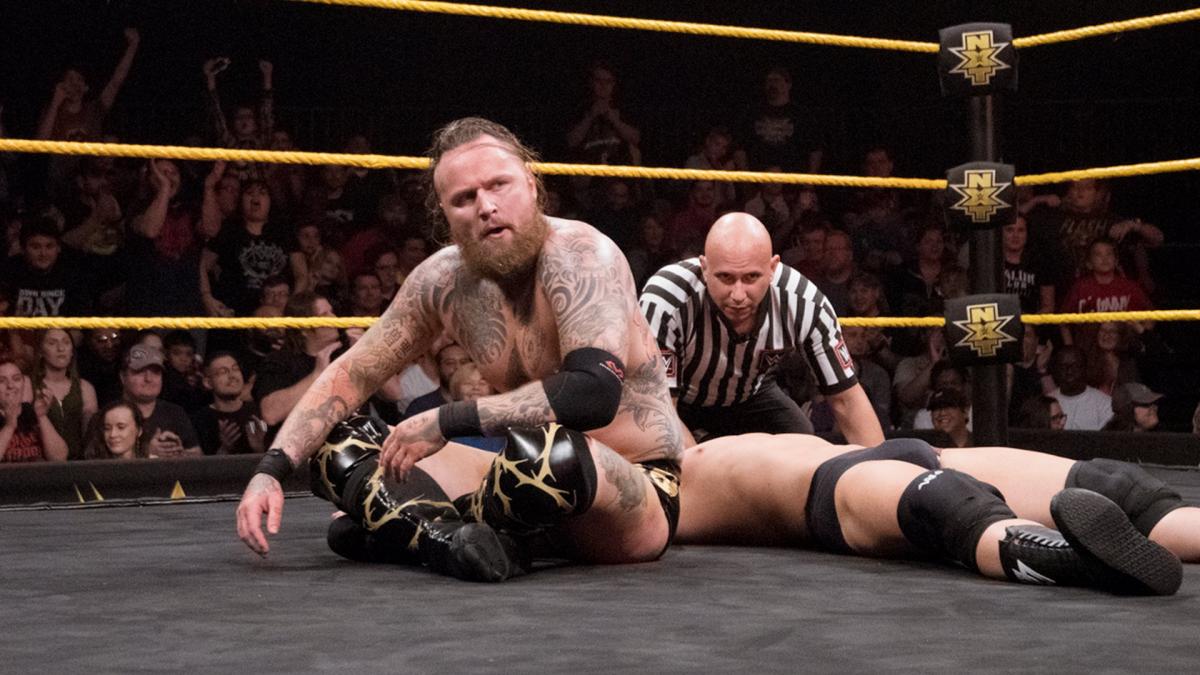
The episode of NXT that aired on USA had Aleister Black vs. Adam Cole to decide who would advance to the upcoming fatal four-way number one contender’s match, Andrade “Cien” Almas vs. Fabian Aichner in a non-title match, and The Authors of Pain vs. Oney Lorcan & Danny Burch. Ember Moon and Peyton Royce’s non-title match was left off the USA version (likely due to time constraints) but was included in the usual WWE Network showing of NXT.
While neither WWE nor the USA Network have announced this, the USA Network’s program grid for December 13th lists WWE NXT at 7 p.m. Eastern time.
It is not clear if this will be the episode that would normally go up on the WWE Network that day, or a compilation type of show. The show is listed for 55 minutes instead of a usual 60-minute slot. If it is the first hour of the show taped this past Wednesday, it would be built
around the tournament to crown a number one contender for the NXT title for TakeOver: Philadelphia and have Killian Dain vs. Trent Seven, Johnny Gargano vs. Kassius Ohno, and Lars Sullivan vs. Roderick Strong, plus a no DQ match between current main roster wrestlers Ruby Riott and Sonya Deville.
The Gargano vs. Ohno match in particular got rave reviews, with our NXT reporter JJ Williams calling it one of the best matches in Full Sail history.
It makes sense because that week is the annual WWE Week on the USA Network, and Tribute to the Troops, which would air on Wednesday, is being moved to Thursday, as the USA Network is airing the movie “Thor” in prime time on Wednesday night.
We’ll have an update when more information becomes available.
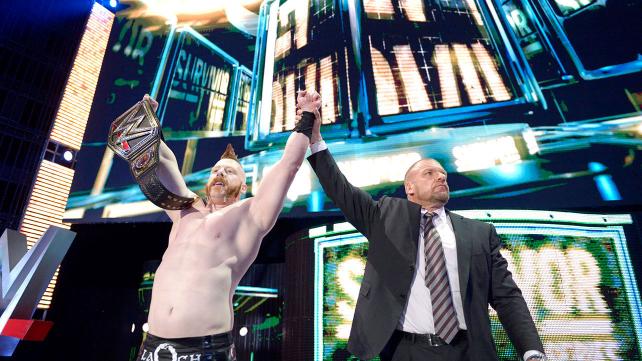
The post-RAW Survivor Series was one for the record books featuring WWE World Heavyweight Champion Sheamus supposedly kicking off a brand new dawn for the company, while nearly every other component of the show remained almost exactly the same. Viewers expressed their enthusiasm for the product by tuning out in droves, leaving the show with a viewership below 3 million for the first time since 1997. Against an above average Monday night football game, Raw pulled in a sub 3 million second hour and a pitiful 2.71 million viewers in the third hour. It’s stunning enough that Raw’s viewership was down by 330,000 viewers week-over-week, but the fact that viewership was down 1.34 million viewers year-over-year (albeit an inflated number given the WWE debut of Sting in 2014) is astronomical.
The ratings went up by 210,000 viewers the following week, but that number was still only good enough to tie as the second lowest watched non-holiday episode of Raw since 1997 and only barely eclipsed 3 million viewers in the third hour. Then came this past Monday’s show, the final hour of which consisted of 44 year old Tommy Dreamer going one-on-one with Braun Strowman and an unconscionable 15 minute show closing promo segment wherein Roman Reigns mocked the champion for having tater tots instead of potatoes. To the surprise of no one, the ratings declined to 3.04 million viewers with a final hour viewership of 2.85 million, and reports from the arena had people leaving in droves before and during the main event angle.
Things are almost certainly going to get worse for Raw in the long, cold trek between now and the beginning of 2016. There will almost certainly be spikes caused by the returns of John Cena and Brock Lesnar, and there should also be a decent boost from the late-December conclusion of Monday Night Football. As the bottom continues to drop out, it will become confoundingly clear that absolutely nothing substantial is going to change. Not until Cena and Lesnar rear their heads and not until the last whistle is blown on MNF will any ratings decline be viewed through a lens of objectivity. Even then, it would probably take weeks of pulling in fewer than 3 million viewers before major changes would take place. Perhaps it would take an episode of Raw only getting 2.75 million viewers. Perhaps that number would have to hit 2.5 million. Whatever the case, it likely means that we can expect about two more months worth of stale at best, completely indigestible at worst, programming between now and the Royal Rumble.
But one would almost have to think that something must eventually give. The ratings almost have to improve in January, but logic dictates that they will drop even further at this same time next year unless something is vastly different. That trend will continue until something is done to reverse course. Whenever that change comes, hopefully sooner than later, it needs to be drastic and comprehensive. Should WWE ultimately decide to change its product, it might want to take a page from one of the biggest brands in all of entertainment: Marvel.
The Diverging Path of Comic Books and Professional Wrestling
It’s difficult to fairly compare and contrast wrestling to comic books on a number of fronts. In terms of financial success, mainstream acceptance, audience growth, creative solvency, social awareness, and infrastructural competency, wrestling does not even remotely stand up to comic books. It would be quite a bit like comparing tater tots to potatoes, really.
At a point somewhere in time, the kind of person who watched professional wrestling and the kind of person who read comic books were likely subjected to the same degree of stigmatization and ostracism. If my experiences growing up are any indication, there is a pretty significant intersection between comic book fans and wrestling fans. Both were once outsider products consumed primarily by those perceived as socially undesirable, but in 2015, this has changed drastically at least on one front.
Companies like Marvel and DC have taken what were once niche products and properties consumed primarily by children and social also-rans and built empires by making them cool to the public at large. Comic books have grown into a humming and ever-evolving megalopolis with shining towers and lavish tourist attractions on every corner. People plan their visits and get excited because if they’ve been away for even a little while, something has likely changed and almost certainly for the better. In this place, there is something for everyone.
By that logic, the wrestling industry is a modest village. It houses a few nice buildings with some pronounced architecture and burnished fixtures (Ring of Honor, New Japan, and Lucha Underground) and a couple of hip coffee houses and bars (Pro Wrestling Guerilla, Progress Pro Wrestling, Insane Championship Wrestling, Chikara, etc.). Ultimately, however, everything operates in the shadow of one dust blown and aged tower on the horizon; it’s been there for so long and touched so many that most of the visitors look past those happy new places because they don’t hold that same level of nostalgic resonance. Once or twice a year, the tower is lit and lively, but it feels like a dark and cold place. There may be new faces who visit the village during brighter seasons, but they’re far outnumbered by those who leave because they simply tired of that tower and its oppressive presence. If you are not drawn by that tower, you are almost certainly not drawn at all.
There is something that can be gained by looking at how the biggest company in one industry has continually reinvented itself to increasing degrees of success while the biggest company in the other has seen diminishing returns because of its stagnant product. Given their control over their respective markets, let’s assume that the face of the comic book business is Marvel (they held a 37% share of all North American comic sales in 2014) and that the face of wrestling is World Wrestling Entertainment. One has managed to grow interest in its core product by reinventing and rebranding it whenever things begin to feel stale. The other is WWE.
The Many Reinventions of the Marvel Brand
Much can be said about Disney and Marvel’s success in building up the Marvel cinematic universe. New Marvel films are now cultural events to the degree that the first trailer for Captain America: Civil War was viewed a record 61 million times in its first 24 hours online. Of the current top 10 highest grossing films of all time, three are Marvel films released since 2012. The highest grossing film of 2014 was Guardians of the Galaxy, a title built around a team of characters with whom the general public was almost completely unaware. Phase two of the Marvel cinematic universe’s three phase plan pulled in more than $5.2 billion around the world between 2013-2015. Phase three, which kicks off next year with Civil War, should make even more than that.
Consider for a moment the fact that Marvel has the next five years of films and strategy planned out while WWE is probably still unsure how the Royal Rumble will play out.
Because of its incredible brand cache, Marvel will be able to launch franchises around new characters like Captain Marvel and Doctor Strange with impunity because its audience trusts the brand to produce a quality product every time. WWE, in contrast, seemingly cannot even create a single new main eventer and has done everything it can to sap the audience of its faith that it ever will. The degree of success Marvel currently enjoys may breed contentment in other companies. WWE, for example, has felt increasingly listless since subsuming WCW and ECW in 2001, but Marvel instead opted to undertake radical change in its core product: Marvel Comics.
In 2012, Marvel acknowledged a decline in comic sales by relaunching almost all of its ongoing titles under the Marvel NOW! banner. This overhaul entailed changing the look and marketing of the product, bringing in new writers and artists to handle the creative direction, allowing those new talents to shake up character and team dynamics, and relaunching a number of familiar titles from scratch or doing away with them altogether. It was a massive, calculated risk that was certain to isolate a percentage of the hardcore contingent of the fanbase.
One of the most polarizing moves was the decision to kill off Peter Parker and have his body taken over by Doctor Octopus (yes, it’s as confusing as it sounds) in Amazing Spider-Man #700, which lead to the launch of a new title called The Superior Spider-Man. The final issue of Amazing sold around 200,000 copies and the first issue of Superior sold 188,182 copies, making both bankable successes for Marvel Comics. The bigger picture: over the course of a 31 issue run, in spite of the rumblings from purists, average sales of Superior were up considerably from Amazing. This is attributable to a number of factors, not the least of which being that it was something new, fresh, and exciting.
Another soft relaunch occurred in 2014 (entitled All-New Marvel NOW!), centered largely around the return of Peter Parker in The Amazing Spider-Man #1. Marvel sold more than 700,000 copies of that first issue, singlehandedly wiping out its Q1 2014 shortfall and becoming the company’s best selling single comic since 2009. That same year, Marvel announced it would kill off the character of Wolverine seemingly for good. Despite skepticism from jaded fans (character deaths are common and easily undone) and even more grousing about change, all four issues of the mini series were among the year’s top sellers, ranking 4, 5, 8, and 9, respectively. Moreover, of the 10 best selling single issues in 2014, nine were Marvel comics.
Earlier this year, the company engaged in yet another rebranding effort, launching the All-New, All-Different Marvel. The result saw even more shakeups, including having new characters portray mainstays like Thor and Captain America that resulted in further dissatisfaction from pockets of fans. Still, cumulative North American comic sales through September were up 5% year over year, and of the top 10 comics sold in each month, an average of seven were Marvel titles. In September, the top 10 best selling comics were all Marvel titles, as well as 18 of the top 20. The year’s single best selling comic book: Marvel’s first issue of the Star Wars comic, which has moved more than 1 million copies to date.
At a point in time where Marvel Comics has every incentive to remain stagnant and proceed with the status quo, it has instead chosen to reboot its product line three times in four years. It’s a strategy that has helped engage with new consumers and get fresh eyes on the product, and it has improved their bottom line a great deal. Controversial decisions are made with surprising regularity, and because they tend to pay off in a somewhat rewarding fashion, even those cynical fans become willing to go along for the ride.
This couldn’t be further from the case with the WWE. Trust in the decision makers behind the product may be, like the ratings, at a long time low. Given this fact, WWE should be doing anything but sticking to the status quo. It’s an odd inversion of circumstances: Marvel can afford to take risks with its product because it has a substantial safety net, and WWE needs to start taking risks with its product because its running out of options. WWE may not be willing to take those risks on its flagship show, but there’s no reason that it couldn’t attempt something new with its other weekly television program.
Starting Over, Starting with Smackdown
Marvel has built itself into an entity so powerful that it is able to shape the landscape of television. When it was announced that Netflix had acquired the rights to produce and distribute the original series for Daredevil, Jessica Jones, Iron Fist, Luke Cage, and The Defenders, it was seen as a huge coup for its legitimacy. Recently, Jessica Jones has earned widespread critical praise for the care with which it handles decidedly complex, mature subject matter. Raw, meanwhile, was notable this week for Roman Reigns comparing Sheamus’ testicles to tater tots.
WWE is moving Smackdown from SyFy Network to USA on January 7, and while it’s possible that there could be less buzz about it, there certainly couldn’t be all that much less. Smackdown is a stale, tired product, and its ever waning viewership is a testament to that fact. With the current formula, Smackdown plays out ostensibly like a palette swapped Raw where the events that transpire have little or no consequence in the larger scheme of WWE’s universe. The reason fewer and fewer people watch Smackdown is likely much of the same cause for the ratings drops for Raw of late: people simply don’t want to watch a show that doesn’t mean anything.
This could all very well change when Smackdown debuts on USA Network in just three weeks time, a move in which WWE seems to be investing at least some effort, fortified by the announced hiring of announcer Mauro Ranallo. The move will likely kick off with a live special that could eventually lead to Smackdown going live on a weekly basis, which could serve the purpose of drumming up some additional ratings (as well as costs). WWE will likely also bolster interest in the show by promoting names and matches beforehand (which is an incredibly novel concept indeed). This may grab some ratings, or it may not.
If Smackdown falters out of the gate, WWE will almost certainly drop the pretense of its importance and quickly return to business as usual. Even with increased emphasis placed on making it a ratings winner, it’s hard to picture Smackdown feeling like anything but what Smackdown has felt like for the longest time, which is a directionless, empty show that is indistinguishable from Raw but for the fact that it is measurably less important. That is, unless WWE opts to make some significant changes.
Since Smackdown will likely be seen by a larger audience in those first few weeks, it may be the perfect forum for WWE to cautiously approach making the kinds of alterations that Marvel has with its comic books. WWE can scrap the status quo and push the idea that the show coming to USA Network is not just Smackdown, but an All-New, All-Different Smackdown.
To do this, WWE should scrap everything about Smackdown from top to bottom.
Spare nothing, because there is really nothing worth sparing at this point. Get fresh, young minds behind every aspect of the project and give them enough free reign to take chances and try different things. Change the cinematography away from the multi-cut-zoom Kevin Dunn style, reconfigure the format of the show entirely, drop the blue and silver color template, get a new logo, build a new set, and get a new theme song that sets the tone for the show. Get another new face at the commentary desk with Ranallo and allow them to drop the WWE version of Newspeak for something more authentic. Let wrestlers cut promos looking head on into the camera. Don’t script championship contenders to cut 15 minute promos that revolve around tater tot jokes.
Let Smackdown become a breeding ground for new talent and new ideas. Let it act as a bridge between NXT and Raw that helps talent tweak their characters and hone their skills on the mic and in the ring even further. Try different stories and different angles and have a long term plan for how they play out. Don’t simply holdover the concepts put forth on Raw; advance them and take them in unexpected directions. Create a sense of competition between Raw and Smackdown comparable to what Paul Heyman helped created in the early 2000s. Give Smackdown the sense of purpose it has needed so desperately for years, and give it a different identity. After three hours of Raw, it’s hard to imagine that anybody could possibly want two more hours of the exact same thing on Thursday (or Tuesday for that matter), and at the rate that the ratings are falling, it’s clear that fewer and fewer people have the appetite for it on Mondays.
While we’re at it, why not change the name? Despite more than 15 years on television, there is no loyalty to the Smackdown brand. Giving the show a new, hopefully less ridiculous name can set the precedent that things will be different across the board, ala dropping Amazing Spider-Man for Superior Spider-Man and going back to Amazing again. Let the Smackdown brand die on SyFy and allow a new, exciting product to rise on USA Network in 2016.
If WWE allows itself to take some chances in order to generate excitement for a new product on a new network, and if the new Smackdown begins gaining traction, it can let some of that newness seep into Raw. With a few new flourishes here and there, it can inform the viewer that the changes coming are worth sticking around for. Maybe this then can lead to a comprehensive overhaul and a reboot of that show over time. It may not lead to a full ratings recovery, and it may not bring it the kind of mainstream acceptance WWE so desperately seeks, but by shaking things up and coming up with something new and different, the chances of recovering lapsed fans and bringing in new ones improves more than it would by staying the course.
WWE is financially secure for the foreseeable future, and it is in no danger of going under even as its ratings plunge. That being said, despite the likelihood of a Wrestlemania sellout and a new all-time attendance record, the product feels miles and miles away from Wrestlemania X-7 in terms of interest and engagement. The needle can move closer to that level again, and it will, but only if WWE challenges itself and takes risks along the way like Marvel has with its products and properties. WWE wants its audience to believe that, like Marvel, it’s in the business of making movies. If we are to gauge that claim by the level of interest heading into TLC, it’s much closer now to Howard the Duck than it is to Captain America: Civil War.
In a press release today highlighting its January premieres, USA Network announced the move of WWE Smackdown from the SyFy network. What was notable from this release is that despite rumours of a possible move to Tuesday nights, airing live, the premiere was announced for January 7th, a Thursday, meaning it’s likely that this means the show will stay in the same Thursday time slot it’s been in for the last year.
This move is expected to increase audience viewership of the WWE’s #2 show, as the USA Network has a much higher average viewership than SyFy. Despite both networks being in virtually the same number of homes, USA averages about 1.6 million viewers in Prime Time (week ending Nov 1) vs about 770,000 for SyFy. Smackdown has consistently been the highest rated show on SyFy, averaging around 2.1 million viewers for the 2 hour show.
Smackdown has had many different TV homes over the years. The show debuted at the height of pro wrestling’s popularity in the US in August 1999 on the fledgling UPN network. In 2002, when the WWE did it’s brand split, Smackdown became it’s own “brand” and often had a higher viewership total than RAW, due to being on an over the air network.
In 2005, UPN moved the show to Friday nights. The show ratings predictably went down but it was still doing far better than what the network had previously been airing on Friday nights, usually old movies. In September 2006, Smackdown moved to the CW. Technically this was still considered a “network” but had far less penetration than UPN and the viewership numbers declined again.
During this time, the brand split gradually faded and the show was becoming more of a “B” show. In addition, WWE had revived the ECW brand, and the SyFy network had picked up that show. In 2008, Smackdown moved to another new network, MyNetworkTV. The premiere episode did 3.2 million viewers for a supershow featuring wrestlers from all 3 brands. While numbers were down for Smackdown it was still the highest rated show in MyNetworkTV history.
There was yet another move for Smackdown in 2010 as SyFy picked up the show after it was not renewed for the fall season by MyNetworkTV. While it was still the highest rated show on the network, the network was hemorrhaging money and the show was too expensive to retain. In 2011, the brand extension officially ended and wrestlers from RAW and Smackdown were able to appear on both shows (even though they’d already been doing that for years).
In 2015, SyFy announced that it was moving Smackdown back to it’s original Thursday night timeslot. This was expected to increase the viewership of the show as Thursday is traditionally a much more popular night for television viewing. This did not materialize as numbers continued to slide at a similar rate as on Monday Night RAW to get to the current 2.1 million level.
The move to USA network is expected to be accompanied by a renewed focus from WWE on the show to make it more relevant and a subsequent increase in TV viewers is the hoped for result.