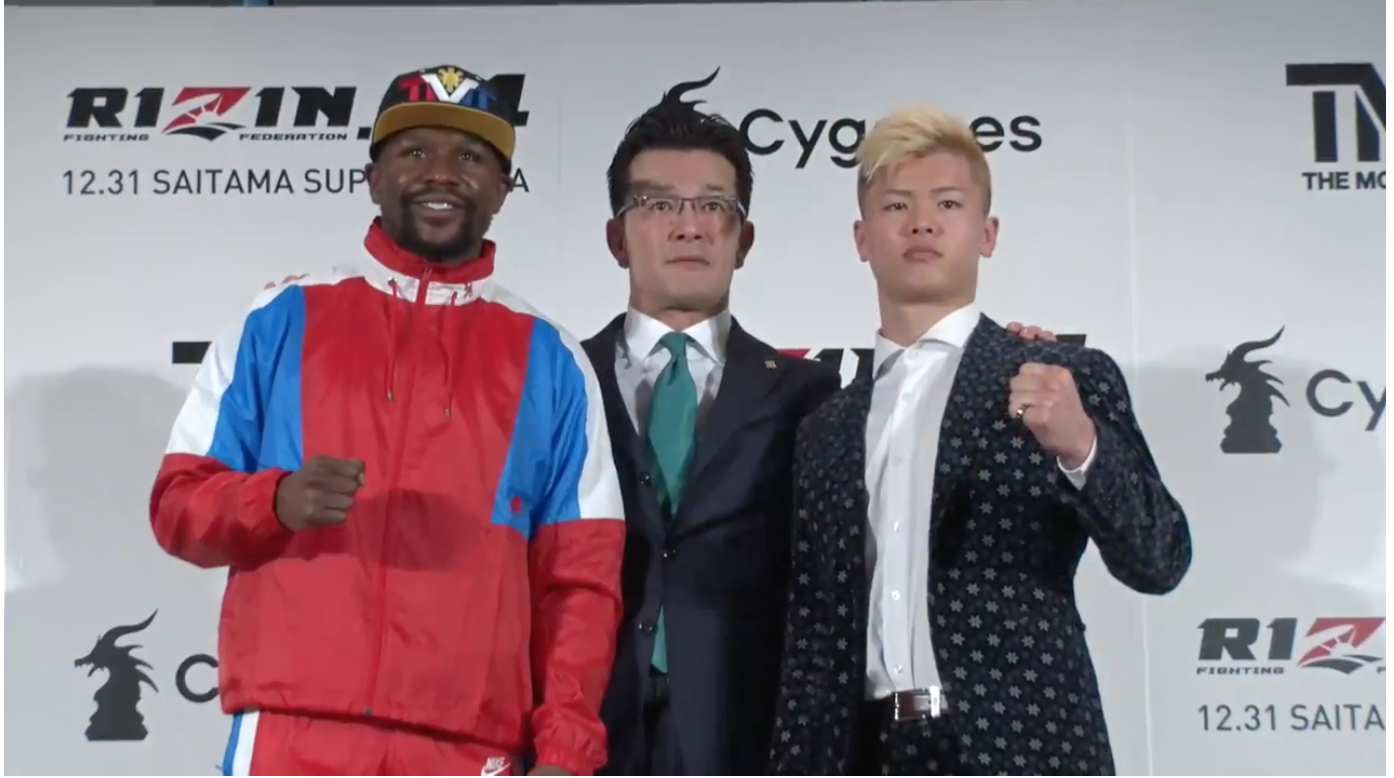
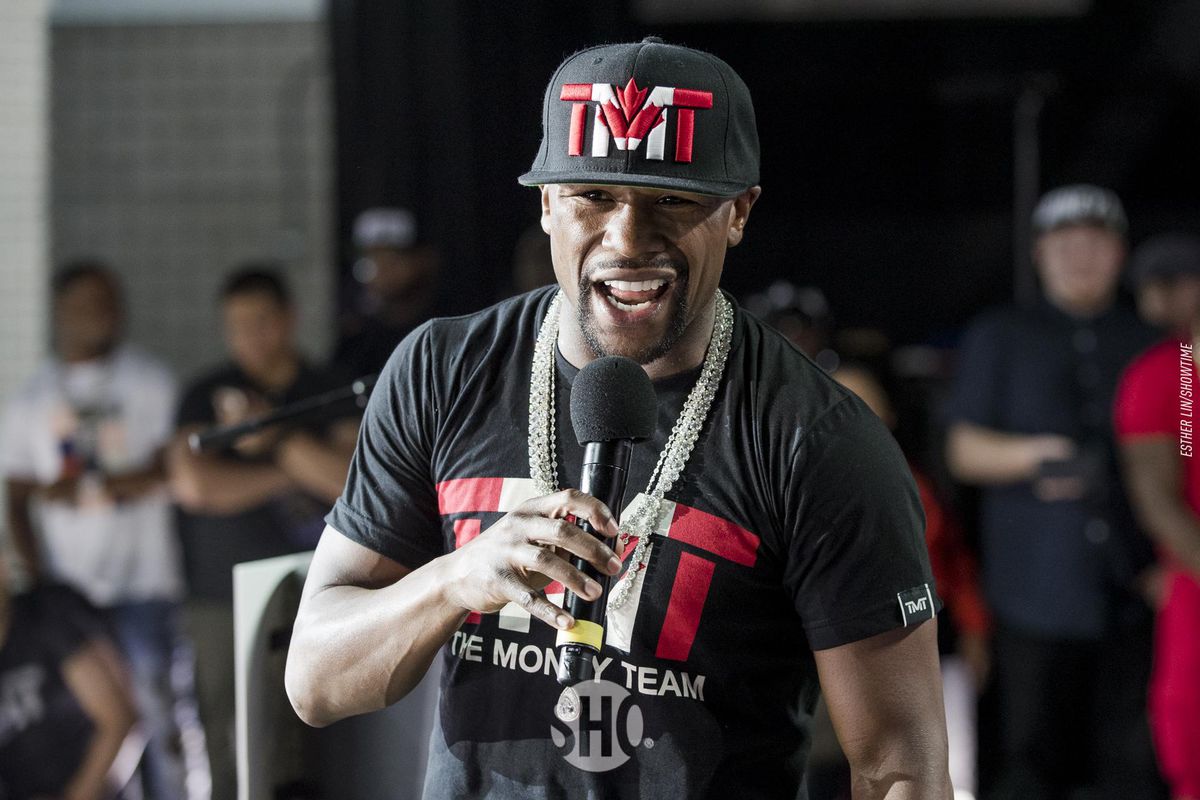
Undefeated boxing star Floyd Mayweather just can’t seem to quit combat sports as Japan’s RIZIN organization announced at a press conference that the on-and-off-again retired boxer will return to action once again on their annual New Year’s Eve show.
In a bit of a surprise, the 41-year-old (50-0) will face rising kickboxing star Tenshin Nasukawa at RIZIN 14, set for Tokyo’s Saitama Super Arena. Both men were in attendance at the press conference. The rules and weight class have yet to be finalized with the promotion and Mayweather saying they “were working on it” and that things should get sorted out over the next few weeks.
Mayweather said competing in Tokyo was a motivating factor and that his team and RIZIN were able to come to terms on this fight.
Nasuakwa is just 20 years old, but has an extensive amateur and pro career, currently sitting at 27-0 with 21 wins by knockout. He’s also 4-0 in MMA, but hasn’t competed in that sport since 2017.
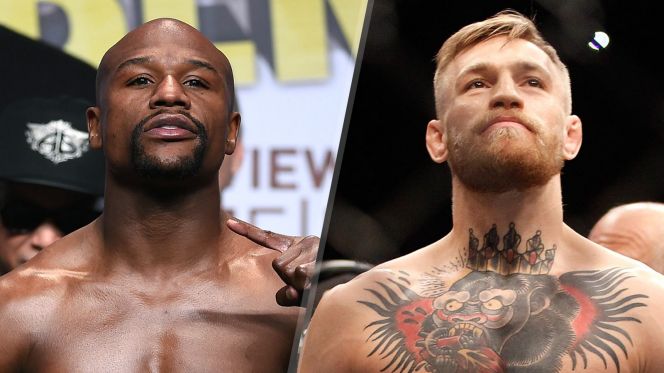
Mayweather was last seen defeating two-division UFC champion Conor McGregor in August 2017 in a boxing match that set financial records. He had been trying to play up a boxing match with UFC lightweight champion Khabib Nurmagomedov, former foe Manny Pacquiao, and even McGregor himself in recent months.
In a content era in which it seems like anything and everything is possible, Dana White told ESPN Wednesday that the UFC is talking to retired boxer and all-time pay-per-view king Floyd Mayweather about coming to the Octagon.
“We’re interested in doing something with Floyd. Everything is a realistic possibility. Mayweather vs. McGregor f—ing happened. Anything is possible,” White told ESPN’s Brett Okamoto.
Mayweather recently made headlines by saying that he could earn $1 billion in “3-4 fights” in the UFC and that “They just called me not too long ago and asked me to come back,” not specifying exactly who “they” was (UFC, Showtime, etc).
Whether Mayweather has a deal with Showtime that would necessitate their involvement as co-promoters is unclear.
The undefeated Mayweather famously crossed over into the MMA consciousness with his August boxing match against Conor McGregor that generated more than $600 million in total revenue. Mayweather won that fight via 10th round TKO and was expected to retire from combat sports. McGregor hasn’t competed in the UFC since November 2016 and seemingly has no plans to do so anytime soon.
One would assume that a Mayweather-McGregor rematch in the UFC would be the move to make if the fight could be sanctioned. The obvious lack of ground training would put Mayweather at a significant disadvantage against even the most novice of grapplers.
Former heavyweight champion James Toney famously came into the UFC for one fight against Randy Couture at UFC 118 in Boston, MA, seven years ago. Couture had no issues taking down Toney and submitting him in the first round easily.
Unless someone gets hit with a lead pipe or slips on a wet floor, Floyd Mayweather and Conor McGregor are set to box this Saturday night in what promises to be one of the biggest single-night financial windfalls in sports.
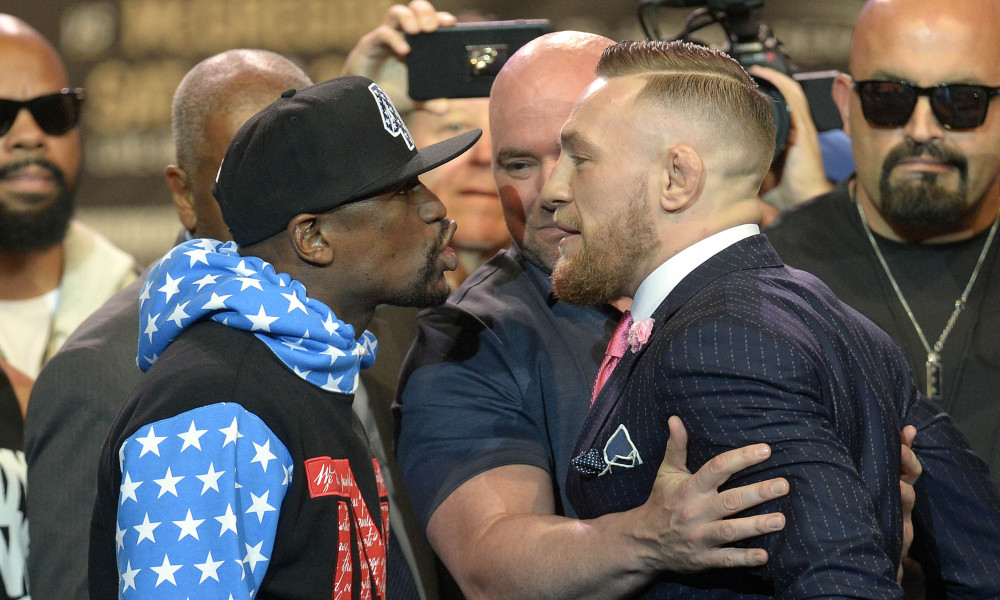
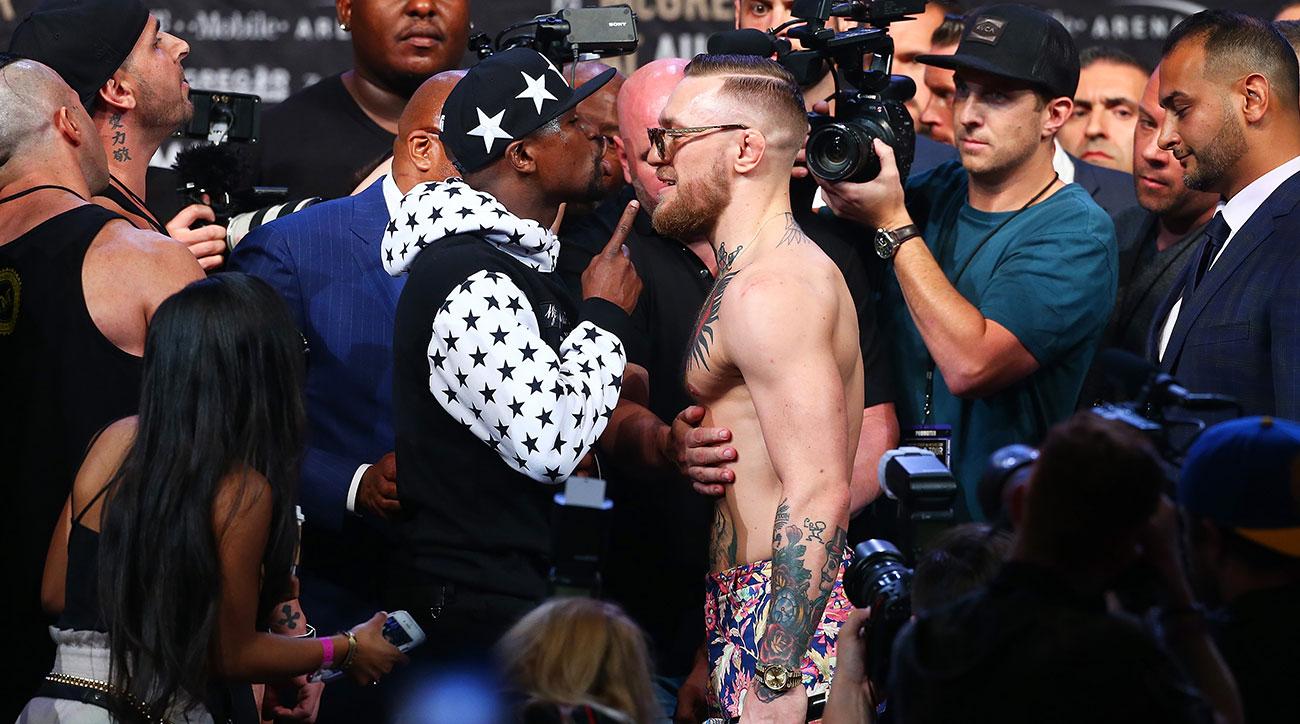
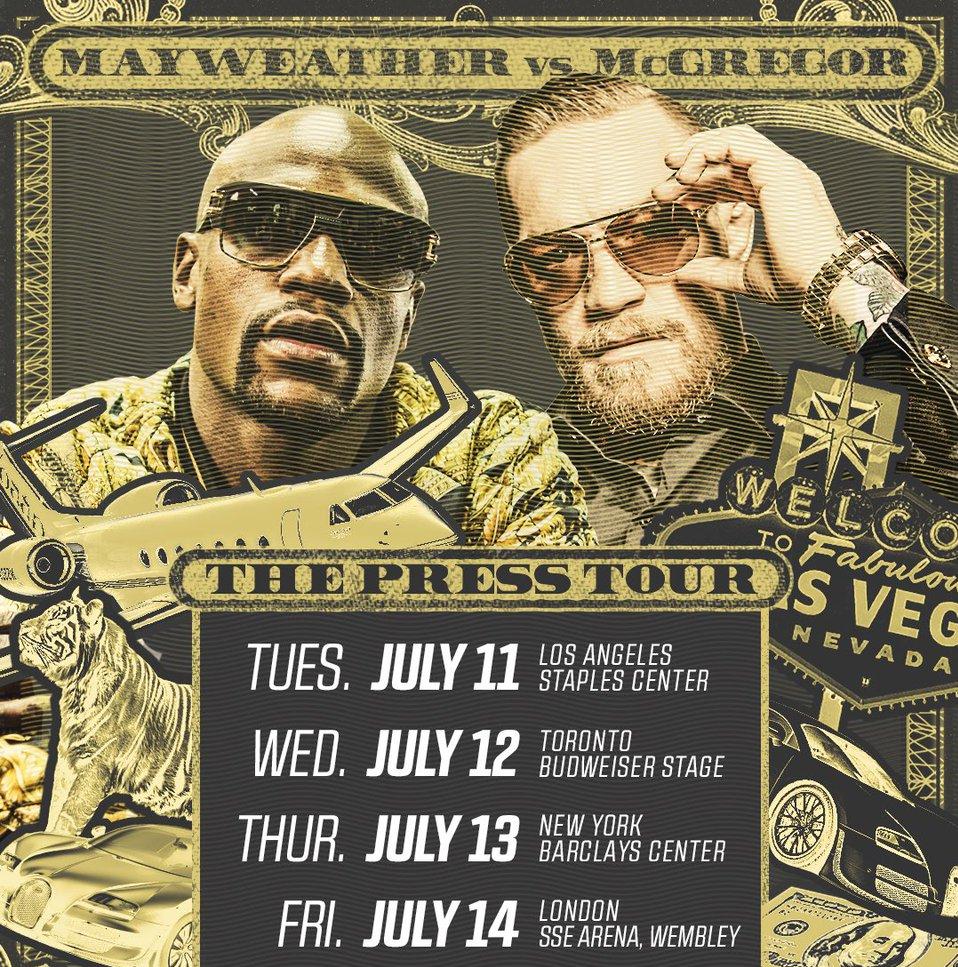
After a memorable set of media events during a four-city tour in July, the two will meet outside the ring for the final time at a press conference in Las Vegas at 4 PM EST.
The two made news last week when the Nevada State Athletic Commission approved the use of 8 oz. gloves for the fight, a one-time exception for a rule in place that allows for 10 oz. gloves to be used in fights contested at 147 pounds or more.
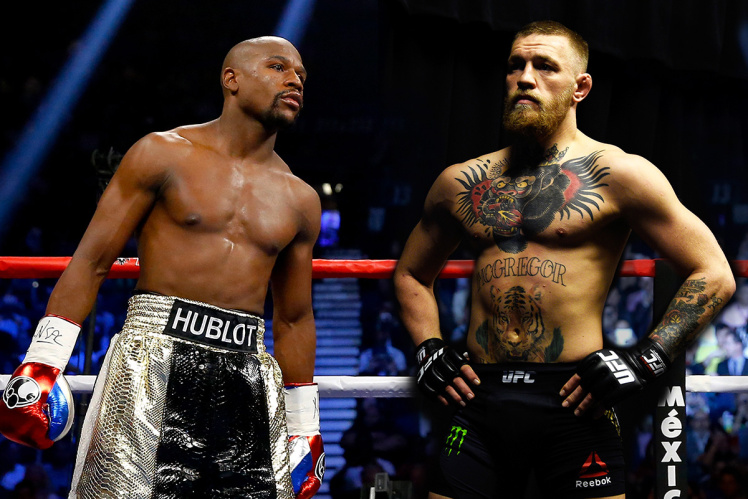
As is well known, this will be McGregor’s first foray into boxing while the heavily favored Mayweather will be looking for his 50th pro victory against 0 defeats.
As if the spectacle around Floyd Mayweather vs. Conor Mcgregor wasn’t enough on its own, Wednesday brought an unprecedented new wrinkle into the equation and one that could change things drastically when a punch connects.
At the request of both camps, the Nevada State Athletic Commission approved the use of 8 oz. gloves for the Mayweather-Mcgregor August 26th boxing match instead of 10 oz. gloves that are supposed to be in use for fights contested at 147 pounds or above. The commission said this will be a one-time exception and will study the results post-fight.
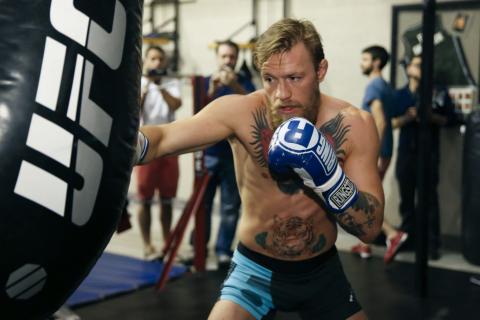
The biggest fight of the summer — financially, anyway — is just a few weeks away and while things have been relatively quiet in August, Conor McGregor hopes to stoke the promotional fire Friday afternoon with a media day/workout session.
The session, held at the UFC’s Performance Center in Las Vegas, NV, starts at 6 PM EST/3 PM PST and can be seen here:
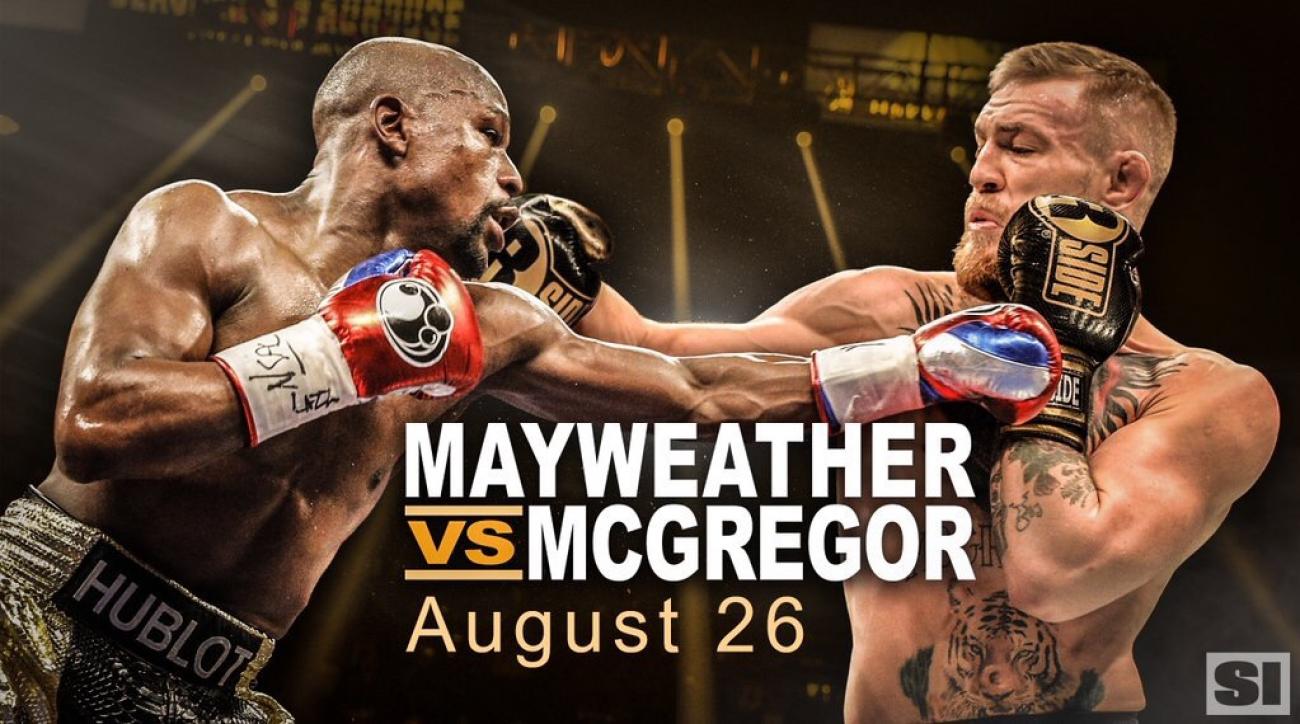
For those just out of a coma, Mayweather is coming out of retirement to face McGregor in a boxing match at the T-Mobile Arena in Vegas on August 26th. Mayweather will be looking for his 50th win against zero losses while McGregor will be competing in his first ever boxing fight.
The fight is expected to do record business, both at the gate and on PPV.
It’s been a little quiet over the past few weeks when it came to promoting the August 26th boxing match between all-time great Floyd Mayweather and UFC lightweight champion Conor McGregor.
That ends starting Tuesday.
The two men expected to generate $500 million in business for their super welterweight fight at Las Vegas’ T-Mobile Arena began their tour de force press conferences this week, starting on Tuesday in Los Angeles, Wednesday in Toronto, Thursday in New York, and Friday in London.
Courtesy of Showtime, we’ll stream all four pressers here. Just bookmark and you’ll be good to go:
TUESDAY, JULY 11 – Los Angeles 5 p.m. ET/ 2 p.m. PT from Staples Center
WEDNESDAY, JULY 12 – Toronto 5:30 p.m. ET / 2:30 p.m. PT from Budweiser Stage
THURSDAY, JULY 13 – New York 6:30 p.m. ET/ 3:30 p.m. PT from Barclays Center In Brooklyn
FRIDAY, JULY 14 – London 7 p.m. BST / 2 p.m. ET / 11 a.m. PT from The SSE Arena, Wembley
I feel like I have to preface this column with a bold statement: one way or another, I will watch Conor McGregor and Floyd Mayweather box in late-August.
I know, what a hot take. Call me Stephen A. Nason or Josh Bayless.
I could try to tell you that this affair is a complete atrocity, that it’s terrible for MMA, and that I can’t support it, but that would be completely disingenious. Like many of you, I will find a way to watch and will be entrenched in the build leading up to this “fight”.
But after taking in everything after the announcement and listening to that first conference call discussing how the deal was made, there’s a lot of reality checks that all of us that are heavily invested in MMA need to come to grips with before this thing happens in late-August.
So far, the ‘MMA’ and ‘UFC’ might as well be curse words
According to all parties, the day itself will feature no MMA whatsover and will be, as Dana White said, “a boxing day”. In the intro for the call, McGregor was referred to as an “Irish superstar” and there was no mention of his being a UFC lightweight champion, two division champion, etc. In a promotional tweet Mayweather sent, the UFC logo was absent. Even, the Showtime tweet about the promo poster even used #UFC and not @UFC while properly tagging the fighers’ handles.
It’s only been a few days, but considering McGregor came to prominence in the UFC and in MMA, it’s surprising and, likely negotiated, how little that seems to matter now.
The UFC isn’t promotionally riding shotgun, but is sitting in the back middle seat
The most disheartening aspect of the Wednesday night call was hearing White cite Showtime as “kind” for allowing them to do promotional content like UFC Embedded leading up to the show. It’s as if White and the UFC are bowing down and paying a penance instead of standing side-by-side in promoting this whole thing.
While I understand that Mayweather is a PPV superstar, the UFC built a $4 billion brand that has a foothold in the sporting conscious, even if just in name value alone. The day shouldn’t just be “a boxing day”. What about the MMA fans that don’t care about boxing and need to be sold on why they should spend $100 for a one-fight show in which that one fight will be probably pretty bad?
To see a fight brand and promoter that has openly swatted aside notions of co-promotion (M1 and Fedor Emelianenko, anyone?) now have to play second-class citizen to a network they used to despise and a retired boxer they’ve never done business with before is jarring.
Boxing isn’t dead
Like many MMA writers, I did once pen the obligatory ‘boxing is dead’ column years ago after another frustrating night watching two heavyweights slog it out while two UFC heavyweights were doing their thing. While it may never return to its previous heights, I was definitely wrong with your latest example being the crowd and overall buzz for the recent Joshua/Klitschko fight in England’s Wembley Stadium.
It definitely isn’t dead when you consider that a retired 40-year-old boxer is going to face a boxing newbie and give that newbie the biggest payday of his life even though he’s the UFC’s biggest star and arguably their biggest financial draw of all time. It also definitely isn’t dead when you consider this fight will do bigger business and will get more mainstream media attention than any MMA fight ever.
It proves that no matter how far we think MMA has come, there’s still so, so far to go.
This will cost us a quality McGregor UFC title fight
White seemed confident that McGregor will fight in the UFC once this year, using that as a bully pulpit to bash his own fighters for not taking fights against anyone at anytime. (Who could he be talking about, I wonder?) I hope that’s the case as there’s no shortage of quality fights waiting for the lighweight champ…if he decides he even wants to return, a talking point given the Brinks truck that’s about to back up at 1 McGregor Way.
Even with the birth of his first child, you’d expect him to be fighting this summer if this Mayweather business wasn’t going on, probably against the likes of Tony Ferguson or Khabib Nurmagomedov. Yeah, they’re not the marquee names like Mayweather but for those who follow the sport, those are the guys we want McGregor to test himself against. That’s our idea of a $100 PPV, so to speak.
And let’s not forget this fun fact: McGregor has yet to defend any UFC title he’s won.
The promotion will be the best part
Impending hyperbole and talking heads blathering aside, McGregor’s chance of beating Mayweather are slim even if Mayweather hasn’t fought in two years. What’s going to sell this fight for the mainstream is both guys talking and they have a concentrated time to do it in: two and a half months. Going into this, we all knew the real draw was going to be everything before the fight anyway.
With all that said, it’s going to be a dizzying sprint focused on an event featuring the UFC’s top draw in a fight that isn’t in the UFC nor in the sport that brought him fame. Plus, there’s that other bit of business for White and company: the eight scheduled UFC shows between now and then starting with this weekend’s overlooked event in Singapore.
Whether you’re going into this kicking and screaming or are primed at the pump for it, your seat aboard the McGregor-Mayweather train is reserved. Let’s all just hope there’s no delays on the track ahead.
Three of the key parties — UFC president Dana White, Mayweather Promotions CEO Leonard Ellerbe, and Showtime Sports’ executive VP and GM Stephen Espinoza — conducted a 40-minute media call Wednesday night to answer a bevy of questions.
While you can listen for yourself below, here’s a few key highlights to listen for:
– Despite having issues with him in the past, White was all Team McGregor on the call. He doesn’t think a loss would hurt McGregor or the UFC brand at all, and that the experience will only elevate the UFC lightweight champion.
– Speaking of that, during the intro, there was no mention of McGregor as a UFC fighter but rather an ‘Irish superstar’.
– When asked, Ellerbe didn’t shy away from the night clearing $500 million in revenue.
– No PPV price point has been set yet, but White didn’t shy away from the $100 tag that Mayweather vs. Pacquaio had.
– White was amazingly complimentary of Showtime, calling them “kind” for letting them do some content creation like UFC Embedded.
– White thinks McGregor will fight in the UFC again this year. He did bash his own talent several times for having the ‘fight anywhere, fight anyone’ mentality that McGregor has.
– There will be no UFC that day, even on an earlier card. The day “will be a boxing day” according to White.
– When asked, Espinoza wouldn’t commit to Mauro Ranallo calling the action which is curious considering he’s the voice of Showtime boxing. That would indicate that perhaps UFC might have some say in that.
ESPN boxing writer Dan Rafael reported Monday night that boxing megastar and pay-per-view king Floyd Mayweather will request August 26th as the date for his fight with UFC lightweight champion Conor McGregor.
Mayweather’s Mayweather Promotions was originally going to request the date for an unspecified event from the Nevada State Athletic Commission this Wednesday, but that item has been pulled off the agenda.
A formal agreement has not been made public yet, despite UFC president Dana White and McGregor coming to terms near a month ago.
While Rafael made no mention of a venue, Ariel Helwani added that both sides would like to run the larger T-Mobile Arena as opposed to the smaller MGM Grand. As of now, there are no events for that day at T-Mobile.
McGregor and Mayweather have been attempting to work at making this fight happen for quite some time and with each passing week, the bout looks closer and closer to being made.
Dana White and Conor McGregor have come to terms for one side of the Mayweather vs. McGregor boxing match.
White announced that tonight on TNT after the Cleveland Cavaliers vs. Boston Celtics basketball game.
“McGregor’s side is done,” said White, when being interviewed by Shaquille O’Neal, a longtime UFC fan who at one point asked if he could fight in the organization. “I’m starting to work on the Mayweather side now. I got one side done, now it’s time to work on the other. If we can come to a deal with Haymon and Mayweather, the fight’s going to happen.
McGregor, on his own website TheMacLife.com, confirmed that he has signed for the fight.
“It is an honor to sign this record breaking deal alongside my partners Zuffa, LLC, the Ultimate Fighting Championship and Paradigm Sports Management,” McGregor said. “The first, and most important part of this historic contract has now officially been signed off on. Congratulations to all parties involved. We now await Al Haymon and his boxer’s signature in the coming days.”
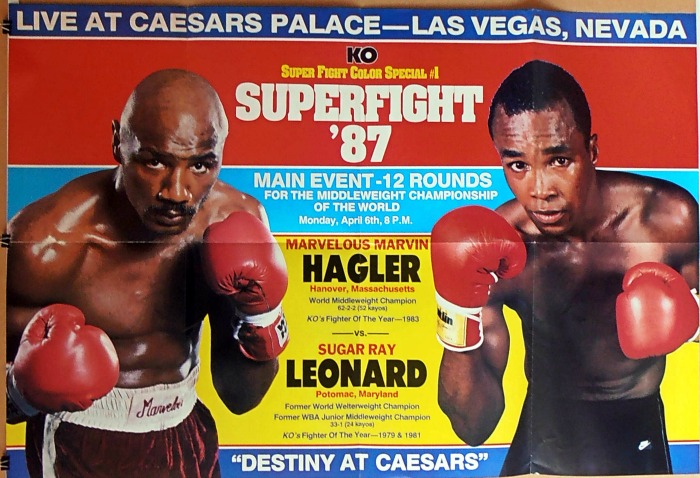
Thirty years ago this week and long before Floyd Mayweather Jr. and Conor McGregor were in the public consciousness, a true pugilistic “superfight” took place.
On Monday, April 6, 1987, “Marvelous” Marvin Hagler made the thirteenth defense of his world middleweight championship against “Sugar” Ray Leonard. And, when it was over, the wildly popular Leonard, returning from his second retirement, had clawed out a 12-round split decision victory.
Controversial and passion-inducing – as so many all-time great tilts are – the outcome of “The Superfight” as it was billed, only told one part of that night’s story. Side sagas abounded, some which have helped to cement a foundation that has lasted to this day.
To that point, Leonard vs. Hagler became the most-ordered boxing pay-per-view ever with an estimated 150,000 buys in a wired universe that was under five million homes. Las Vegas hotel and casino Caesars Palace established a record bid for a site fee, putting up $6.7 million for the right to hold the event. 12,379 paid come through the turnstiles, generating a record-breaking gate of $6.2 million.
The show also established a high-water mark for fighter purses as well as Hagler was guaranteed $12 million, while Leonard took home $11 million.
Hagler earned more than Leonard, but not for the obvious reason of coming into the bout as the defending champion. Instead, it was due to accepting a deal which would see the fighter paid off with a percentage of what the fight grossed, as opposed to a flat fee. By doing so, Hagler raked in millions upon millions more.
Leonard, who long distrusted promoters, including Top Rank Incorporated maven Bob Arum, instead negotiated for the largest guarantee ever received. And, while $11 million was still an incredible payday, the deal that was turned down reportedly featured an $8 million base guarantee, plus a thirty percent slice of all closed circuit and pay-per-view revenue, which was reported later to be upwards of 2.5 million viewers combined that night. (Though, Leonard’s deal did grant the Palmer Park, Maryland, native half of all Baltimore-Washington DC territorial closed-circuit profits, as well.)
Recalling the bout during an November 1989 interview with The New York Times, Arum opined that because he didn’t have to share any profit with Leonard, Top Rank cleared “$4 million to $5 million.”
Two days after the event, The Boston Globe wrote, “If the projected combined revenue… is accurate, Leonard may have sacrificed a lot of money by insisting on a straight $11 million guarantee, supposedly because he didn’t trust promoter Bob Arum’s counting.” Which led to Arum reportedly sighing, “I wouldn’t trust me either.”
Utilizing the spaciousness of the 20-foot ring Leonard’s camp had negotiated, “Sugar” would attempt to evade trouble for much of the round, avoiding exchanges with his heavier hitting opponent and attemping to steal rounds with dazzling displays of defensive prowess and punching speed. A universal betting underdog coming into the fight, the technique earned Leonard a highly controversial decision with its fallout echoing throughout the sports world quickly.
Fans of Leonard rejoiced. Conversely, fans of Hagler were incensed. Feeling as though Leonard was consistently beaten through a majority of most rounds, and relied solely on dazzle, some fans and many in the media would ponder aloud if such controversial decisions would finally be the nail in the sport’s coffin.
Judging from the thirty years that have followed, the answer is a resounding no.
*****
A superfight in every sense of the word, a week leading into the bout, Steve Marantz penned this in The Boston Globe:
“As hammers pounded at ringside, the whole city throbbed in anticipation of the event. It is expected to lure 200,000 visitors and pump about $300 million into the local economy, according to hotel officials. All 60,000 of the city’s hotel rooms are booked, and the 20,000 seats for closed-circuit telecasts at six hotels are sold out… The bout already is setting sales records, according to Arum. In New York City, Tavern on the Green restaurant sold out its 1,000 seats at $125 each.
“Radio City Music Hall sold 6,000 seats at $60… Indications are that two million closed-circuit seats will be filled, and 700,000 homes will buy the bout on a pay-per-view basis, Arum said. By comparison, when Hagler-Hearns took place in 1985, about 700,000 closed- circuit seats were sold, and about 100,000 homes bought it as pay-per-view.”
It were those 100,000 homes, paying around $25 each, that continued to sound an alarm to the powers-that-be in canvassed matted promotions. That alarm started a few years prior when Leonard fought the other two members of the legendary 80s foursome he and Hagler would be associated with: Roberto Duran and Thomas Hearns.
Despite closed circuit arena gatherings still ruling the roost, the past success of Leonard’s bouts against Duran (1980) and Hearns (1981) opened the eyes of keen observers, including Arum, as to the future of audience participation. For Leonard’s fight against Hagler, the promoter focused on the rising interest of the new technology by severely limiting access of clubs, restaurants, and bars to show the event, instead concentrating on closed circuit and home pay-per-view only.
On June 22, 1986, a day before Arum promoted a pay-per-view between Hearns and Mark Medal, The Los Angeles Times talked to him about his philosophy when it comes to the burgeoning technology, writing: “With risk comes reward. With some 3.5 million homes wired for this kind of event, and with a traditional average of a 5% sale, Arum calculates 175,000 buyers. Of the $15 they pay, Arum collects $8 a head. Do your own math, but it tends to work out to a nice profit of $1 million for Arum’s Top Rank company.”
By the time Leonard and Hagler rolled around the next year, the bout’s suggested retail price would be set by Arum at $34.99-39.99. While some bristled, the promoter correctly predicted that consumers would be able to justify it due to the magnitude of the matchup and the hullabaloo which surrounded it.
*****
Premium cable channel HBO paid Top Rank $3.1 million dollars to rebroadcast the bout only four days later, much to the chagrin of cable operators and closed circuit facilitators. Believing that kind of turnaround was too quick, pundits were already complaining the station, which often reaired bouts only seven days after they took place, was ultimately bastardizing live viewership.
Theories that consumers would be content to wait were shot down quickly. The desire to be “in the moment” of an event would only grow in the upcoming years, which happened to coincide with the rise of heavyweight champion Mike Tyson. Pay-per-view replays airing the following Saturday on both HBO and Showtime would become an accepted practice by the end of the 1990s.
ABC’s Wide World of Sports would lock up network broadcast rights, which was a practice that had already began moving in the opposite direction. With premium networks, who also handled the show’s production, taking on larger roles, paying increasingly larger sums, and growing in overall reach, the practice of allowing for over-the-air networks to rebroadcast big fights in a timely fashion became passe.
Despite the hopes that the highly decorated 1984 United States Olympic team would spark interest, by 1987, networks were still reeling from the brutal 1982 encounter between Ray “Boom Boom” Mancini and Duk-koo Kim on CBS which resulted in Kim’s death from a subdural hematoma. That tragedy, along with being squeezed out of the top tier fights, difficulty in negotiating with some of the sport’s personalities, and general consumer/advertiser interest waning, network sports executives had already begun losing their zeal for the boxing business. And, to this day, not much has changed.
*****
An ardent boxing supporter for many years, Anheuser-Busch brewery’s flagship product, Budweiser, invested heavily into the “Superfight” promotion, incorporating the event into its own advertising, and using its relentless presence across media platforms to saturate the marketplace. In doing so, Budweiser would set a standard for future events which would continue to evolve as the pay-per-view boxing industry did.
The Boston Globe covered the Leonard-Hagler fight strongly, due to it being Marvelous’ “hometown” newspaper. (The Hagler family had moved to Brockton, Massachusetts, in 1969.) After it was over, it would continue to keep tabs on the event’s fallout – including a bizarre story that showed how nearly everyone wanted to see the bout:
“An hour before the fight, FBI agent Arthur Roderick entered the TV mobile truck and informed (HBO) producer Ross Greenburg that he had reports three of the most dangerous fugitives in the country were in the audience and that he would use the TV cameras that occasionally panned the audience to try to find them. ‘I asked him what he would do if he saw any of them,’ Greenburg said. ‘He told me he would arrest them. I didn’t dare ask if he would do it between rounds.’”
Greenberg boasted the fight would feature twelve cameras, including the introduction to boxing of a super slow-motion camera that ABC had introduced during its coverage of the 1984 Los Angeles Olympics.
A day after the bout, The Globe ran a story which noted the struggles of a young local fighter who had a place on the card, but couldn’t even land a seat of his own for the main event:
“After earning a fourth-round TKO over Kelly Koble in the card’s second fight, junior welterweight Mickey (sic) Ward of Lowell said he was going to rush to his hotel several blocks away, and return in time to watch Hagler-Leonard. ‘But I’m not going to be able to sit in the stadium,’ Ward said. ‘Can you believe that? I’ve got to watch it on the big screen (in the press room).’ . . . Ward’s fight became part of the international closed-circuit broadcast after Lupe Aquino stopped Davey Moore in the fifth round of the first broadcasted fight.”
The story also recorded the celebrity headcount, further driving home the magnitude of the event, and once again proving the allure of a big-time fight.
“Here’s a list of the celebrities who showed up for the fight: Frank Sinatra, Bo Derek, Joan Collins, Gene Hackman, Chevy Chase, David Brenner, Randi Oakes, Gregory Harrison, Tom Selleck, Don Rickles, Jack Klugman, Tony Danza, Wayne Rogers, Timothy Hutton, Garry Shandling, Louis Gossett Jr., John Madden, Dolph Lundgren, Ray Parker Jr., Thomas Hearns, Ray Mancini, Jimmy Connors, Yannick Noah, and Wilt Chamberlain. The Pointer Sisters, who are currently appearing at Caesars, sang the national anthem.”
*****
Marvelous, who had legally changed his name to include his moniker in order to control his rights, hadn’t lost since 1976. With the loss, he saw his chance to break Carlos Monzon’s record for middleweight title defenses (14) go up in smoke. Openly contemplating retirement before the bout, an angry Hagler unsuccessfully chased Leonard for a rematch before declaring he’d never fight again. Going on to pursue his acting and broadcasting careers, the Newark, New Jersey, native ended his run being universally praised as one of the top five middleweights of all-time.
Monzon’s 160-pound record would ultimately be broken by Bernard Hopkins in 2002, reaching a final total of 20 in 2005. As an aside, Hopkins’ run coincidentally would also be ended due to a controversial split decision loss, coming later that year at the hands of Jermain Taylor.
With the victory, Leonard picked up his fourth lineal world championship and in his third different weight class. He too would retire – for the third time – but, unlike Hagler, Leonard would once again come back.
In November 1988, “Sugar” won the WBC light heavyweight title from Canadian “Golden Boy” Donny Lalonde under the promotional banner of Vince McMahon’s Titan Sports. Leonard would retire and un-retire two more times, finishing for good after a loss to Hector “Macho” Camacho in 1997, an event which also ended up falling under the promotional governance of McMahon, who helped to save the show from cancellation.
*****
I’m sure you’re wondering, “Why did Vince McMahon have to save a Sugar Ray Leonard fight? Let’s digress for a minute:
In December of 1996, New Contenders Incorporated, the promoters of record for the bout, were asked by regulators to be investigated by the New Jersey Casino Control Commission for alleged ties to organized crime. The promotion’s chairman, Michael Blutrich, was also serving as a lawyer for the New York City gentlemen’s club Scores, which had recently been raided due to suspected ties with the Gambino crime family.
Due to that investigation, Sun International Hotels, Merv Griffin Gaming and Entertainment, and TVKO, HBO’s pay-per-view arm, all pulled out. Ultimately, the fight would go on with McMahon’s Titan Sports, and Caesars Atlantic City being asked by the fighters to come on board, with Camacho’s promoters, Bernard Dillon and Mike Acri, stepping up their financial obligations.
*****
All of the records from thirty years ago have fallen by the wayside.
The site fee record fell first with Donald Trump bidding $11 million in 1989 in order to host the legendary 91-second Tyson annihilation of Michael Spinks. Leonard broke his own Vegas gate record with his third fight against Roberto Duran, in 1990. Since then, the record would be broken again, dozens of times. The same goes for the largest selling pay-per-view of all-time, as well as purse totals for superstar megafights.
For example, earning a percentage of different revenue streams as Floyd Mayweather Jr. did, generating nearly a quarter of a billion dollars for himself in winning a one-sided 12-round decision against “Pac Man” Manny Pacquiao. That fight, of course, earned a record breaking 4.6 million buys at the record breaking price of $99.99.
Utilizing the spaciousness of the 20-foot ring Mayweather’s camp had negotiated, “Money” would attempt to evade trouble for much of the round, avoiding exchanges with his heavier hitting opponent, and attemptting to steal rounds with dazzling displays of defensive prowess and punching speed. A universal betting favorite coming into the fight, the technique earned Mayweather a highly controversial decision with its fallout echoing throughout the sports world, quickly.
Fans of Maywather rejoiced. Conversely, fans of Pacquiao were incensed. Feeling as though Mayweather was not looking to engage during a majority of the round, relying solely on defense and dazzle, some fans and many in the media would ponder aloud if such controversial decisions would finally be the nail in the sport’s coffin.
Judging from the thirty years that preceded us, the answer is a resounding no.
At the first official press conference to hype the upcoming “Triple G” Gennady Golovkin-Daniel Jacobs boxing fight at Madison Square Garden, both the Garden and HBO thanked World Wrestling Entertainment for their flexibility in moving an event already scheduled on March 18.
According to MSG Executive Vice President of Marquee Events and Operations Joe Fisher, to make the fight happen, WWE needed to move a show they already had booked that night in the building.
“A lot of you don’t know this, but I really need to thank the WWE. Everybody says ‘why the WWE?’ Well, we had an event booked on March 18, with the WWE, and they are just tremendous partners. They realized the magnitude of this event. And the fact that we needed to have it here. It had to be at Madison Square Garden. So with their cooperation, and partnership, they were willing to move off the date, and made this date possible. So I really, really want to thank all the great people at WWE.”
Later, Peter Nelson, EVP of HBO Sports, also showed his appreciation, adding, “I want to echo Joel’s moments about the WWE, and the spirit of partnership that they shared in moving an event so that this event could take place in its natural habitat.”
The fight was announced on December 17, and features two guys known for their power. Featuring Golovkin, one of the sport’s top pound-for-pound fighters, the bout could become boxing’s Fight of the Year, as well as its best selling pay-per-view.
Just when you thought Conor McGregor’s 2016 couldn’t get more interesting, the reigning lightweight champion is now a licensed boxer in the state of California.
Several sources reported the news Wednesday night including MMAFighting.com, FloCombat, and FoxSports.com, confirming with both McGregor’s management team and the state athletic commission.
Here’s what we know based on those reports:
– While he was granted a license in California, Fox Sports’ Damon Martin said he’s expected to also attempt to gain licenses in other “prominent states” like Nevada, Texas, and New York.
– The obvious play is the much-discussed boxing match with the currently retired Floyd Mayweather. FloSports’ Jeremy Botter believes the mutliple state licensing might means McGregor will use the Ali Act to make the fight happen despite his UFC contract. He also said the two sides have been discussing the fight for more than a year.
– McGregor was last seen winning the lightweight gold in a one-sided affair over Eddie Alvarez at UFC 205 several weeks ago. He was stripped of his featherweight title this weekend as part of a series of moves designed to give the upcoming UFC 206 a main event and purpose for remaining on PPV.
McGregor hasn’t commented on the stripping of the belt, so this could simply be a public show of displeasure toward that move and to generate more media attention for him.
Dave Meltzer and Bryan Alvarez will discuss this news on Wrestling Observer Radio for subscribers late Wednesday night.
On Saturday, September 12th, Floyd Mayweather Jr fought in what he claims is the final fight of his storied career when he defeated Andre Berto by unanimous decision. Mayweather was heavily criticized for selecting Berto as his final opponent, as many in boxing felt that Berto was past his prime and chosen to give Mayweather an easy win on his way out. It headlined a four bout pay per view and took place in Las Vegas at the MGM Grand Garden Arena, which has been Mayweather’s home for his final twelve fights.
The fight went exactly as most people anticipated. You practically could have guessed the entire fight ahead of time. Mayweather dominated the bout, winning the decision on scorecards of 120-108, 118-110, and 117-111. If anything, the two judges that gave Berto two and three rounds respectively were being generous as Berto showed little by way of skill and was clearly outclassed by a much more talented opponent.
It was clear from round one that Berto had little chance. He barely touched Mayweather throughout the fight and in the twelfth round was actually hurt by a combination of punches by Mayweather in the corner. The two began talking trash late in the fight, to the point where the talk was more intense than the fight and referee Kenny Bayless had to separate the fighters and issue each of them a warning for stalling the fight with all the trash talk.
According to ShoStats, Mayweather connected on 232 of 410 punches for a 56-percent compared to Berto, who connected on 83 of 495 punches for 16-percent. Those stats tell the story of the fight.
The real story of this fight was outside the ring and that story has many chapters. First there was the lack of box office drawing power. Selecting Berto as Mayweather’s opponent was an obvious miscalculation. Multiple major news outlets were reporting in the days leading to the fight that the MGM Grand had at least 2,100 tickets still available.
The fight didn’t sell out. Attendance was 13,395 with the arena scaled for 14,500. StubHub, an online ticket resale site owned by eBay, had cheap seats available the final week of the fight for just over $160. That was down from over $300 a week earlier. Those tickets went back up to $300 the day of the fight, as all the last minute travelers came to town.
I was in Las Vegas all week for both UFC 191 and Mayweather vs. Berto. I decided not to attend Mayweather vs. Berto at the MGM Grand, partially because the ticket prices were too high for this fight (also, I’m Canadian and the exchange rate is abysmal right now, making the fight substantially more expensive) and also because I was exhausted from attending the Boxing Fan Expo at the Las Vegas Convention Center all day.
Instead, I stayed in my hotel room and ordered the fight on pay per view online. This was the first pay per view offered online by Showtime. The retail was $60. The pay per view was headlined by CBS and anyone who ordered received three months free of CBS All Access, which is the network’s streaming service and normally costs $5.99 a month. The only issue I had with the online stream was at the start of the show when the stream went dead. I called CBS’ hotline and they gave me an alternate link where I could watch. The stream was clear with little buffering, which was a positive since I was on hotel wifi.
The problem with Berto as an opponent is that no one believed Berto had a chance at defeating Mayweather. Berto went into the fight at +600 and Mayweather at -1800, which was actually better odds than Berto was given days earlier because of a rush of late underdog bettors throwing some money on Berto in the hopes of an unlikely payday.
Part of the attraction of watching a Mayweather fight is the chance at seeing him get his mouth shut. He’s the greatest drawing heel of all time. I see Mayweather as being like The Sheik, a classic wrestling heel who drew well in Toronto and Detroit by never losing with the idea that each new opponent could finally be the one to beat him. The Sheik drew a lot of money for that era from people who were only paying to see him lose.
To some degree, I think the same thing happened when Mayweather beat Pacquiao. Although boxing insiders knew Pacquiao stood little chance of beating Mayweather (particularly anyone who knew about Pacquiao’s injury ahead of time), most of the people watching the fight were only casually interested in boxing and probably never bought a boxing pay per view before. Those casual fans all thought Pacquiao was going to be the man to beat the man. He wasn’t. Once Pacquiao lost handily, those fans were probably left thinking, if Pacquiao can’t beat Mayweather, then no one can.
So, in order to draw money Floyd’s supposed final opponent would have be someone that people actually believed had a chance at winning. Someone who would present Floyd with a challenge. Berto wasn’t that someone. Although a former WBC and IBF Cruiserweight champion and the current interim WBA champion, Berto was a 32-year-old who had lost three of his last six fights dating back to a bout against Victor Ortiz in April 2011. He had tested positive for norandrosterone in 2012 and suffered a shoulder injury in a loss to Jesus Soto Karass in July 2013 that kept Berto out of action for 14 months.
Mayweather improved to 49-0 with 26 knockouts. Berto fell to 30-4 with 23 knockouts.
If this was indeed Floyd’s final fight, it was a missed opportunity for Al Haymon, who de facto controls Mayweather Promotions and is also the de facto promoter of Premier Boxing Champions. Even if Haymon and company stayed with Berto as Floyd’s final opponent, the hype for the fight was poor. PBC has a ton of network television time and ought to have used some of that time to give Berto a fight on NBC to showcase his skills and personality in order to build Berto up in front of as large an audience as possible. Instead, Berto’s only fight on PBC this year was against Josesito Lopez in the co-main event of PBC’s debut on Spike in March.
Berto was barely part of the pre-match hype. Much of the talking for Berto strangely came from Mayweather himself, who in response to people criticizing Berto kept saying that anything can happen in a fight and not to count Berto out. A bit was made out of Berto coming from a fighting family. His father Dieuseul was an MMA fighter back when MMA was better known as NHB, racking up a 0-3 record that included a loss at UFC 10 in July 1996. Some footage of Berto competing in minor league MMA was even used on the pay per view broadcast. No mention was made of Dieuseul’s history as a pro wrestler (if there was, I didn’t notice, which was surprising since Mauro Ranallo did play-by-play for the broadcast). Also, I heard no mention of Andre’s brother Edson, who is an MMA fighter with a 17-12-1 record having competed in Bellator, Strikeforce, and EliteXC.
Berto was obviously the wrong opponent, both from a skill and from a box office standpoint. Some people have suggested that Mayweather ought to have faced Gennady Golovkin, who holds multiple titles at middleweight. Golovkin had said publicly that he would be willing to come down in weight to face Mayweather. Golovkin probably would be the biggest challenge for Mayweather, but anyone who thinks Mayweather vs. Golovkin could have happened is in a fantasy world. Mayweather fights for Al Haymon and Golovkin fights for HBO. Even if Golovkin fought for Haymon, Mayweather still isn’t going to fight someone so much larger than him and someone who would go into the fight as a favourite and ruin Mayweather’s perfect record.
There were, however, other fighters that are actually signed to Al Haymon that would have made for better opponents than Berto. This list includes (but is not limited to) Keith Thurman, Amir Khan, Danny Garcia, and Shawn Porter. A lot of people feel Thurman is the next major star at welterweight and he might have even been favoured to beat Mayweather. If Mayweather was looking to put someone over on his way out, Thurman would be the best bet. Talks with Khan also occurred and Khan had been rumoured to face Mayweather many times over the last few years. When Khan beat Chris Algieri on Spike a few months ago, the way that fight was promoted was that it was leading Khan to a pay per view bout against Mayweather. That was still strange because of the idea at the time was that Khan would be Mayweather’s final opponent, one would think they would want Khan competing on NBC instead of Spike to get as many people watching him as possible.
If I had to choose an opponent for Mayweather’s 49th fight, I would have selected Shawn Porter. Porter is the anti-Mayweather, a friendly, likeable fighter from a Christian background. Like Mayweather, Porter is trained by his own father. Unlike Mayweather, Porter isn’t cocky, arrogant, and has a clean personal history.
I met Porter and his father Kenny at the Boxing Fan Expo earlier in the day. After talking with the two of them for a minute, I remain more convinced that he would have been the ideal challenger for Mayweather assuming that Mayweather was not looking for too much of a challenge. Mayweather would probably defeat Porter, but the loss would give Porter’s career a boost and the fight would have drawn better at the box office than Mayweather’s fight against Berto.
If I could write the story, I would have Mayweather beat Porter for Mayweather’s 49th win, then return to beat Pacquiao to open Las Vegas Arena next year to earn win 50 and break Rocky Marciano’s record. After, I would have Mayweather put Thurman over in his retirement fight and retire at 50-1 while in the process making Thurman into a new star.
It’s not that I believe any of that will happen, but that is the scenario that I picture would make the most money and be the most useful for PBC’s long-term fortunes after Mayweather is gone. In my little story, you could change a few of the components, like substituting Khan for Porter, or Danny Garcia for Thurman, and it would still work better than a fight against Berto.
It was clear that Mayweather handpicked Berto as his final opponent because Berto stood little chance. Berto’s last fight on Spike took place before the Mayweather-Pacquiao bout and any talk at that point that Berto would be Mayweather’s next foe would have sounded ludicrous. When Mayweather told the media a few months ago that he was considering fighting either Berto or journeyman Karim Mayfield, no one believed him. And then Berto was announced. I think it is probably the case that Mayweather lives in a bubble world surrounded by yes men and any idea that he pitches is going to be responded to positively. At this point Mayweather has made so much money for Al Haymon that I figure Haymon just allows Mayweather to do what he wants now with little feedback.
The fight will probably draw poorly on pay per view. The only question is what constitutes poorly for a Floyd Mayweather fight at this point. There might be enough interest in Mayweather’s name alone to carry the fight to a profitable buy rate. Alternatively, the negative press and lack of hype could flatten the buy rate to the lowest since Mayweather signed his lucrative contract with CBS Showtime, a contract that allowed Floyd to earn more than $400 million. $250 million was for the Pacquiao fight alone. He earned another $32 million for this bout.
Even though Berto lost nearly every round and looked out of his league against Mayweather, he was all smiles in his post-fight interview. That is probably because he earned a $4 million payday for the loss.
The second story outside the ring is the accusation that Mayweather misused an IV leading into his fight against Pacquiao. The story was broken on SB Nation by long-time boxing scribe Thomas Hauser, who clearly enunciated the details of what Mayweather did and didn’t do and the poor response from the USADA, who overlooked drug testing for that bout (the article is at http://www.sbnation.com/longform/2015/9/9/9271811/can-boxing-trust-usada). A ton has been said and even more has been written about Hauser’s contentious article, which made Mayweather look as if he cheated going into the Pacquiao bout. Mayweather has been a vocal proponent of serious drug testing in boxing, so the article was damaging to his reputation as a clean fighter. Hauser also published the piece at the most inopportune time for Mayweather, as the article became part of the pre-fight hype and may have helped contribute to the fight’s poor box office performance (although the fight was probably going to draw poorly anyway).
Mayweather was quizzed heavily about the IV issue and the lack of interest in the Berto fight in a television interview with journalist Charles Payne of Fox News. The interview is worth watching as it is one of the few times someone has bothered to ask Floyd questions that aren’t merely public relations (the interview is about seven minutes long and is at http://www.foxbusiness.com/business-leaders/2015/09/11/inside-ring-with-floyd-mayweather-jr/).
The third story is the one that people are going to be talking about for months and that is whether Mayweather stays retired. After beating Berto, Mayweather continued to insist that it was his last fight and that he was now retired. His retirement feels like a pro wrestling career match stipulation that no one believes and is adhered to for a few months at most until a lucrative match draws the wrestler out of fake retirement.
“You got to know when to hang it up and it’s time for me to hang it up. I’m not going to be doing this when I’m 40 years old,” said Mayweather in his post-fight interview.
If Mayweather does come back, what will that lucrative match be? He’s not going to put anyone over on his way out because his mentality is all about winning, even at this stage of his career. The obvious fight is a rematch with Pacquiao to open the new Las Vegas Arena next summer. The fight would take place nearly a year after the original bout and the story would be that Pacquiao is going into the fight without a serious injury and theoretically would stand a better chance of beating Mayweather. Mayweather is also a free agent now that his CBS Showtime contract has expired with the Berto match and could feasibly go across the street to HBO, who is Pacquiao’s broadcaster.
The Pacquiao fight is really the only fight for Mayweather at this point. There are other matches with guys like Golovkin, Khan, Thurman, etc, that fans would like to see, but those are never going to happen. Mayweather will probably beat a healthy Pacquiao if they fight a second time. With the new arena opening in Las Vegas, I imagine Mayweather will get tremendous money offers to open it with a fight against Pacquiao.
And if Mayweather does sign to fight Pacquiao again and then claims he will retire after that, it would be far more believable.
No one believes that Mayweather is going to remain retired. But no one believed that Berto was going to be Mayweather’s next opponent, even though Mayweather told everyone as much. Maybe Mayweather really is serious about being retired. If he is, in his post-fight interview he said that he wants to focus on Mayweather Promotions and helping establishing his young fighters into new stars. I could see Mayweather as the public face of PBC, like in the Dana White role, with the difference being that Mayweather is only a public face and unlike Dana would do little actual work behind the scenes.
The pay per view undercard included three additional bouts besides the Mayweather-Berto main event. They were all excellent fights. It was clear that Showtime loaded the show with a strong undercard in order to make up for the weak main event.
The pay per view broadcast opened with Jonathan Oquendo beating Jhonny Gonzalez by majority decision at super featherweight. Scorecards were 98-92, 95-93, and 94-94. It was a close fight and a good action bout. Oquendo, 32, was knocked down in round one and Gonzalez, 33, was knocked down in round two. Oquendo improved to 26-4 with 16 knockouts and Gonzalez fell to 58-10 (49 KOs).
In the second bout of the night, Badou Jack, 31, upset George Groves, 27, by split-decision to retain the WBC Super Middleweight title. This was another exciting fight. Scores were 116-111 and 115-112 for Jack and 113-114 for Groves. Groves suffered a flash knockdown in the first round, but came back to control many of the middle rounds. This fight could have gone either way. There weren’t many people in the arena yet, but there were a large British contingent in Las Vegas to see their countryman Groves and they were vocal in their support.
It was a disappointing result for Groves, because a win could have led to a unification bout with James DeGale, who holds the IBF Middleweight title. Both are British fighters, with DeGale being the first British fighter to win both an Olympic gold medal and a major professional title. Groves is the established star in Britain and DeGale is the rising star. That fight wouldn’t mean much in the US, but if PBC wanted to debut in Britain, they could do a lot worse than headlining with Groves-DeGale for two middleweight belts.
Badou Jack spoiled that idea, though, just as he spoiled Anthony Dirrell’s undefeated record when he upset Dirrell for the WBC title on a PBC show in April. Jack put together two underdog wins in a row, so he’ll probably be taken more seriously as a fighter from now on. Jack could fight either Dirrell or Groves in rematches. I would think Groves would get a rematch first, especially since the initial idea was for Jack vs. Groves to headline a Showtime broadcast before it was moved to the Mayweather pay per view undercard.
With the win, Jack improved to 20-1 with 12 knockouts and Groves fell to 21-3 with 16 knockouts.
The third bout of the evening was a barn burner with Roman Martinez going to a split draw with Orlando Salido. It was an all action fight with both fighters pummeling one another from bell to bell. With the draw, Martinez retained the WBO Super Featherweight title. Scores were 115-113 Salido, 115-113 Martinez, and a 114-114 draw.
Martinez, 32, and Salido, 34, combined for 1,728 punches thrown over twelve rounds. Salido connected on 285 of 1,037 punches for 27-percent and Martinez connected on 189 of 691 punches also for 27-percent. A draw was fair, although many watching the fight scored it for Saldio based on his tremendous level of activity.
“I threw a lot of punches. There will definitely be a third fight,” Martinez said in his post-fight interview. The fight was a rematch of a bout between the two that took place on April 11th in San Juan, which Martinez won by unanimous decision to capture the WBO title.
Martinez fell to 29-2-3 with 17 knockouts and Salido fell to 42-13-3 with 29 knockouts.
The show also featured a number of dark matches that took place before the pay per view broadcast. A couple of these fights aired on the preshow for the online pay per view. Highlights among these fights include Vanes Martirosyan (36-2-1, 21 KOs, 29 yo), beat Ishe Smith (27-8, 12 KOs, 37 yo) by unanimous decision at super welterweight. Martirosyan was able to knock Smith down in the third and eighth rounds, although calling the one in the third round a knockdown was generous. Also, Gervonta Davis (12-0, 11 KO, 20 yo) knocked out Recky Dulay (8-2, 5 KO, 21 yo) in the first round at super middleweight. Davis is considered one of the top young prospects in Mayweather’s gym and even though Dulay was a step up in quality of competition for him, Davis put him away quickly. Davis is a fighter to keep an eye on.
Other notable prospects to pick up wins on the undercard were middleweight Christopher Pearson (13-0, 10 KOs, 24 yo) and super-middleweight Ronald Gavril (14-1, 10 KOs, 29 yo).
The week prior to Mayweather-Berto there was a tremendous amount of boxing on TV. PBC had a card on CBS last weekend, plus a show in Toronto on Spike TV on Friday night that went against a Top Rank Show on TruTV. There was also an NBC show on Saturday afternoon that was used as a last minute build for the Mayweather pay per view. I didn’t have a chance to watch that show, but it was headlined by Peter Quillin (32-0-1, 22 KOs) knocking out Michael Zerafa (17-2, 9 KOs) in the fifth round. The fight sets up a bout between WBA Middleweight regular champion Daniel Jacobs and Quillin for that title.
Also on NBC Saturday afternoon, 25-year-old Jermall Charlo (22-0, 17 KOs) beat 42-year-old Cornelius “K9” Bundrage (34-6, 19 KOs) to win the IBF Super Welterweight title. Charlo knocked Bundrage down in rounds one, two, and three for four knockdowns in total, finishing the fight with a third round knockout.
Note: In Saturday’s column I mentioned that Adonis Stevenson was probably the biggest boxing star to fight in Toronto. I forgot about the time Muhammad Ali faced George Chuvalo at Maple Leafs Gardens on March 29th, 1966. Ali was defending his Heavyweight title and beat Chuvalo, a tough Canadian from Toronto, by unanimous decision after fifteen rounds. There will probably never be a bigger boxing star than Ali, so he will remain the biggest name boxer to ever fight in Toronto. But in the last 49 years, there hasn’t been much else and certainly little in the way of big name boxing in Toronto since the new millennium. But if anyone knows of any other major fights in Ontario history, I’m all ears.
On Saturday, September 12th, Floyd Mayweather Jr. engages in what he is claiming will be the final fight of his career when he faces Andre Berto at the MGM Grand in Las Vegas.
The problem is that almost no one believes Mayweather will retire. And almost no one cares.
Mayweather’s selection of Berto as an opponent has proven to be a misfire. I’m in Las Vegas for the fight (I’ve been here since before UFC 191 on Saturday) and there is no feeling of hype or excitement in town. Articles published on a variety of web sites earlier this week noted that there were more than 2,100 seats still available.
On StubHub, a secondary marketplace owned by eBay for ticket resellers, tickets for the fight could be had for as little as $166 as of Thursday night. That is down from over $300 for tickets in the cheap seats a week ago.
MGM Grand also apparently isn’t showing the fight on closed circuit due to the amount of disinterest in the fight. I’ve been keep tabs on the Facebook pages of popular sports bars on the Las Vegas Strip to see if any of them are having viewing parties. Again, as of Thursday night I haven’t come across a single bar that is advertising a Mayweather viewing party (although there are nightclubs advertising after parties, which isn’t the same thing). Most are advertising NFL parties instead.
I talked to lots of different UFC fans over the weekend that came to Vegas for UFC 191. Many of the people I talked to were boxing fans from the UK and Europe. I think a disproportionate amount of foreigners go to the UFC press events to try and snap photos with fighters because if you’re going to travel that far for the UFC, you may as well get your money’s worth. But even these admitted boxing fans weren’t sticking around for the Mayweather fight, with the feeling it was an afterthought.
Promotion for the bout has been strange. Months ago Floyd told the press that the two frontrunners for the honour of being trounced by him in September were Karim Mayfield and Andre Berto. People thought he was joking. He wasn’t.
Mayfield is a 34-year-old journeyman with a 19-2-1 record. The highest title he ever earned was the WBO NABO Welterweight title. He had lost two of his last three fights and hadn’t fought since November.
Berto, 32, has a career record of 30-3 with 23 knockouts. He is a former WBC and IBF Welterweight champion and currently holds the interim WBA Welterweight title (which is about as meaningless as a title belt can get in boxing these days). But he has lost three of his last six bouts, with his two recent wins coming over unknown fighters Josesito Lopez and Steve Upsher Chambers. In 2012, Berto tested positive for norandrosterone.
Most people will say that the reason Berto was selected as the opponent for Mayweather’s 49th professional fight was to give Mayweather the easy win to tie Rocky Marciano’s record. Apparently among Mayweather’s people there was also the belief that Berto is an action fighter and they didn’t want a repeat of the criticism that Mayweather endured for the Pacquiao fight being so boring.
The reaction of the general public to the quality of the Mayweather-Pacquiao fight was interesting. A lot of people watching that fight probably had never seen boxing before, except maybe in a Stallone movie. When the pay per view broadcast showed the graphic that the majority of fans thought Pacquiao would win the fight, it became obvious there was a tremendous amount of super casual fans watching the bout. Insiders with knowledge of both fighters had Mayweather as a heavy favourite.
Many fans turned on the bout, due to the enormous retail price of $100 and how dull the fight was. It was the most expensive fight in history, but the price didn’t deter people from buying it. I would have priced the fight the same way if I was Al Haymon or whoever it was that made that decision, because the fight grew into something more than just a fight and became a cultural event that people had to see no matter the cost. No one wanted to be left out when it came to saying that you saw the biggest fight of all time.
But that meant all of the extra people that ordered the fight were people that never watch boxing. People who don’t watch boxing expect boxing to be a fistfight, which it isn’t. I think if you polled many of the viewers of Mayweather-Pacquiao and asked them to name a famous a boxer, probably most would say Mike Tyson or Rocky Balboa. Some might say Muhammad Ali, but have probably never seen an Ali fight.
Of course, this is all speculation on my part, but based on poll results on who would win between Mayweather and Pacquiao and the public reaction to the fight afterwards, my speculation is probably true.
Mayweather-Pacquiao wasn’t a boring fight. It was a typical Mayweather fight. I watch boxing every weekend and I see far duller fights regularly. It was boring if you weren’t a boxing fan, though, and most of the people that bought that pay per view weren’t boxing fans.
So, I think the idea to bring in an action fighter like Berto to face Mayweather was an overreaction to public criticism of the Pacquiao fight.
I don’t necessarily think that Mayweather needs to face a top young opponent at this point in his career. I expect Mayweather to only do things at this point that protect his legacy. But Berto has no name value. His last fight was in March on the debut PBC on Spike show as the co-main event against Lopez. There was no talk at the time of Berto facing Mayweather after Pacquiao. Such talk would have been unbelievable.
If Mayweather were to put someone over on the way out, the choice would probably be Keith Thurman, although Danny Garcia and Amir Khan would also be discussed. He could also do a rematch with Canelo Alvarez, but politically that wouldn’t happen with Mayweather in Haymon’s camp and Alvarez signed to Golden Boy. But again, I only expect Mayweather to do things to protect his own legacy and not create a new star on the way out (like De La Hoya did in losing both to him and also to Pacquiao).
With that in mind, the opponent I would have selected for Mayweather is Shawn Porter. Porter is the anti-Mayweather in a lot of ways. Porter is a devout Christian, a seemingly honest fighter with a clean personal history. His father Kenny is his trainer and is also a devout Christian. Porter has a nice smile, has done colour commentary for PBC, and although he lacks charisma he speaks well and is likeable. A few weeks ago I wrote an article comparing Porter to Ricky Steamboat or Christy Mathewson, the latter being a baseball pitcher who played for the New York Giants from 1900-1916 who was known as “The Christian Gentleman”.
Porter is an ultra babyface, bland but likeable. Mayweather is charismatic and unlikeable. Mayweather is the greatest drawing heel in history. The only people that like Mayweather seem to be people obsessed with his lavish lifestyle and who adorn themselves in “TMT” brand clothing. Mayweather was on a recent All Access show shadowboxing with a huge wad of money in his hand. He calls himself “TBE” and constantly talks about Muhammad Ali and why Ali doesn’t stack up. He has a criminal record for domestic violence, which is a whole other ball of wax.
Mayweather versus Porter would have been a great face-heel matchup. Porter could be sold to a wider audience as a young upstart with wholesome values who is going to get a chance to fight the cocky self-proclaimed best ever.
It’s not a great fight, but it has selling points that are stronger than a fight against Berto. I think Mayweather would beat Porter, but I think Porter is a more lucrative opponent than Berto (who will also lose to Mayweather).
There are two main selling points to the fight against Berto and both are weak. First, Mayweather selecting Berto as an opponent is like a promise that this fight will be more action-oriented than the Pacquiao bout. That’s a weird stance. Imagine going to a restaurant and to get you to return the waiter promises your next meal won’t suck so much and will be less expensive.
What was even weirder was the way this fight was being hyped by Joe Tessitore and Teddy Atlas during the ESPN broadcast of the Santa Cruz-Mares fight a couple weeks back. Tessitore actually said that the Santa Cruz fight was a makeup bout for all the people who bought the Mayweather-Pacquiao and weren’t happy with that fight. That blew my mind. This was WCW level stupidity. This would be like WCW doing a Ric Flair-Hulk Hogan pay per view in 1998 and then doing Rey Mysterio vs. Ultimo Dragon on Nitro six months later and Tony Schiavone saying that the Nitro match was there to make up for all the people who thought the Hogan-Flair match was awful. And they do this just a week before Hogan is wrestling Kevin Nash or someone on pay per view.
It is incredible that a PBC broadcast team would actually admit that Mayweather’s last fight was terrible just a couple of weeks before Mayweather was scheduled to fight again on pay per view.
The second point is that Mayweather will retire after this fight. I also have a pro wrestling analogy using Hogan and Flair to illustrate why the second selling point of Mayweather-Berto doesn’t work. No one believes it. It is a pro wrestling retirement stipulation. This is once again like WCW in 1994 when they would say that Hulk Hogan or Ric Flair (or both) were retiring after their bout and no one believed that the retirement stipulation would be adhered to.
Pacquiao will be ready to fight next year and a rematch between him and Mayweather will draw money based on the idea that Pacquiao will be fighting injury free. It won’t draw as well as the first one, but will draw better than anything boxing can sell otherwise in 2016.
Also, Las Vegas Arena is set to open next summer. Dana White claims he is getting the first date for a sports event with UFC 200, but who knows. If I owned the new arena, I would want to open it with Mayweather-Pacquiao II.
Mayweather stands to make a ton of money fighting again next year. Does anyone actually believe he will pass all that money up? I mean, the guy’s nickname is actually “Money”. How can you get any more obvious?
There is also the matter of breaking the Marciano record by hitting 50-0, which is a nice fat number to retire on. I don’t know how much that means to Mayweather, but it’s there as a selling point for another fight next year.
I don’t know how to estimate a buy rate for this fight. Will it beat Ronda’s buy rate from August? If it doesn’t, that will certainly give Ronda another talking point in the media about how she outdrew Floyd Mayweather. If that’s the case, I can’t imagine that would please Mayweather and might motivate him to try to milk the box office for one more fight with Pacquiao.
I think there is also some degree of burnout by the general public on Mayweather, in a way that it doesn’t really matter who Mayweather faces. I get the sense that maybe the public is tired of him. The public seemed to think (for whatever reason) that Pacquiao was the man to beat Mayweather, and when Mayweather beat him handily, the public might feel that no one will ever beat Mayweather, or that Mayweather has so much power in picking his opponents that he will never face someone who stands a chance of winning.
What I find especially bizarre is PBC’s poor use of their network television slots to create an opponent for Mayweather. One would think that PBC would have Berto fight on NBC instead of on Spike in order to get as many people familiarized with his name as possible. It is obvious that when Berto fought on Spike earlier this year that no one was counting on him as even a possible opponent for Mayweather after the Pacquiao fight. Another advantage to having Porter fight Mayweather is that Porter earned a high profile win over Adrian Broner on NBC a couple of months ago.
Errors like this make PBC look like such a waste of money. They have a massive amount of television time they can use to create new stars and build pay per views and they are completely squandering it. The whole thing with PBC is to use network and cable TV time to build new stars and then have these stars fight on pay per view. But they didn’t even build a new star for Mayweather’s opponent in September, which would have been so easy to do given how many millions of people watch PBC.
If this is the best PBC can do, there is a problem.
All I can say is that the fight will likely draw poorly on pay per view, but what constitutes poorly for Mayweather after the Pacquiao fight is anyone’s guess.
Besides the negative press regarding the fight being a box office bomb at the MGM Grand, there has also been the matter of the Thomas Hauser article published by SB Nation (http://www.sbnation.com/longform/2015/9/9/9271811/can-boxing-trust-usada) regarding the USADA and how Floyd gets preferential treatment. Hauser writes with great clarity, which is probably the nicest thing someone can say about a writer. In his article both Floyd and the USADA come off terribly and if there is ever a BALCO type investigation into the USADA and Mayweather, then Floyd’s image could be irreparably damaged even years after his retirement.
No matter what happens in the next eighteen months or so, even if the Berto fight draws poorly, Floyd is the greatest drawing heel in history. But unless a federal investigation into the USADA or something of that sort happens and tarnishes Mayweather’s image, years from now I think the general public’s attitude towards both Floyd and the Pacquiao fight will change.
History is kind to people and fights that the public decide are legendary. Here’s a pair of examples. Mayweather was convicted of domestic violence and served time in jail. He’s a reprehensible human being and plays that role up as much as possible in order to build hype for his fights. Years from now, unless the general public are smacked in the face with evidence of doping (as in the case of Lance Armstrong), he will be loved, not because he’s a good guy, but because he’s a legend.
Few people care about Mayweather’s history battering women. Mike Tyson is a convicted rapist and now he has a cartoon. Tyson was a bigger draw after he got out of prison than he was before, even though it is generally agreed that Tyson was already past his prime before he went to jail. Tyson is a household name. People don’t mind that he is probably a psychopath.
What could damage Floyd’s image isn’t beating up women, but the general public finding out he beat up women while on steroids. It seems to make no sense, but these are the priorities of the general public. If I were Mayweather’s people and I could dictate to the USADA how drug testing works, I would want to make sure any frozen samples from Mayweather were destroyed. It’s obviously unethical, but based on what Hauser published about Mayweather and the USADA, what they are doing is obviously unethical anyway. Being caught cheating is the main thing that will destroy Mayweather’s career and get people to go from paying to see get beat up to just wanting to see him go away, like Lance Armstrong or half of the people that played baseball in the ‘90s.
I also think history will be kind to the Mayweather-Pacquiao fight. The Ali-Inoki fight in Japan was a debacle when it occurred, but subsequent history in Japan treats it like the first real major mixed fight in history. Even if you ask American fans about that match, the people who are aware of it wouldn’t be able to accurately describe what happened, but would probably talk about it in terms of being a legendary match.
History tends to be kind to fights that people don’t actually have to watch, but just have to hear about how legendary they were. Mayweather-Pacquiao is like that and it will be interesting to see how history treats both Mayweather and that fight.
What history won’t treat well is Mayweather’s forgettable bout this Saturday against Andre Berto. We’ll see if the box office treats it any better.
Jeremy Wall can be contacted at [email protected] and followed on Twitter @jeremydalewall.