One Championship’s new anti-dehydration weight cutting policies and analysis

One Championships has announced that they will no longer allow weight cutting by dehydration and have implemented new regulations and policies to enforce this change. This is a great idea conceptually, but will they be able to pull it off? What they are suggesting seems like a logistical nightmare, but at least it’s something. As a long time observer of Asian MMA, I can tell you, it’s not high on standards and regulation enforcement. However, I’m happy they are attempting to change the policy of weight cutting, and really, they had to given the most recent death of Yang Jiang Bing, the 21-year-old who died cutting weight in preparation for a fight in One Championships on December 11, in Singapore. My thoughts will be in italics after the regulation.

GENERAL REGULATIONS & POLICIES RELATED TO ATHLETES’ WEIGHT

1. Athletes must submit their current walking weight and daily training weight regularly. Athletes will input and track their daily weight online via a dedicated web portal. Athletes may input data weekly but must include daily weights. — This is a great idea and is something that is already imposed to a degree in high school wrestling, but obviously this can easily be gamed by lying athletes. I’m sure athletes will argue that this is too frequent, and really, it is too frequent, but I understand the attempt at accountability. Start strong. You can always back it off later.

2. Athletes will be assigned to their weight class based on collated data and random weight checks. Athletes are not allowed to drop a weight class when less than 8 weeks out from an event. — Another great policy, especially the first part. Your weight class should be based on data. What a novel concept! We use science to answer a question about biology, it’s genius! I’m not sure what is intended with part two because if you’re booked to fight, it’s not like a month in advance you’re going to say, “Hey opponent, I’m going to drop to 145, so if you want to fight, you have to meet me there.” I’ve never heard of that happening. It’s an attempt at something, but I’m not sure what.

3. During fight week, weights are checked daily. Urine specific gravity will also be checked the day after arrival and 3 hours prior to the event.  Athletes must be within their weight class and pass specific gravity hydration tests all week and up to 3 hours before the event.  If an athlete falls outside the weight, or fails a test, they are disqualified from the event.  Doctors may request additional testing at their discretion. — The specific gravity thing is currently being used in high school wrestling, and I’ve seen it gamed first hand. I actually sat in on a meeting while the coaches discussed how to beat this. If they are really going for something legitimate, then this is a no-brainer rule, but it needs to be subject to examination by non-crooked doctors/trainers, that’s all I’ll say.

4. Catch weight bouts are allowed. However, the athlete with the higher weight will not be heavier than 105% of the lighter opponent’s weight. — This is fine, but seems needless. Once guys are fighting in their proper weight classes, there won’t be a reason to have catch weight matches. The reason GSP vs. Anderson Silva was ever possible was because they were going to do it at 177 or something close, with the theory that since GSP has a huge cut to 170, he’ll sacrifice a bit of size for a little less suffering during the cut, and all Silva needs to do is dehydrate 8 more lbs down from 185 which he’s done before. OR THEY COULD HAVE BOTH FOUGHT AT 195! The thing that is dumb about catch weights is that it’s just like saying, “Weight classes don’t really mean much.” Which is fine, but you’re saying the exact opposite by enforcing them. Catch weight matches should not really need to exist. 

5. ONE will conduct random weight checks on athletes at our discretion. — Solid. Now let’s see if it happens.

6. Athletes may petition to change weight classes outside of the 8-week competition zone and must be within their new desired weight at that time. In addition, athletes must pass a specific gravity urine test when their weight is within the limits of the newly petitioned weight class. ONE doctors can request additional testing to determine the amount of weight drop allowed over a specific time. — This stuff is all good and practical, but unless you’re monitoring the fighters all year with in depth body fat analysis, specific gravity, hydration, etc. what will happen is that guys will just end up cutting much earlier, just to get the declaration of a weight class. This means that now the fighter will be potentially, under weight, under fed, under hydrated, and in a worse state physically for his 8 week camp. They are claiming that this will be a sweeping, contractually long policy, but I’m skeptical. Will they really send doctors to just check weights? Maybe.

7. The usage of IVs for the purpose of rehydration will not be allowed. — That’s good. It seems to be working for the UFC thus far. 

Overage and limits of weight reduction:

· 3 weeks to event day: Athlete must be within contracted weight class

· 4 weeks: 1.5% bodyweight over max

· 5 weeks: 3%

· 6 weeks: 4.5%

· 7 weeks: 6%

· 8 weeks: +6% max over.

(ONE Chief Doctor may approve up to +/- 0.5% maximum error in any weekly weight check)

Final thoughts: My predicition is that for at least the first year, this will be a disaster. The mentality of the fighter does not change even when the rules change. Just as we see with PEDs, testing evolves behind the discovery, which is to say, they make the new steroid first, then it gets out there, then they develop the test. There will definitely be a window of time where we see a lot of fights cancelled becasue dehydration is inherent in the sport and fighters are attempting to game the system. Good coaching is the only way to really stop this, but this is a great first effort, and I applaud One Championship for making the effort. 
UFC on Fox Orlando Cerrone vs. Dos Anjos: The Observer Picks

32 events later (that we picked from anyway), we’re here at the finish line. We’ve seen quite a bit this year with the rise of superstars, the falls of others, a lot of title changes, and a lot of flotsam and jetsam along the way.

Thank you for following along with the 2015 picks, and I’m happy to say we’ll be back for another year…but with a different captain helming the ship. Paul Fontaine will be penning these starting in 2016 and will be joining the picks group along with fellow staff writer Ryan Frederick. Everyone, including yours truly, will be back with the exception of Sherdog’s Jack Encarnacao who is taking his victory lap tonight and will leave a champion. 

For the final time in 2015, I present your picks panel:

Jack Encarnacao (111-46 | .707): Sherdog Rewind host, The Lapsed Fan podcast co-chair

Steve Juon (104-53 | .662): AngryMarks founder, MMA Mania writer

Mike Sempervive (102-55 | .650): Wrestling Observer Live & Big Audio Nightmare co-host

David Bixenspan (102-55 | .650): Figure Four Weekly writer, Observer Daily Update writer, podcast host

John Pollock (101-56 | .643): Fight Network personality, Live Audio Wrestling co-host, The MMA Report host

Dave Meltzer (98-59 | .624): Wrestling Observer founder & writer

Front Row Brian (97-60 | .618): MMA newsbreaker, Twitter personality, podcast host

Mike Sawyer (94-63 | .599): Tough Talk MMA, 2014 picks panel champion

Josh Nason (90-67 | .573): JNPO host, Wrestling Observer digital media and content guy, WON Twitter guy

*****

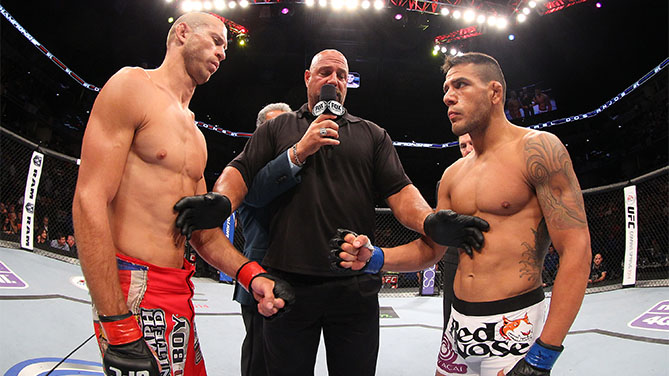
> UFC Lightweight Champion Rafael dos Anjos (24-7) vs. Cowboy Cerrone (28-6-0-1) II

It feels like it’s been two years since we saw RDA shock the MMA world in dispatching Anthony Pettis back in March to win the title. Since 2012, RDA is 9-1 with wins over Cerrone, Nate Diaz, Pettis, Benson Henderson, and a slew of lower-tier lightweights. His sole loss in that stretch? To oft-injured Khabib Nurmagomedov. The winner of four straight has a lot of MMA gossip bees buzzing about how different his body looked, but at weigh-ins, there wasn’t a discernable difference. Underappreciated? Yes. Overlooked? Yes. A win tonight would help that a lot.

Cerrone’s UFC career began back in 2011 following the WEC merger, and he’s been nothing if not active and a winner in that time. In 18 trips to the Octagon, he’s won 15 times and is on an eight-fight win streak. The heads of Edson Barboza, Jim Miller, Eddie Alvarez, Myles Jury, and Benson Henderson were mounted on his trophy wall during that time and a possible tilt with featherweight champion and game-changer Conor McGregor awaits him if he can pull out a win. There’s a lot riding on tonight.

RDA (favorite): Meltzer, Juon, Bix, Encarnacao, Sawyer
Cerrone: Nason, Sempervive, Pollock, FRB

> Junior dos Santos (17-3) vs. Alistair Overeem (39-14-0-1)
Heavyweights

I feel like this fight has been talked about for a solid year and to no surprise, it’s been a year since we last saw JDS winning a brutal bout with Stipe Miocic on Fox. The big question here is whether the beatings JDS has taken in the past few years have caught up with him to the point where he wilts in a fight he should win. He’s 11-2 in a long UFC career with two losses coming to a guy named Cain.

The Reem is a free agent after this fight, so it’s in his best interest to put on a great show. He’s only fought once this year, a March decision win over Roy Nelson that I remember nothing about. He’s won two straight and has had an odd UFC career the past few years, a mix of no-doubt KOs that had him looking up at the lights and a few decision wins that kept him alive. What’s the value of a 35-year-old heavyweight free agent? His performance tonight should help give us an answer.

JDS (favorite): Nason, Sempervive, Meltzer, Juon, Bix, Pollock, Encarnacao, Sawyer
Overeem: FRB

> Michael Johnson (16-9) vs. Nate Diaz (17-10)
Lightweights

Holy Christmas, I can’t wait to see this. The two had a pull-apart earlier this week and are intense enough where you know they’re not going to mess around in there. Johnson was steamrolling through a slew of veterans until rising prospect Beneil Dariush stopped that cold in August with a split decision win. This is a big spot for him and one that UFC has to expect him to win. He’s just got to do it.

It’s been a solid year since we last saw Diaz, a loser in three of his last four. In those three, those defeats have come at the hands of Benson Henderson, Josh Thomson, and the current lightweight champion with his only win coming over a guy in Gray Maynard who should be retired. He’s an underdog here and for a good reason. He’s in fantastic shape, but with the Diaz brothers, there’s always more of a question of what’s happening between the ears.

Johnson (favorite): Nason, Sempervive, Meltzer, Juon, Bix, Pollock, FRB, Encarnacao, Sawyer

> Randa Markos (5-2) vs. Karolina Kowalkiewicz (7-0)
Strawweights

This is the first fight on big Fox for a reason, friends. The 30-year-old Markos is 1-1 in the UFC and is coming off an April decision win over Aisling Daly. However, the Polish Double-K is the real reason to pay attention here. The undefeated 30-year-old is making her UFC debut just a few years into her pro career. To no surprise, she’s on a similar career track to countrywoman Joanna Jedrzejczyk and with two or three impressive wins, you could see an all-Polish title fight happening in that country in late-2016 or early-2017.

Markos (favorite): Juon, Bix, Pollock, FRB
Double-K: Nason, Sempervive, Meltzer, Encarnacao, Sawyer

> Charles Oliveira (20-5-0-1) vs. Myles Jury (15-1)
Featherweights

The 26-year-old Oliveira missed weight…again. It’s the third time he’s failed to hit 145 in eight efforts. While it might not seem like a big deal, it is. Oliveira saw a four-fight win streak (three finishes) snapped in August due to a ruptured esophagus against Max Holloway, a very strange finish to one of the most anticipated featherweight fights of the year. He’s got a chance here to get back in the conversation and to perhaps get a Holloway rematch with a big win.

The 27-year-old Jury makes his featherweight debut in his first fight since getting his first loss in January to Donald Cerrone. Before that, he had won all six of his battles in the Octagon including Michael Johnson, Diego Sanchez, and Takanori Gomi. He can be a force at 145 if his body adapts appropriately and if his skills continue to evolve. I see lots of good things ahead for Jury if both of those come together.

Jury (slight favorite): Nason, Sempervive, Juon, Pollock, Encarnacao, Sawyer
Oliveira: Meltzer, Bix, FRB

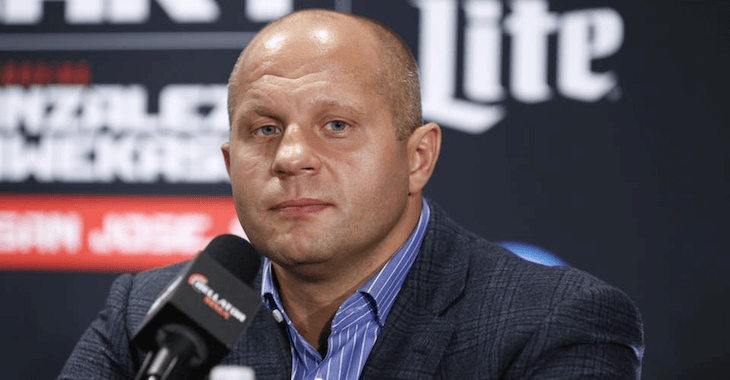
Fedor finds a fighting date for New Year’s Eve

At Bellator’s September Dynamite show, it was announced that Fedor Emilianenko would return to MMA on New Year’s Eve for a new Japanese promotion which we later learned would be called Rizin Fighting Federation. Former Pride president Nobuyuki Sakakibara made the announcement but didn’t announce an opponent for the former Grand Prix champion.

Several names have been rumoured to be Fedor’s opponent with word first leaking out (and quickly denied) that the opponent would be former Super Fight League fighter Jaideep Singh. Seemingly every non-UFC heavyweight who didn’t already have a fight booked was linked at one point or another, and late Thursday night, the promotion held a press conference, to announce Fedor’s opponent on December 31st.

And that opponent is…Jaideep Singh.

At the time of the original rumours, Singh had only fought one in MMA, a 2013 bout in which he submitted 0-1 fighter Alireza Tavakoli. He’s since fought for the DEEP promotion in Japan, scoring a 2nd round KO over Carlos Toyota (6-6-1). Fedor and Singh will be the main event of  “Breakfast with Fedor” — a show that will be broadcast on New Year’s Eve on Spike TV at 10 AM Eastern. The show will feature fights from the three shows that Rizin will be running that weekend, two of which involve current Bellator fighters Brennan Ward and King Mo Lawal in separate fights.

Emilianenko was at one time considered the top heavyweight and pound-for-pound fighter in all of MMA. He had a 10-year winning streak snapped at the hands of current UFC heavyweight champion Fabricio Werdum in June 2010. He went on to get knocked out in his next two Strikeforce fights against Bigfoot Silva and Dan Henderson before returning to Russia and Japan. He won twice for M1 Global and once for Dream before retiring after a June 2012 KO of Pedro Rizzo.

Weight cutting in MMA: A scientific approach to fixing the problem

Weight cutting in MMA is a problem. Actually, It’s a problem in any sport that puts fighters into weight classes. The problems range from the health and safety concerns of the fighters, as we saw recently with the death of a fighter in the Philippines, to fighters attempting to gain a competitive advantage. 

But ultimately, it’s bigger than that. It’s a cultural problem. Weight cutting is generally accepted, even though EVERYONE knows it’s dangerous and stupid. The problem is that everyone is doing it, so everyone must continue to do it. After watching a glut of weigh-ins due to UFC running three shows in three days last week, I’ve given the matter a lot of thought. 

First, let me support what I’m about to say by giving you some background about me personally.

As a former MMA fighter and high school wrestler, and current BJJ competitor, I’ve spent a lot of my life cutting weight.  Heck, I even did two bodybuilding shows where I actually cut more weight than any of those previous endeavors. Over the last two decades, I’ve been a wrestling coach, personal trainer, and nutritionist. I’ve helped many normal people lose weight safely, and also helped many high level athletes take their bodies to the extreme. I’ve experienced enough weight cutting to have learned some tricks of the trade, and also learned what’s not going to work. 

I also spent a few years working at an eating disorder facility where I saw firsthand just what awful effects both short and long-term “weight cutting” can have. It was an incredibly eye opening experience. One of the myths about weight cutting is that there is a healthy way to do it, but there is no perfectly healthy way to cut weight. Some ways are safer than others, but whichever method a fighter chooses, it will have consequences. 

I don’t want to bore people with a biology lesson, but to put it simply, weight cutting has two phases; body weight loss and dehydration. Note I said body weight, and not exclusively fat. The goal is to lose as much body fat as possible while sparing muscle, but it’s next to impossible to do one with out the other, naturally.  Phase one of losing bodyweight usually starts about 12 weeks out from a fight and comes in the form of changing nutritional habits and exercising more.  The fighter simply cleans up their diet and reduces calories, and the weight comes off. 

The second phase, dehydration, is the dangerous part.  A fighter will most commonly use water manipulation to suck every ounce of both interstitial and intracellular fluid out of their bodies. This can be done through use of the sauna, steam room, exercise, diuretics, and a few other sneaky things like mineral manipulation. Here’s the problem; you’re not only dehydrating your muscles, but you’re also dehydrating your heart (since it’s a muscle) as well as your brain. This is incredibly dangerous. 

Why? Fluid acts as a padding for your brain. If you’re lacking that padding, head impact can have a much more detrimental effect. Fighters sacrifice literal brain size by cutting fat (the brain is almost entirely fat), and now they are depleting the cranial fluid.  Since fighters eat and rehydrate before fighting, this is generally mitigated, but it’s impossible to fully rehydrate in 24 hours, so without a doubt, most fighters are going into the cage with their brain less than 100% re-padded. For most fighters, they believe this is an appropriate risk level for their sport.  I recall cutting weight for fights that final week and feeling like I was in a fog. It was noticeable too as people around me kept asking me why I was spacing out. My brain was starving!

Also, your heart can’t beat properly if dehydrated. This is how people die: your heart goes into arrhythmia or stops all together due to the lack of minerals, which were flushed out during the dehydration. Basically, you’ve reduced your intravascular blood volume. Most people have around 6-7 liters of blood circulating at all times, and since blood is mostly water, this is a big problem. The heart tries to compensate for the lack of blood by pumping more, which causes irregular blood pressure as it beats faster and faster, and eventually fails. This is most likely what occurs when people die in a sauna. 

So now we know why weight cutting is dangerous, but what do we do? 

There have been a lot of options floated around, but none have come to fruition, such as same day weigh-ins and creating more weight classes. The UFC, more specifically WADA and USADA, have outlawed the use of IV rehydration in an attempt to keep guys from risking the huge weight cut.  The idea is obviously that if rehydration is more difficult, then perhaps the massive weight cut won’t be attempted. This may work, but ultimately, it doesn’t change the problem that guys are still going to cut a dangerous amount of weight and just try and rehydrate orally. Personally, I’ve rehydrated both with IVs and without, and never noticed any difference, other than I had to have my EMT buddy steal me saline and hook me up, which was unpleasant. At fight time, physically, I felt the same.

There’s actually data that supports the claim that oral rehydration is superior. In fact, the quickest most effective way to get lost electrolytes and other minerals back in to the blood is by rinsing the mouth with a solution and spitting it out. There’s a bunch of info you don’t need to know about gastric emptying involved. If someone wants to make a million dollars, go invent the perfect mouth rinse for fighters to use between rounds. 

It’s often suggested that more weight classes be used, but I don’t like this idea at all. For one, it waters down the championships but that’s not nearly as important as the safety of the fighters.  The real reasons why more weight classes is a bad idea is because it will actually encourage more weight cutting. I’ve seen it happen. 

Each year, the people in charge of collegiate wrestling regulations adjust the weight classes. They do this for various reasons, but basically it’s done to better facilitate the current population. For example, suppose last year there were more wrestlers registered at 180 pounds than ever before. That would indicate that perhaps the sport needs a weight class adjustment, and maybe the addition of a 187 pound class instead of jumping from 180 to 195. This makes sense, but what usually happens is that athletes get greedy. Now, a wrestler that used to make 195 starts to think that maybe he or she could stretch it even further and make that new 187 pound class. So the athlete that was cutting from 205 to 195 is now going to cut an extra 7 pounds.  Good coaching can offset some of this, but it doesn’t always happen. 

At the lower classes, it happens even more as there is often only three or four pounds between a weight class. That seems like nothing to these competitors. When an athlete that walks around at 125 who cuts to 117 only has to drop three more to make 114, and only 4 more beyond that to make 110, for a total of only 15 pounds total, that’s incredibly enticing. People think, “Well, that’s only 15 pounds. Some of these big boys cut 30!”  Right, they do, but 30 off a 235 pound person is actually cutting nearly the same percentage of total body weight as the 125 pound person cutting 15 pounds. 

In this example, the smaller person lost 12% of their body weight while the bigger guy lost about 13%.  Take into account the fact that the big guy has a lot more muscle and fat to drain water from, and you realize that the little guy’s brain is probably in way worse shape than the big guy’s.  Amateur wrestling implemented the hydration testing before the season to determine the lowest weight class in which a wrestler can compete to keep things like the above example from happening, but MMA is a different beast.

I’d like to point out quickly that this past weekend, we saw two main events end the exact same way: flash KO.  This is not to diminsh the punching power of Frankie Edgar or Conor McGregor, but Chad Mendes and Jose Aldo looked smaller and more depleted than usual IN THE CAGE than in the past. This was the first time either man has attempted to rehydrate without IVs, and both suffered KOs from punches that each has eaten dozens of times in the past. It’s purely speculation, but was that a pair of coincidences…or perhaps each was suffering from a dehydrated brain and could not withstand the impact?

Since more weight classes does not seem to work (at least in amateur wrestling where weigh-ins occur sometimes just an hour prior to competition), I’d like to propose something different: fewer weight classes.

Simply put, if the weight class gap widens, less people will attempt the cut. Of course, there are masochists out there who would go for it, but my guess is that it would stem the tide of dangerous weight cuts.

So now, where do we make the classes? How do we decide where to put the markers? It’s simple: use science. There would have to be a study of the human population to see where they are needed. (It may already exist.) First, determine the average size of the population and chart it out from there.  It would be a bell curve. 

I’m just guessing, but most adult men are probably somewhere around 150-160 pounds (at least in developed countries), with fewer at 200, and even fewer at 300 pounds, just as fewer are at 125 and still fewer are 100 pounds. Obviously, as a species, we are evolving to be larger, but we can determine the current bell curve for today. Put more weight classes in the middle and fewer towards the ends of the charts. 

There are of course other factors to examine. For instance, we don’t need to know the average of the entire population, just those involved in fighting. Eight-year-olds and 80-year-olds can be left out. Just look at men and women (separately) likely to be involved, so from ages 18-50 (since Bellator still exists). Also, look at people most likely to fight. There aren’t many African pygmies in the UFC, so we can ignore that population. 

Once we determine the bell curve, we then make the weight classes which doesn’t have to be every ten pounds. Since as we discovered above, percentage of body weight is also important thus the gaps should be larger toward the heavy end and smaller toward the light end. I have not done the studies or even tried to find the data, but as a jumping off point for discussion, here is my best guess at the new weight classes.

– Men: 125, 132, 142, 155, 175, 205, 265
– Women: 115, 125, 140, 160

This would create ten total champions: six for men and four for women.

Each year, the weight classes could swing a pound or two in any direction. They don’t have to be set in stone. The names of the divisions and champions would stay the same. There would have to be some fine-tuning of this method, but it could be implemented, and it would make a difference. 

The other option, of course, would be for fighters to just stop doing it, but we all know that’s not happening.

UFC 194 prelims do record viewership on Fox Sports One

Photo: MMAWeekly.com

In what could be a precursor to a big PPV buyrate, Saturday’s UFC 194 prelims did a record 1,931,000 viewers on Fox Sports One, double their 2015 prelims average of 987,500.

The numbers shatters the record set earlier this year by January’s UFC 183 prelims that did 1,546,000 viewers that Miesha Tate in the featured prelim fight of a show headlined by Anderson Silva vs. Nick Diaz. 

Saturday’s four-fight prelim show headlined by Urijah Faber vs. Frankie Saenz garnered the highest number for a UFC PPV prelim show on any broadcast partner since the UFC 126 prelims on February 5, 2011 on SPIKE TV did 2,000,000 viewers for a 60-minute two fight broadcast featuring Donald Cerrone and Chad Mendes in separate fights. This was also during a time period when UFC was on television far less frequently and that number, while good, wasn’t thought be particularly notable as many Fight Night shows were either at or near that number.

Saturday’s viewership total was higher than all but one FS1 Fight Night show which was January’s UFC Fight Night 59 headlined by Conor McGregor vs Dennis Siver. That show was on a Sunday after the NFC conference championship game.

The company’s final prelims average on FS1 for 2015 is 1,073,273 viewers – a 47% increase over the 2014 average of 728,444.

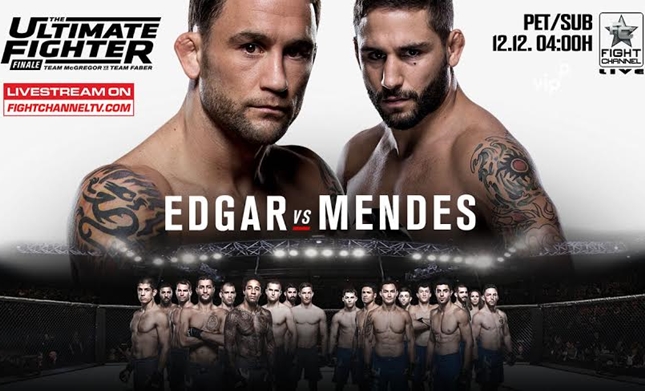
In other UFC ratings news, the TUF 22 Finale featuring Frankie Edgar vs. Chad Mendes did 893,000 viewers, up from the July TUF 21 finale (691,000) but down from the December 2014 TUF 20 finale (989,000) The FS1 prelims did 809,000 viewers, way up from July’s 470,000 and the December 2014 prelims’ 719,000.

JNPO: 5 things to watch for at UFC Fight Night: Mendes vs. Edgar

One UFC event is down, but two more remain starting with Friday’s UFC Fight Night/TUF 22 finale show on Fox Sports One featuring Chad Mendes vs. Frankie Edgar in a battle to be the top challenger to the winner of Saturday’s featherweight title showdown.

In this quick-hit preview, Josh Nason takes a five minute look back at Thursday night’s show and the dominance of Rose Namajunas before delving into five things to watch for in tonight’s show:

– The awesomeness of Chad Mendes vs. Frankie Edgar

– The real co-main event of Tony Ferguson vs. Edson Barboza

– The coinflip fight between veterans Joe Lauzon and Evan Dunham

– The must-win situation Gabriel Gonzaga finds himself in

– The feel-good comeback of Mike Pierce

Another UFC night is upon us, so get ready by listening to this preview show now! Subscribers can click below to stream the show or right-click to save the show to your desktop.

*****

Right click save

MMA fighter dies after weight-cutting issues

In a bit of sad news in an MMA heavy weekend, a 21-year-old fighter from China passed away Friday in the Philippines due to weight cutting issues.

Yang Jian Bing, a flyweight who was scheduled to compete for ONE FC, was announced by the promotion as having passed away at 12:06 PM Friday, just hours before a scheduled show at the Mall of Asia Arena in Pasay, Philippines.

Bing (5-1) was scheduled to face Geje Eustaquiao (6-4). He had collapsed while cutting weight on Thursday morning and was rushed to San Juan De Dios Hospital in Pasay. He never recovered and passed away due to cardiopulmonary failure.

On a Facebook announcement about the death, Eustaquiao said that Bing had been rushed to the hospital due to dehydration and possible heat stroke. The promotion announced his death at the start of today’s event and said the cause was not yet determined, but sent out a release later with a cause of death.

“There is nothing more profoundly tragic and sad than when a member of the ONE Championship family, current or past, passed away.  Our thoughts and prayers are with the family and loved ones of Yang Jian Bing.  We will work closely with the famly and offer all the support they need in any way we can during this difficult time.”

Bellator 147 live results: Josh Thomson vs Pablo Villaseca

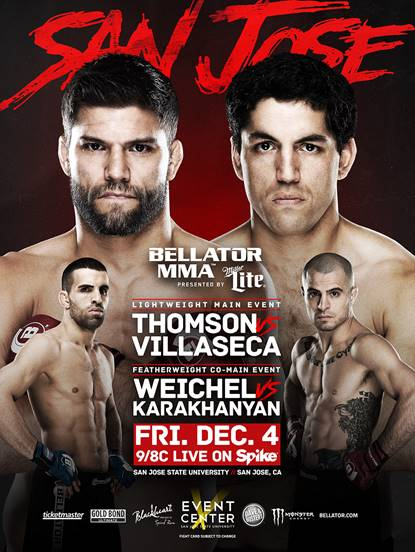
Bellator MMA is back on Spike TV at 9 pm eastern with it’s final event of the year, from San Jose University Events Centre. Former Strikeforce Champion Josh Thomson hopes to get closer to a title shot in Bellator with a win over virtual unknown Villaseca. Also on the card is an interesting Featherweight match between former WSOF Champion Georgi Karakhanyan and perennial Bellator contender Daniel Weichel, coming off a loss to then-champion Patricio Friere. And speaking of the Pitbulls, Patricio’s brother Patricky returns to the Bellator cage in a Lightweight fight with another longtime Bellator competitor Derek Anderson. Brian Rogers makes his Light Heavyweight debut against former Strikeforce fighter Virgil Zwicker. Rounding out the card is a Lightweight fight between unbeaten Adam Piccolotti and Mario Soto, with only one loss  on his record.

The prelims start at 7 pm eastern and can be viewed at Spike.com. We’ll have results here after  they take place and then full play by play and results of the main card once it starts on Spike. 

Light Heavyweights Virgil Zwicker (14-4-1) vs Brian Rogers (11-8)

First round:   Zwicker missed weight.  He doesn’t look in shape at all.  They traded punches.  They traded again.  Another big trade.  Neither is getting the better of it.  Hard body kick by Rogers.  Rogers slammed  him down into side control and kept him down the rest of the round.  10-9 Rogers.

Second round:    Rogers kicked him in the groin hard and Zwicker went down.  This was a super nasty kick.  Zwicker is up and going to be able to continue.  Zwicker with a  low kick.  Nice right by Zwicker.  Low kicks by Zwicker.  Rogers threw a kick and lost his balance but got back up.  Takedown by Rogers.  He got his back.  Rogers moved to full mount and throwing punch after punch.  Zwicker is in trouble.  He’s working for a head and arm choke from side control, and got it.     

Lightweights Adam Piccolotti (6-0) vs Mario Soto (6-1)

First round:  These are two local fighters.  Piccolotti has his back in the piggy back position.  Now he’ got him down and has his back.  Now he’s moved to mount.  He’s working for a head and arm choke.  Who is the agent tongiht?  Trying to steal finishes form the opening match.  Soto tried an ankle lock but  Piccolotti reversed to his back.  Soto out of trouble and back up.  Left and right by Piccolotti.  Piccolotti with some punches.  Piccolotti 10-9.

Second round:    Piccolotti took him down off a kick and throwing punches on the ground.  Now he’s in full mount.  Now he’s got his back.  Piccolotti just throwing punches.  Piccolotti workihg for a choke.  Piccolotti gave it up to throw more punches.  Sotob leeding from elbows and Piccolotti working for a choke and looks like he has it.  Soto tapped.  Soto was busted up pretty bad from the elbows.

Lightweights Patricky Freire (14-6) vs Derek Anderson (12-2)

First round:  Glad Coker doesn’t hate Ole Anderson, or else he’d be Derek Kennedy.  Trading hard shots.  Freire smiled.  Anderson landed a good right.  High kick by Anderson.  Right by Anderson.  Anderson got inside and landed some more.  Both now missing a lot.  Pitbull tried for a takedown, Anderson went for a choke but Pitbull escaped and got his back.  He’s in the piggy back position now.  Both to their feet.  Anderson with a nice slam and Pitbull reversed to the top in side control.  Now Pitbull on top  with an elbow.  Andeson reversed to the top.  Pitbull up.  Good round.  10-9 Anderson.

Second round:   Anderson landing.  Pitbull starring to land and hurt him.  Pitbull low kicks and a nice uppecut and jumping kick.  Body kick by Anderson.  Pitbull landed a nice series.  Anderson with a  body kick.  Knee by Pitbull.  Pitbull took him down into side control.  Pitbull has his back.  He’s got a body triangle.  Pitbull with punches.  Pitbull’s round so 19-19.

Third round:   Anderson landing punches.  Head kick by Anderson.  More punches by Anderson.  Pitbull with a takedown.  Anderson back up.  Pitbull got in and Anderson tied him up.  A knee, two punches, and a low kick by Anderson.  Knee by Pitbull.  Both trading.  Pitbull with elbows as Anderson shot for a takedown.  Pitbull reversed a takedown to the top but Anderson back up.  Anderson going for a takedown and Pitbull switched to the top.  Anderson tried a guillotine at the bell.  Close round.  Anderson 29-28 but this could go either way.

Scores:   29-28 Anderson 29-28 Pitbull 29-28 Anderson

Featherweights Georgi Karakhanyan (24-4-1) vs Daniel Weichel (35-9)

First round:  Weichel with a body kick.  Weichel kicked him low.  Weichel landing good low kicks.  Weichel with some punches.  Kharakhanyan slapped him in the face.  Weichel 10-9.

Second round:  Weichel with a front kick.  Karakhanyan with a front kick.  Weichel landing punches.  Weichel with more punches.  Karakhanyan wih a spin kick to the head.  Body kick had by Weichel.  Another body kick by Weichel.  Another body kick by Weichel.  Body kickj by  Weichel.  Weichel landed a left.  Weichel 20-18.

Third round:   Weichel with a punch and body kick.  Kharakhanyan with a body kick.  Nice spin kick to the head by Kharakhanyan.  Right landed by Weichel.  Front kick by Weichel.  Right by Weichel.  Weichel continues to land.  A nice exchange .  Weichel still landing more.  Weichel landing much more.  Kharakhanyan’s left leg all bruised up.  Kharakanyan tried a spin kick and missed.  Weichel 30-27.

Scores:    All three have it 30-27 for Weichel

Main Event –

Lightweights Josh Thomson (21-8) vs Pablo Villaseca (10-1)

First round:  Thomson obviously is the star of the show.  Body kick by Thomson.  Takedown by Thomson.  Thomson working for a triangle.  Now he’s got an armbar.  Now an uma plata.  Villaseca escaped from all the attempts.  Knee by Villaseca.  Knee by Thomson.  Low kick by Villaseca.  Villaseca got a takedown.  Thomson back up.  Villaseca got him down momentarily agan.  Villaseca with a knee to the groin.  Thomson with a takedown.   Thomson 10-9.

Second round:  Thomson  with a takedown and landed some blows.  Thomson trying to get mount.  But Villaseca managed to block the attempt.   Thomson with lots of punches.  Thomson landing a lot of punches.  Thomson is landing punch after punch and it’s about to be stopped.  And it’s over.    3:59

After the fight they Jimmy Smith asked Thomson about facing Will Brooks for the title.  Interestingly, he kind of blew it off, saying he’ll fight Brooks but right now he said the hype was for a fight with Michael Chandler.  That was an interesting response.

Looking at the options for UFC free agent Benson Henderson

In the morning hours here in North America, former UFC lightweight champion Benson Henderson fought Jorge Masvidal in the main event of the UFC’s debut in Seoul, South Korea — the last fight on his UFC contract. Now a free agent, the 32-year-old veteran is near the peak of his game and will be either an attractive acquisition or solid re-signing for the company that manages to secure his services.

In the past few years, many fighters considered top 10 in their weight class have been cut loose by UFC much to the outcry of hardcore fight fans who felt that if UFC was to be taken seriously as a sport, they shouldn’t let top tier talent walk away. But with Henderson, it’s different. Guys like Phil Davis, Jon Fitch, Jake Shields, and Yushin Okami were still top contenders but didn’t move ratings or PPV buys (proven when they went elsewhere), weren’t serious title contenders, and carried high price tags. While UFC runs a lot of cards and could use the depth that these guys provide, they also have a future to think of and names like the ones I’ve listed here were essentially roadblocks for younger talent to make their way to the top.

This is why someone like Henderson is very important. He could arguably be a top 10 competitor at either 155 or 170, and is someone that can very easily headline an FS 1 or Fight Pass card. He also fits in nicely in a co-main event position on a FOX show or PPV. The top of the show is familiar territory for him as in 14 UFC fights, he has been in either the main or co-main event position all but two times. And on one occasion, it could be argued that he was in the co-main (UFC on FOX 1), since only the main event fight aired on television.

On those shows, Henderson has delivered in terms of ratings or PPV buys…for the most part. Here’s a look*, listed by most recent appearance:

  • Fight Night 60 (main event vs Brandon Thatch) – 913,000 viewers on FS 1 (above average vs. an opponent with very little name recognition)
  • Fight Night 59 (co-main vs Donald Cerrone) – 2,751,000 viewers on FS 1 (record number obviously powered by Conor McGregor, but this was a strong co-main)
  • Fight Night 49 (main event vs Rafael Dos Anjos) – 689,000 viewers on FS 1 (below average,, but this was a very weak undercard and during a very down period for UFC)
  • Fight Night 42 (main event vs Rustam Khabilov) – 1,217,000 viewers on FS 1 (2nd highest FS 1 number at the time against an opponent with no name recognition)
  • UFC on FOX 10 (main event vs Josh Thomson) – 3.2 million viewers on FOX (above average)
  • UFC 164 (main event vs Anthony Pettis) – 270,000 PPV buys (the second highest number for a show headlined by a lightweight title defence that didn’t involve BJ Penn up to that point)
  • UFC on FOX 7 (Main event vs Gilbert Melendez) – 3.7 million viewers on FOX (well above average)
  • UFC on FOX 5 (main event vs Nate Diaz) – 4.4 million viewers on FOX (3rd highest number ever for UFC on that station)
  • UFC 150 (main event vs Frankie Edgar) – 190,000 PPV buys (very weak number for the period. Probably too soon after their first fight, which did very well
  • UFC 144 (main Event vs Frankie Edgar) – 375,000 PPV buys (still the highest number for a show headlined by a Lightweight title defence that didn’t involve BJ Penn)
  • UFC on Versus 5 (co-main vs Jim Miller) – 766,000 viewers on Versus (second highest number of the year on the station for a show with a weak main event of Dan Hardy vs Chris Lytle)

*His other two UFC fights were on the undercards of the first UFC on FOX show and UFC 129, both of which did monster numbers that had next to nothing to do with him.

Clearly, he’s made a difference for a number of years and should continue to do so as his skills haven’t diminished and as recently as this year, he was still doing very strong numbers for UFC. He’d be valuable for Bellator as they hope to bring bigger TV ratings to Spike TV, and would likely be favored in a fight against either their welterweight champion Andrei Koreshkov or lightweight champion Will Brooks. A win by either of those champions would legitimize those divisions in the eyes of fans and a win by Henderson would give them greater exposure and provide marketability that no fighter still in his prime has had for the company.

Asian MMA company ONE Championships would be another viable option. They run shows that draw big crowds in southeast Asia on more or less a monthly basis but have yet to make any real kind of dent in the North American market despite their shows being available on iPPV. A star the level of Henderson could help them get that foothold there while also helping ticket sales in that region, where he is very popular due to his maternal family being from the area.

Henderson is in a rare position where the UFC needs him as much as the outside companies do, maybe even more. Many cards that the UFC runs are somewhat skippable these days but having someone of his caliber on the marquee makes his fight almost a must-see. He almost always has the best fight on the show, and is one of the more skilled fighters in the world in two different weight classes.

Fighters like this do not become available all the time and Henderson should be in a position to almost name his price.

WSOF 25: a bad idea on paper & even worse in execution

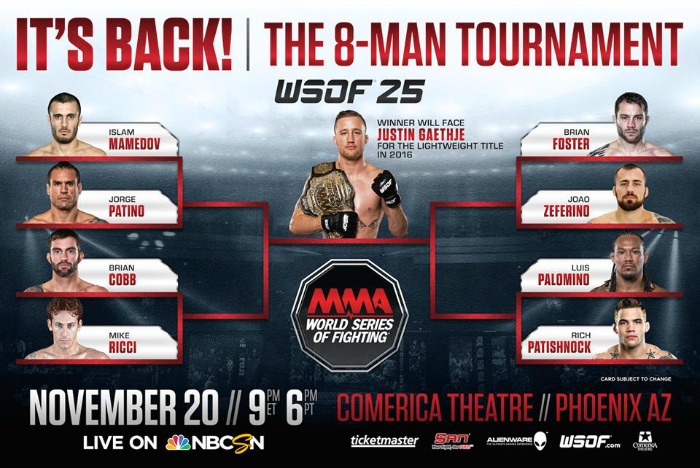
You may have missed it (and judging from the ratings, a lot of people did) but last Friday, World Series of Fighting ran a one-night tournament for a shot at Justin Gaethje’s lightweight belt. This piece isn’t about the quality of the fights that, for the most part, were very good. This is about the absurdity of running a one night tournament in 2015 and the absolutely terrible job the promotion did in putting it on. Everything from the presentation to the commentary to the decisions made in regards to the tournament were lacking and made the promotion come off as anything but major league.

For starters, the show was built around eight guys in a tournament who were all fighting their opening round fights at WSOF.com where almost no one watches. For the viewers watching only on television, they had no idea who was fighting: a recipe for ratings disaster. They also ran into an issue where the bigger names in the tournament wouldn’t make it onto the televised show which happened with former UFC TUF prospect Mike Ricci, the most familiar name to casual fans, who won his first round fight but was unable to continue in the tourney.

Bellator MMA just tried a version of a tourney in September with similar results. The show did very poorly in the ratings and they were forced to scramble after King Mo was injured in his opening round win and was unable to continue. In that case, as with this tournament, they had a reserve bout. Francis Carmont, the winner of the reserve bout, took Mo’s place in the tourney. In the WSOF case, Ramil Mustapayev, a Russian prospect on a four-fight win streak, won his fight and looked very impressive. Despite two people being injured in their opening round fights (Islam Mamedov was the other), Mustapayev didn’t advance. This despite the fact that commentator Chael Sonnen spent the whole fight talking about how everyone in the back was worried about having to face this guy later on.

As an aside, in the reserve fight, Sonnen was going over the rules of the fight and said that it would be two rounds and that there were no elbows allowed. He didn’t say anything about foot stomps. When the second round ended, I assumed they would go to the judges but there was a third round, and the refs were warning people all night about foot stomps. Sonnen openly criticized them about that at one point. No explanation was given as to what would happen if the two rounds ended up tied though it never came into play.

So, Mamedov and Ricci didn’t advance despite winning because they were too injured to continue. The rules of the tournament stated that if the winner couldn’t advance, the loser would take his place. Mamedov had beaten Jorge Patino, so Patino was allowed back in the tourney. Ricci’s opponent, Joe Condon, couldn’t continue either as he was knocked out. No explanation was given as to why reserve bout winner Mustapayev wasn’t put into the tourney instead of Foster, who also lost his first round fight. He was submitted by Joao Zeferino and then went on to face him again in the finals of the tourney. Foster submitted Zeferino to win the tourney and earn the future title shot.

For viewers who spent three hours watching the prelims online, their most loyal and hardcore fans, as late as 10 minutes before the start of the broadcast on NBC Sports Network, there were graphics on the screen advertising semifinal matches of Ricci vs. Patino and Zeferino vs Luis Palomino. Seemingly the fighters themselves had been preparing for these fights as well. They even had a reporter talking to Ricci after his fight in the back, and he said he was medically cleared and good to go for the next round. Yet, at some point, this all changed and when the broadcast version of the show started, Patino was in there against Zeferino, rather than Ricci. Later in the broadcast, Ray Sefo, the face of the company, was beaming about this development, saying anything can happen in a tournament.

This brings me to something that may have bothered me more than anything on this show and speaks volumes about the overall professionalism of everyone in this company. After the opening round of the tournament was completed, they ran a couple of non-tournament matches to fill out the time before the main card started and these were also broadcast on NBCSN. The final fight was a bantamweight bout between Joe Barajas (11-1 going into this fight) and Erik Villalobos (4-4). The booking of a fight with two guys with such differing records is questionable and was even more apparent when the fight started and Barajas completely dominated his overmatched opponent.

Except that’s not what the commentators were telling us.

Bear in mind that the walkouts were aired, complete with graphics for each guy. The ring announcer introduced both fighters and identified them correctly. There was a graphic on the screen identifying each fighter by glove color. Both fighters had previously fought in the World Series of Fighting so there seemingly was tape on both of them for the commentators to study prior to the broadcast.

There were four commentators for this fight for some reason; Todd Harris, Mike Corey, Sonnen and WSOF Middleweight and Light Heavyweight Champion David Branch. All four fighters commentated at various points of the first round and all identified Villalobos as dominating the fight. They talked about how surprising it was that he was dominating a guy with only one loss. Even between rounds, as the cornermen were talking to the fighters, they were saying that Barajas was going to have to regroup despite his corner (correctly) telling him he was doing great and to keep it up.

About a minute into the second round, Sonnen interrupted either Harris or Corey mid-sentence and said something to the effect of “Guys, I have to stop you here. We’ve got these guys mixed up and Barajas is actually the one who’s winning”. He went on to admit that he’d never seen either guy and didn’t know alot about them, despite earlier in the fight going on and on about both of them (clearly reading notes that someone else had written).

But that’s not all. At the start of the third, after Barajas was dominating to the point that it was obvious the ref could stop the fight at any time, Harris said, “So do you think that Barajas should continue this pace or try to save energy for later on in the tournament”.

There was a long pause. Sonnen then said, “What the hell are you talking about?” and started laughing. He then explained to the viewers (who I’m sure were quite aware) that Branch was mistaken and this was not a tournament match. They were not even in the same weight class as the fighters in the tournament. He went on to call a waitress and ask if he could some of whatever Branch was drinking.

I’m usually not this harsh on MMA broadcasts. As a fan of the sport, I especially like to watch these minor promotions to try and keep an eye out for future stars. As such, I’ve watched several minor promotions with nowhere near the exposure that an organization like WSOF has and certainly not the broadcast platform. Everyone involved with the production of this show should be embarrassed. Everyone, I should say, but the fighters themselves who gave it their all and put on for the most part a very entertaining show, especially the main card. I only wish the executives and commentators put as much effort into their jobs as the fighters did.

True Ten MMA Scoring System: The Results of the Scoring Experiment

We are getting close to the biggest UFC event ever to take place.  We are less than 2 days away from Ronda Rousey defending her Women’s Bantamweight championship against Holly Holm.  The UFC is now a massive company.  It generates millions of dollars, and is popular almost everywhere.  It has expanded across the globe, and has visited many countries and continents.  Yet, the sport of MMA is still using an archaic scoring system taken from boxing.  Unfortunately, this has resulted in bad decisions with the wrong fighters winning or losing.  A change is over due with the scoring, and it needs to be initiated by Dana White and the UFC or it will never happen.  

Thank you to everyone who has been following my experiment.  I have received quite a bit of feedback via email and twitter (@hendosfoodblog), and most of it was actually useful. 

In this ten part series, I tried to find out if there is a better way to score a fight.  My theory was simple.  Using more of the allotted 10 points will lead to fairer decisions.

I started out with multiple options, but eventually settled on the “True Ten” scoring system, which scores using the exact same criteria, except more of the points may be used.  Here are the possibilities:

10-10 = an even round, where a judge could go either way.  Stop!  Use this score.  We needs judges unafraid to be indecisive.  Make a fighter earn the round.

10-9 = the round where not much damage was done, but one fighter eked it out.  Some called this the 10-9.5 round using a half point system.  Needlessly complicated.

10-8 = the current 10-9, where a fighter obviously won a round.  If it’s less than obvious, do not use this score, go back to a 10-9. 

10-7 = A fighter obviously won, and did some decent damage.  We need to see a lot more of these scores. 

10-6 = the current 10-8 where a fighter dominates the round

10-5 = A dominant round and the fight possibly could have been stopped. 

It’s pretty logical.  Use more 10-10s and we will have fewer bad decisions and more draws, which is fine in my book.  Use more 10-8’s (or 7’s or 6’s) and we will have a more realistic scoring differential.

Pros: 

  • More draws which is a positive because we will have automatic rematches with stories to go with them, and fewer split decisions which no one enjoys (and many do not understand).
  • A more realistic point differential; with so many fights ending 30-27 or 29-28, it’s difficult to understand how the fight went with only a few scoring results possible.
  • Penalty points mean less; which is good because refs would not have to fear that they just snatched the fight from a fighter because he grabbed the cage.  As it stands, one penalty point can cost a fighter a match.
  • It takes some of the pressure off the judges, as they can feel free to give a 10-10 round rather than agonizing over who won the round if it’s incredibly close.
  • It’s no longer a two out of three competition.  Since hardly any judges use 10-8s as it stands, it’s basically a best of three rounds fight.  It still would be, but less so, because a fighter has a real chance of coming back in round three to win if he kept it close in the first two.

Cons:

  • The percentage of outcomes that changed was statistically insignificant.
  • More math; while simple, still could be too complicated for some judges.
  • It’s still pointlessly predicated on the number ten.  I think the “must” part of the current scoring system and my system is faulty.  Why not just give the round winner points?  The easiest way to do this would be to have a five point round potential.  Then a judge just scores a round 5-0, 4-0, 3-0, etc., which simplifies it.  Heck you could even do it with just three or two points, but I like five. 

By the Numbers…

  • 10 different MMA shows
  • 36 total fights scored using True Ten
  • 28 unanimous decisions
  • 4 split decisions
  • 4 “other” decisions: 1 majority decision, 1 split draw, 1 majority draw, 1 two-round match

Those are the stats I collected, but the only statistics that really matter are the next…

Number of differing outcomes using True Ten scoring:  2**

Percentage of differing outcomes using True Ten:  5.5%

** Both of those two differing outcomes resulted in the match being ruled a draw.

Note on scoring…

One thing that I noticed as I scored all these fights, was how the earlier rounds influenced my judging later.  Often I’d found that because the first round was close but I went with Fighter A, I then tended to find a reason to pick Fighter B in the second round.  That way, I could let the third decide it.  Another common decision I was making was that if Fighter A took the first and second pretty obviously, then if the third was close at all, I’d give it to Fighter B, because of, I don’t know, pity.  So what I’m suggesting is a rotation of judges.  No one judge can judge more than one round of a fight.  I’m sure this would be a logistical nightmare, and if studied, probably would not reveal any significant results, but I know that the earlier rounds effected my later round judging, as much as I tried to prevent it, and this is the only way I can think to make judging completely objective.

Also, why are we limiting ourselves to three judges?  Make it five.  Or let the referee have a vote.  I don’t know why we are limiting the polling size so greatly.  Let the Internet be a vote.  That could get whacky!

The results of this study were less than satisfying, because I had predicted that we would see a statistically significant amount of change.  Unfortunately, nearly every outcome using True Ten was the same as the Ten Point Must, so it would seem that this is an unnecessary scoring change for this moment.  However, beyond merely deciding the outcome of a match, the score represents the drama.  It represents a fight.  It needs to be the blind justice in the fighting world, not left up to the whims of the ghost of boxing’s past.  MMA judging needs to tell the story of the fight, and take the viewer on an adventure.  Such as a comeback in other sports is only thrilling because of the large point differential, fighting should be the same.  It should have both highs and lows.  However, most of all, it should be correct.  Do I ask too much of numbers?  Some would say yes.  Others would say that I’ve just gone mad, but damn them all, numbers are accurate!  Trust the numbers.  They do not lie.   They have no emotion.  They don’t care.  They don’t breathe… The 600 series had rubber skin. We spotted them easy, but these are new. They look human… sweat, bad breath, everything. Very hard to spot. I had to wait till he moved on you before I could zero him…

If you’ve enjoyed these columns and found any value in my urgency to change the system, I’d ask you to continue the conversation.  If you work for a commission or know someone who does, push the issue.  Talk about it with your peers, or with your family at the dinner table during Thanksgiving.  It’s that important.  We need to keep this issue alive because the scoring needs to change.  No more relics of boxing.  This is a different sport and needs a different scoring system. 

No Fate, but what we make.  #TrueTen 

******

Stats (individually by show):

Total Official Decisions:  36 (by show 4,3,3,3,4,4,4,2,6,3)

Unanimous:  28 (by show 4,2,2,3,2,3,3,2,4,3)

Split:  4 (by show 1,1,0,0,0,0,1,0,1,0)
Other:  4 (by show 0,0,0,0,2,0,0,2,0,0,)

Different Outcomes Using True Ten:  4 (0,0,0,0,0,0,2,2,0,0)

Differing outcomes result in 4 draws

MMA weekend ratings: UFC down, Bellator up from yearly averages

This past weekend saw televised MMA shows from both of the big 2 companies in North America.

The higher profile show was UFC Fight Night 77 from Sao Paulo Brazil on FS 1 Saturday night, which averaged 757,000 for the six-fight main card and 609,000 viewers for the four-fight prelims show, which also aired on FS 1. The show was up against huge sports competition in the form of college football on CBS, ABC, FOX, and ESPN which did numbers varying from 1.5 million all the way up to 11 million — all airing directly against the UFC show. An episode of Saturday Night Live, hosted by Donald Trump, did that show’s highest ratings in three years and aired against the second half of this show.

The show was down about 17.5% from the year to date average of 917,625 viewers on FS 1. The prelims show was actually up 4.4% from the year to date average of 583,083 viewers for previous Fight Night prelim shows on FS 1.

The five most recent FS 1 Fight Nights prior to Saturday had averaged 821,000 viewers and the most recent prelims shows had averaged 525,800 viewers. This would seem to indicate that the hardcore fan base that will watch any fights is actually increasing but that casual fans weren’t terribly interested in this card.

This was the lowest number for an FS 1 show since the 508,000 viewers on July 18th but that show aired in the afternoon from Scotland. The last time a prime time show did this low was the TUF 21 Finale on July 12th that did 691,000 viewers for a show headlined by Stephen Thompson vs Jake Ellenberger and the final matches of the TUF 21 show (which for the first time ever was not a tournament).

An FS 1 show one year ago this weekend, Fight Night 56, headlined by Ovince St. Preux vs Shogun Rua, did 699,000 viewers with the prelims show (airing on FS 2) doing 176,000 viewers. Again, that seems to line up with the general trend of UFC viewership being up in 2015.

Saturday’s show was headlined by Dan Henderson vs Vitor Belfort, who had fought once before on an FS 1 show also from Brazil and also on the same weekend (Nov 9, 2013). That show did 722,000 viewers, so this was up from that time with a similar level of undercard.

*****

The other show this past weekend was Bellator 145: With a Vengeance, which aired Friday night on Spike TV. This was the final tentpole event of the year for Bellator and did an audience of 814,000 viewers, headlined by featherweight champion Pitbull Friere vs Daniel Straus. Lightweight titleholder Will Brooks vs. Marcin Held and featured fights featuring Bobby Lashley and former lightweight champion Michael Chandler were also on the show.

This number was slightly up from the most recent big special for Bellator, headlined by Tito Ortiz vs. light heavyweight champion Liam McGeary, a four-man light heavyweight tournament, and two Glory kickboxing fights. That September 19th event did 800,000 viewers. The average for the five Bellator tentpole events is now 1,061,400 viewers, so this show was about 23% below that average.

Bellator has averaged 759,286 viewers per show in 2015, so this number was up 7% from that average. This is the first time that Bellator has built one of these shows around main event fighters who were essentially homegrown so in that sense it was more like a regular show. It was also in the traditional Friday night time slot while the three higher rated events took place on a Saturday.

The Bellator per show average is up 8.1% from 2014, which averaged 702,227 viewers.

Bellator’s first tentpole show featured Ortiz vs Stephan Bonnar in a heavily promoted grudge match. That show set a Bellator record of 1,241,000 viewers on Nov 15, 2014, which has since been broken by Kimbo Slice vs. Ken Shamrock earlier this year.

WSOF 24 10/17 Results and recap : Jon Fitch vs Yushin Okami

WSOF 24 took place Saturday night on NBC Sports Network. The 11 fight card was headlined by a welterweight title eliminator bout between Jon Fitch and Yushin Okami and featured two WSOF title fights on the undercard. The first 6 bouts aired on wsof.com.

Chael Sonnen provided commentary for the whole show and while entertaining at times was reminiscent of Matt Stryker in his commentating style. So you’re either going to like it or really hate it and it ventured toward the latter for me.

In the main event, Jon Fitch (26-7-1) won a boring decision over Yushin Okami. He clearly won the last two rounds and the first was close. I had it for Okami, as did one of the judges. But Fitch clearly won the fight and will face Jake Shields for the vacant Welterweight title early next year.

In a Heavyweight title fight, Champion Blagoi Ivanov (13-1) KO’d Derrick Mehmen in the 2nd round in what was probably the best fight of the night. These two looked like an indy wrestling version of Rusev and Jack Swagger. Ivanov dominated the fight, finishing him with a brutal punch to an already cut eye that may have broken an orbital bone as Mehmen went down like he’d been shot.

Nick Newell (13-1) won a unanimous decision over Tommy Marcellino on 29-28 scores across the board. There wasn’t really any other score possible, although Marcellino was acting like he’d won after the fight and berated Newell, saying “you know you f’n lost”. Newell responded by telling him to be a better sport. In a post-fight interview that couldn’t be heard due  to technical difficulties on the part of NBC Sports Network, Newell retired from fighting. Interestingly enough, the last fighter that Marcellino fought in WSOF, Frankie Perez, retired in-ring earlier this year on a UFC show.

Two fighters making their WSOF debut had a sloppy fight in the second match on the show, with Vinny Magalhaes (13-7) submitted Matt Hamill in the latter’s first fight in several years. At 39 years old, that was probably it for him with the first round loss. Magalhaes was informed after the fight that he’ll fight Thiago Silva in a #1 contender’s fight for a shot at Dave Branch’s tile. Branch did commentary for most of the undercard and the top 2 main card fights but wasn’t here for this announcement.

The show kicked off with a Flyweight title fight, the first in the promotion’s existence. In fact it may have been the first 125 lb fight on a main card for the promotion. Debuting Magomed Bibulatov (10-0) won a unanimous decision on scores of 50-45 across the board, the same score I had, over Donavon Frelow. Bibulatov took him down at will through the whole fight but his striking games needs a lot of work. In terms of quality, this was a low-level UFC flyweight fight, the kind that you’d see on Fight Pass.

The prelims were full of mostly boring decisions, although the top 2  fights were had entertaining finishes. Rick Glenn (16-3) had a 2nd round KO win over Adam Ward. He knocked him out with two hammer fists on the ground and stopped punching before the ref even had a chance to stop it because he knew Ward was out. Alexandre de Almeida (17-5) got a first round sub with a rear naked choke of Saul Almeida. It was announced that he’d be the next challenge for Rick Palmer’s 145 lb title.

In the other bouts:

Colton Smith (6-4) won by unanimous decision on scores of 30-26 across the board. There was a penalty point deducted in the 2nd round and despite that, both Chael Sonnen and Renzo Gracie scored the fight 30-27 for Smith. I had it 30-25 with a 10-8 2nd before the penalty point.

Pat Walsh (7-2) had a unanimous decision win over Tyler King on 30-27 scores across the board. Really boring fight, typical for Pat Walsh.

Rex Harris (8-2) had a split decision win over Justin Torrey on scores of 29-28, 28-29 and 29-28. I scored it 29-28 for Torrey as did the fan poll and all the MMA media members on MMADecisions.com. Torrey is a training partner of friend of the site and sometime radio guest Antonio “the Promise” Thomas.

Bruce Boyington (11-8) won a split decision over Rodrigo Almeida in the opener. This fight wasn’t terrible but entirely forgettable. Scores were 29-28, 28-29 and 29-28. I scored it for Almeida but the 2nd round was very close and could’ve gone either way. Chael Sonnen actually scored it 30-27 for Almeida, Gracie had the same score as I did and the fan voting was 29-28 Boyington.

The show is not at all worth going out of your way to see but for a weekend with no UFC or Bellator, it was the best we had.

Wrestling Observer Live 10/4: NXT Takeover, Asuka, new PRIDE, tons more!

Wrestling Observer Live with Bryan Alvarez and Mike Sempervive returns today to talk tons of topics including NXT Takeover Respect, an awesome show, Asuka, Bailey and Sasha and more, plus the new PRIDE rebirth in Japan, text questions and tons more! A fun show as always so check it out~!

Right click save

New Japanese MMA promotion with Fedor: Rizin Fighting Federation

Two-time Observer Awards promoter of the year winner Nobuyuki Sakakibara announced today in Tokyo the formation of his new promotion, the Rizin Fighting Federation, a new attempt to rekindle the heyday of Japanese MMA, complete with a New Year’s Eve show that will air in the U.S. in prime time on Spike TV.

What was announced is two shows, both at the Saitama Super Arena, one on 12/29 and the other on 12/31.

The biggest news is that Fuji TV, one of the major networks in Japan, will broadcast the event. Fuji TV was the network that broadcasted Pride until it was dropped in the wake of media stories about Yakuza influence in the promotion, which led to the group’s demise.  It was not made clear if the show would air live in Japan, with the indication that Fuji TV would air it as a special built around the fights of Fedor Emelianenko and New Japan’s Kazushi Sakuraba, who was the biggest name Japanese star announced as competing.

Among the plans for the promotion include an eight person heavyweight tournament with $500,000 going to the winner, which would be taking place at some point in the future.

The rules will be similar to that of Pride, with men’s fights being 20 minutes in length with rounds of ten minutes, five minutes and five minutes, and using the old Pride judging criteria.  Moves like soccer kicks and knees to the head of a downed opponent will be legal.  The fights will be fought inside a ring, but the ring would have five ropes instead of three or four.  Women’s fights will be three five minute rounds.  There will also be non-MMA rules fights, such as kickboxing fights, on the December shows.

Sakakibara was looking to link the world’s of amateur wrestling, pro wrestling, MMA, Jiu Jitsu and kickboxing.  Appearing from pro wrestling were Sakuraba and Nobuhiko Takada, who will be a figurehead officer such as in the heyday of Pride.  Tomiaki Fukuta, the chairman of the Japanese amateur wrestling association was also there.

Rena Kubota, a female star of kickboxing and Shoot boxing promotions in Japan will debut in MMA, as will Gabi Garcia, a ridiculously muscular world super heavyweight Jiu Jitsu champion.

The main event on 12/29 pits Kazushi Sakuraba vs. Shinya Aoki in a battle of Japan’s original submission king against Japan’s current submission star.  Aoki, who is smaller than Sakuraba, is the current One lightweight champion.

Also at the press conference were Scott Coker from Bellator and Jon Slusser of Spike TV.  Coker said that Bellator fighters would be on the show and that Sean Grande and Jimmy Smith would be announcing.

Sakakibara said talent would come from Bellator, BAMMA, KSW, Bushido, Jungle Fight, Desert Force, Deep, Shoot, Pancrase and ZST promotions.

No opponent was named for Emelianenko.  MMA Fighting had reported Jaideep Singh, a kickboxer who has only fought once in MMA, as the foe.